
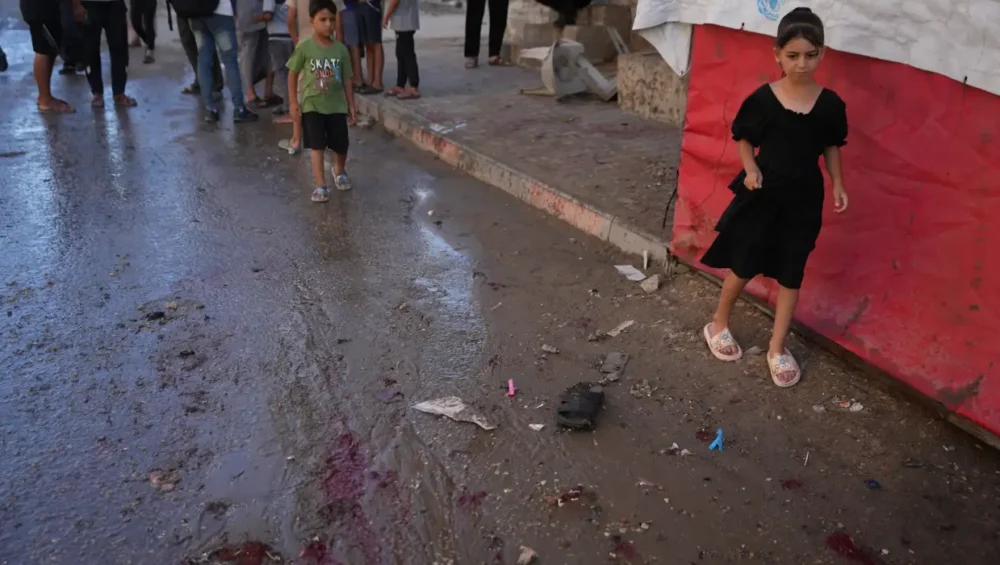
The funeral gathering in the Nuseirat refugee camp in central Gaza was meant to be a moment of collective grief and dignity, a brief pause from months of relentless violence to bury yet another victim of Israeli bombardment. Instead, it became the site of a fresh massacre. An Israeli drone strike tore through mourners assembled near Ahmad Yassin Mosque in the Al‑Balata market area, killing at least seven Palestinians and injuring around twenty others, according to medical sources and local officials. The victims had gathered to honour a man killed earlier the same day in an Israeli attack, only to be killed in a second strike targeting the very act of mourning itself.
The case, represented by the statement Israeli bombs Gaza funeral crowd, is not only a new addition to the list of casualties of Gaza. The case represents the reality of the lack of respect for civilian lives, civilian zones, and general principles of warfare. The case poses some very serious questions on the target selection methods employed by Israel and once again confirms the charges laid against Israel by the Palestinian government and human rights campaigners of systematic violence in Gaza.
The Sequence of Violence: From Strike to Funeral to Strike
Chronologically, the events surrounding the Nuseirat attack are essential to establish the seriousness of the situation and its legal and moral aspects. Previously that day, an Israeli assault on Nuseirat had led to the death of a Palestinian citizen, and in response to this, the family, friends, and neighbors of the deceased gathered in order to hold a funeral ceremony in the central camp. The group assembled outside Ahmad Yassin Mosque, which is located in the adjacent Al-Balata market area – not a militarized place but rather a regular city environment. While the people were assembling for the funeral ceremony, it is alleged that an Israeli drone carried out an assault on the people, hitting the mourners directly. The medical personnel at Al-Awda hospital in Nuseirat confirmed that they received the bodies and treated the injured people during the funeral assault.
The numbers of dead and injured people differ slightly depending on the source, some saying at least seven people dead and twenty-two people injured, other sources say eight people dead and twenty people injured, but all sources agree on one thing, that civilians who were holding a funeral were struck by an Israeli attack.
In broader context, Gaza authorities say more than twenty‑five Palestinians were killed over a seventy‑two‑hour period in attacks on markets, funerals, peaceful gatherings and residential homes. This funeral strike, then, is not an isolated error; it is presented by local officials as part of a sustained pattern of targeting civilian spaces, a claim that carries significant implications for the assessment of Israel’s conduct under international humanitarian law.
Civilian Gatherings, International Law and Human Rights
At the heart of this incident lies the principle of distinction: the obligation under international humanitarian law to distinguish at all times between combatants and civilians, and between military objectives and civilian objects. Funerals, markets and mosques are quintessential civilian spaces. A funeral procession is a protected civilian gathering unless it can be shown to be directly participating in hostilities or being used, in a concrete and immediate way, for military purposes.
Nevertheless, in Nuseirat, it cannot be substantiated by public evidence that the mourners were involved in combat operations or the funeral site was functioning as a military control center and weapons arsenal. Rather, the public records indicate the presence of civilians in an area that is popular both for trading and religious activities. Such an attack contravenes not just the spirit but the legal provisions of international humanitarian law, since it could amount to a war crime, namely, either intentionally or negligently indiscriminate attacks on civilians and civilian property. Human rights activists have consistently accused Israel of meting out collective punishment to Gaza, which is banned under international laws.
By striking an event that is central to social and religious life, Israel is not merely causing physical harm but also attacking the community’s ability to process grief, uphold dignity and maintain social cohesion. Gaza’s media office, reacting to the incident, described ongoing Israeli actions as a “war of genocide” and accused Israel of using a deliberate policy of bombing markets, funerals, civilian gatherings and safe residential apartments. Whether or not international courts ultimately adopt the term genocide, the pattern described – systematic attacks on civilian life – amounts at minimum to grave human rights violations.
The Language of Condemnation Inside Gaza
Local authorities and Palestinian factions have responded with sharp, uncompromising language. Gaza’s media office framed the funeral strike as part of a broader campaign, asserting that more than twenty‑five Palestinians had been killed within three days in attacks on markets, funerals and homes, and condemning what it called a
“deliberate targeting of civilians in their most vulnerable spaces”.
Hamas, which governs Gaza internally, characterised the Nuseirat attack as a “brutal massacre against mourners”, highlighting that those killed were participants in a funeral for a man already slain in an earlier strike.
Although these statements may be purely political and emotional in nature, they play a much larger role. They are a part of the evidence and advocacy structure that Palestinians utilize in international platforms. By pointing out that attacks on funerals and other civilian meetings have been happening, they try to show that there is a pattern of crimes against humanity and even genocide. These statements are addressed not only to the regional audience, but to the world organizations such as the UN, the International Criminal Court and even states that promote their values in terms of human rights.
However, these statements also prove that the language of law is very much tangible for Gaza. In saying ‘massacres’ and ‘genocide,’ the media office of Gaza and Hamas point out the reality of their lives: burying their dead relatives one day and their mourners another day; places previously thought to be safe now become dangerous.
Israel’s Silence and the Question of Accountability
One of the most striking features of the press coverage of the Nuseirat attack is that there does not seem to be any reported military Israeli rationale for the targeting of the funeral ceremony. Press agencies and regional media describe the attack as a drone or airstrike by Israel based on the information provided by Gaza health services, hospitals and officials. On the other hand, in all the available reports Israel seems to have not published any reason for its action in the particular case when a funeral ceremony outside a mosque and market was targeted. Israel’s traditional rhetoric in such cases states that attacks are made on militants, command centers, weapons depots or launch sites, and civilian losses are either unintentional or caused by militants mingling among civilians.
Absence of any official Israeli statements about Nuseirat creates a problem of verification of a generic rationale for the attack which contradicts the particular facts – civilians killed in a funeral ceremony in a market-mosque zone by a drone.
Accountability demands more than generic assertions. It requires transparent investigations, public release of targeting assessments and clear explanations of how particular strikes comply with international law. The absence of such detail here feeds perceptions that Israel can bomb civilian gatherings with impunity, shielded by broad claims of self‑defence and counter‑terrorism. For Gaza’s population, and for human rights observers, the silence is not neutral; it is another form of violence, an erasure of the victims’ legal and moral claims.
A Pattern of Strikes on Funerals
The Nuseirat attack also sits within a documented pattern of strikes on funerals and condolence tents in Gaza over the past two years. Previous incidents have seen Israeli forces hitting tents where condolences were being offered, killing large numbers of people in spaces explicitly designated for mourning. Those earlier strikes were reported by regional and international media with headlines that spoke of “killing the mourners” and “turning funerals into graveyards”, language echoed once again in the wake of the Nuseirat attack.
The significance of repetition lies within the human rights context. One fatal mistake could be interpreted as a case of mistaken identity or a technical malfunction. If funeral and condolence events are targeted multiple times, then there is clearly a problem – either in the targeting approach and the inability of the mechanism to prevent civilian casualties or even worse, in the intention of causing harm to the civilians in those socially important sites. Every funeral bombing adds to the destruction of the already vulnerable society of Gaza. The society relies on its traditions and rituals in order to survive and maintain their identity.
Once these rituals are continuously bombed, the message conveyed is that nowhere is safe anymore – not even those places intended to respect the dead. From the point of view of international legal institutions and organizations dealing with human rights, this fact proves that the citizens of Gaza suffer from collective punishment and/or terrorization of civilians, both prohibited under international humanitarian law.
Human Rights Violation at the Heart of the Story
Labeling the Nuseirat funeral strike a human rights violation is not a matter of political bias; it is a matter of aligning the facts with the norms. Civilians at a funeral, in a market‑mosque area, are presumptively protected under international law. A drone strike that kills and maims them, absent demonstrable military necessity and careful proportionality, violates their rights to life, security, and dignity. It also undermines the broader right of a people to conduct social and religious rituals without fear of attack.
The Gaza media office’s accusation of a
“war of genocide against our people”
and Hamas’s description of a
“systematic targeting of civilians and their gatherings”
expose how Palestinians understand the cumulative effect of such incidents. Even if international legal bodies eventually choose more restrained terminology, there is little question that repeated strikes on funerals and civilian gatherings amount to grave breaches of human rights. They demand robust investigation, accountability and, ultimately, change in behaviour by the responsible military authorities.
For journalists and analysts, the phrase Israeli bombs Gaza funeral gathering must not be allowed to sink into the background noise of war reporting. It is a headline and a key phrase, but it is also a stark summary of a deeper reality: a reality in which mourning has become dangerous, funerals are not safe, and the line between battlefield and civilian life has been systematically blurred.
The Imperative for International Response
The Nuseirat funeral strike reinforces an urgent call for international action. Palestinian authorities have appealed to the United Nations and to international mediators to halt Israeli attacks on Gaza, pointing to this incident as one more example of civilians being targeted in spaces that should be sacrosanct. International human rights organisations, legal experts and states that claim to uphold humanitarian law cannot afford to treat such incidents as routine collateral to geopolitical calculations.
Independent probes, preferably by international organizations, are required to ascertain who is legally liable for this strike and others like it in Nuseirat. Evidence such as statistics of victims, witness accounts, and data on targets need to be gathered before information becomes lost in the fog of war and news cycle hype. Sanctions, weapons embargo, and legal action are some of the instruments employed by the international community in situations where there are credible allegations of war crimes and human rights abuses. The issue is whether or not they will use them the same way in the case of Gaza and the bereaved in Nuseirat.
Until that happens, the words of Gaza’s officials and families will continue to echo:
“They killed us while we mourned our dead,”
a phrase that, whoever first uttered it, now encapsulates the lived experience of many in the strip. That statement is not just a cry of grief; it is an indictment. And it places the funeral strike in Nuseirat firmly within the realm of human rights violations that demand more than sympathy – they demand accountability.