
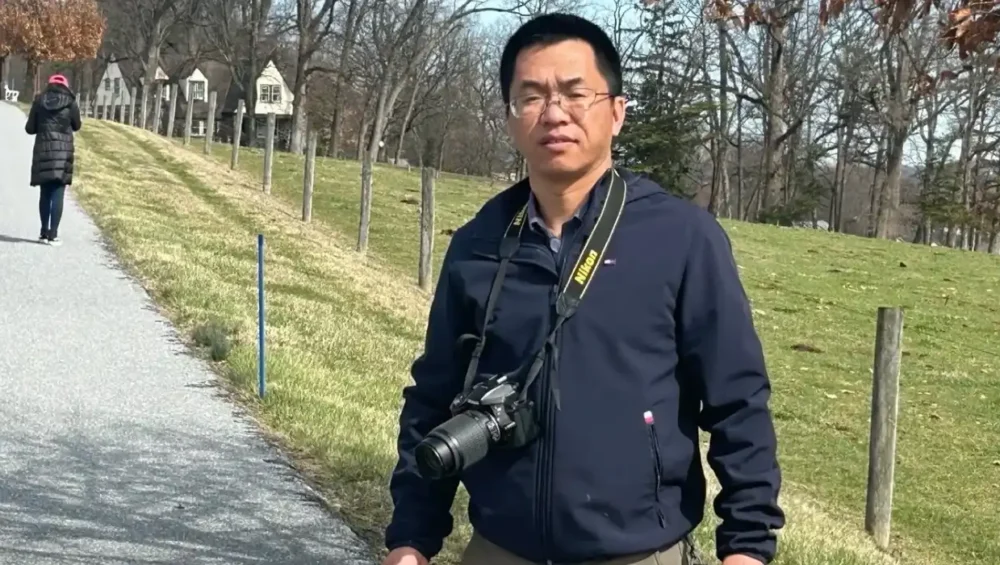
When Chinese human rights lawyer Wu Shaoping fled his homeland in late 2019, he believed he was escaping a machinery of repression that had already swallowed countless colleagues and clients. He arrived in the United States on a tourist visa, applied for political asylum, and tried to build a quiet life driving trucks and delivery vans in Pennsylvania. Now, after a traffic stop that ended with his arrest by immigration authorities, that sense of refuge has ruptured—raising urgent questions about whether the United States might send a prominent defender of personal and religious freedom back into the very system he risked everything to escape.
The case of Wu exemplifies one of the key conflicts that lies in American policy — the conflict between tough action on immigration issues and its supposed dedication to defending people who are escaping from persecution. The situation is especially acute for Chinese dissidents and human rights lawyers, who have characteristics that can easily make them a target in their own country or in any other country working with China.
From Courtrooms in China to a Delivery Route in Pennsylvania
A career built on defending the persecuted
Prior to his arrival in the US, the image of Wu built up in China emerged from one of the most delicate areas of law practice. A lawyer of rights, he was defending political dissidents and members of Falun Gong, a spiritual organization prohibited and fiercely attacked by the Chinese authorities. This type of clients lacked any real legal representation since it entailed certain dangers to the attorney himself. Within the worsening political environment of China, Wu became associated with a group of lawyers who held that constitutional and international human rights laws should be applied to those citizens who openly criticize the policies of the Chinese Communist Party. In particular, Wu advocated the right to freedom and religious belief. Over the years, Wu remained an active defender of the mentioned values and rights, which have become even more dangerous in light of President Xi Jinping’s rise to power.
The crackdown on rights lawyers—commonly referred to by activists as the “709” campaign for its launch date in July 2015—saw hundreds of lawyers and legal assistants detained, interrogated, or disappeared. Many were charged with “subversion of state power” or related offenses for activities that, in most systems governed by rule-of-law, would be considered ordinary professional work. It is within that context that Wu’s choices must be understood: remaining in China meant facing nearly inevitable persecution, while leaving meant abandoning clients and community to preserve his own freedom.
Flight amid growing pressure
By the end of 2019, the pressure had become intolerable. Reports from rights networks describe how, following a gathering of lawyers and activists, authorities began moving against participants. Wu was warned that he was likely next. Rather than waiting for the knock on the door, he left quickly, opting for one of the few pathways still available: a tourist visa that allowed him to enter the United States.
In America, he did what many others like him had done. He sought political asylum and explained his record and fear of persecution and began his life anew. Pennsylvania would become his new home; the courtroom was replaced with the cab of the delivery van. His work was modest yet reliable. It is said that Wu’s life has been rather peaceful – more spent traveling across the states than making any noise through his activism. However, his past was always linked with his present. Wu kept talking and writing about the current situation in China and especially about the other rights lawyers there. For example, he criticized the arrest, interrogation, and confession forcing of lawyer Xie Yang as an abuse of power. Such statements coming from the exile are not ignored in Beijing where any criticism is considered political subversion.
The Traffic Stop That Became a Human Rights Test
Routine policing turned into immigration enforcement
The watershed moment came during what seemed to be an everyday routine at work. Wu was traveling in Pennsylvania, allegedly on an Amazon delivery job, when his car was stopped by the local police. There was nothing abnormal about this stop; it was routine traffic control that drivers often experience. However, for people with an unstable immigrant status, this kind of situation is always critical. Wu, as described by his supporters, did everything he was supposed to do. He said he had an asylum case pending, work authorization, and the documents confirming it. It only shows the complexity of interaction between local police officers and federal immigration agents in the United States. After verifying his information, the federal officials received his report, and ICE agents arrested him.
For many observers, the optics were jarring: a man who once stood in defense of persecuted citizens in Chinese courts was now in the back of a government vehicle in the United States, headed not to safety but into a detention system whose ultimate consequence could be deportation.
Official rationale versus protective obligations
The official justification for the situation, according to government explanations, lies in immigration status. The first thing to note is that Wu’s visa had expired several years ago; thus, he can be considered a violator in terms of immigration. Of course, he is waiting for his asylum claim to be processed, but in their opinion, his arrest does not exceed the bounds of law and represents the legitimate usage of regulations. Nevertheless, there is another side of the story. As the advocates say, asylum processes in the United States may take quite some time, and the work authorization is provided exactly for such cases, in order for people to support themselves until the procedure is completed. Arresting a person who follows all regulations in the process of obtaining asylum can be considered the violation of the non-refoulement principle.
The tension is captured in the reaction of one of Wu’s closest allies. In a widely shared statement on social media, Chinese‑American pastor and activist Bob Fu denounced the arrest, writing:
“ICE agents acted illegally in Pennsylvania by arresting my friend, dedicated Christian human rights lawyer Wu Shaoping, who has legal status staying in the U.S. soil with his family.”
– Bob Fu. For Fu and others in the rights community, this is not a mere status dispute; it is a potential betrayal of the United States’ role as a haven for the persecuted.
The Shadow of Persecution: What Deportation Could Mean
A high-risk profile in Xi Jinping’s China
In order to understand what makes deportation such an alarming scenario, it is essential to revert to the context in which Wu fled. Under the rule of Xi Jinping, the Chinese government has stepped up its efforts to suppress dissent and independent civic engagement. Lawyers willing to defend those accused of political and religious crimes, activists monitoring violations of citizens’ rights, as well as religious groups organizing independently from the state, all have been facing more and more severe penalties. Given this context, the role of the rights lawyer is not that of a professional anymore, but that of a political enemy.
The criminal prosecution of the activist Wu Gan, nicknamed the “Ultra Vulgar Butcher,” and the eight years he was sentenced to for “subversion of state power” stands out as just one example among others of how the state reacts to the use of law in defense of civil rights. To go back to China for Wu Shaoping would certainly mean to be immediately monitored, interrogated and potentially prosecuted.
International experts have been explicit about the stakes. Human-rights scholars, including United Nations mandate holders, have repeatedly warned that Chinese lawyers representing dissidents and religious minorities face severe reprisals. Within that group, those who continue to speak out from abroad can be particularly vulnerable if they ever fall back within Beijing’s reach. Deportation from the United States would deliver Wu directly into that grasp.
Religious freedom and political dissent at risk
Wu’s identity as a Christian adds another layer to his risk profile. While Christianity is officially permitted in China through state‑regulated churches, independent congregations and pastors who resist control are frequently harassed or detained. Lawyers and advocates who assist them are often accused of “inciting” or “organizing” illegal religious activity.
With regard to Wu’s situation, his position of being an advocate for oppressed believers and an oppressed believer himself will greatly increase the chances that he be seen as both a legal threat and an ideological threat. Wu’s defenders claim that he would be at greater risk due to being a former human rights lawyer working on politically sensitive cases, being a Christian with connections in international Christian circles, and being a critic of abuse. In terms of international law, this is important. Asylum is not exclusive to prisoners or people who have been tortured. It applies also to those who can show a genuine fear of persecution in the event of return.
Championing Freedom: Wu’s Legacy and Its Implications
Personal liberty and religious rights at the core
What makes Wu’s situation especially poignant is the nature of the freedoms he has spent his career defending. In the Chinese context, personal liberty often hinges on pushing back against arbitrary detention and forced confessions—practices that rights lawyers have seen repeatedly in cases involving activists, bloggers, and ordinary citizens who challenge local injustices. Wu’s advocacy operated in that space: he argued that citizens should not be disappeared or jailed simply for exercising fundamental rights.
In terms of religious freedom, his defense of Falun Gong adherents is particularly noteworthy. The latter have been targeted by a systematic campaign of defamation and oppression, which includes torture and forced labor. The lawyers who dare defend them are put under serious pressures ranging from losing licenses to being detained themselves. The decision by Wu to defend these people shows that there is much more than professional ethics to it: Wu has taken a stand by defending some of the most marginalized individuals in China. In his statements, Wu presented such a defense as an act of duty, not a free choice. Discussing his fellow lawyers who resisted the pressure, he identified himself as part of a legal tradition where lawyers see legal standards not as tools of the state, but as protection of the citizens. This attitude to the law, according to rights activists, is exactly what should be protected by the United States, not punished.
The chilling effect of deportation threats
The ripple effects of Wu’s detention extend beyond his personal fate. Among Chinese dissidents and rights defenders abroad, the prospect that a high‑profile lawyer could be deported from the United States sends a chilling signal. If America, long perceived as a safe destination for those fleeing political repression, appears willing to return figures like Wu, others may conclude that no country is truly safe.
For younger lawyers and activists inside China, the message could be even more discouraging. Exile has often been seen as a last resort, a way to continue speaking and organizing from afar. If exile itself becomes precarious—if those who leave can be sent back—the incentive to take risks for human rights may diminish. In this sense, Wu’s case is as much about the future of rights advocacy as it is about one man’s journey.
America’s Test: Enforcement, Asylum, and Moral Responsibility
Balancing law and principle
Nobody in his right mind will claim that the United States should stop all efforts in enforcing immigration laws altogether. However, incidents such as that involving Wu bring into focus the extent to which these efforts should go. When there is evidence showing that the individual in question has been actively engaged in the protection of people being persecuted, and there are valid reasons to think that he is indeed being persecuted, strict enforcement of the law may result in decisions that violate international obligations and national principles. U.S. authorities have been denouncing China’s repression of its attorneys, religious followers, and political dissidents for years now. Statements regarding the necessity of protecting these human rights defenders have been made by presidents, secretaries of state, and members of the congress.
In an era where geopolitical tensions between Washington and Beijing are intensifying, decisions about individual cases carry symbolic weight. Granting protection to a rights lawyer can be read as a statement of principle; sending him back can be read as acquiescence to the very authoritarian norms the United States claims to oppose.