
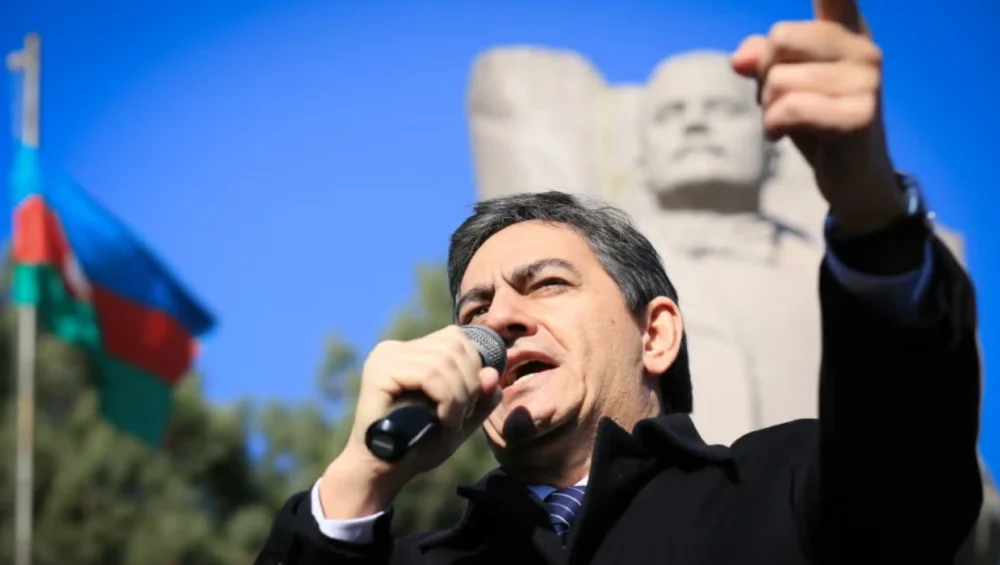
Azerbaijan’s handling of opposition leader Ali Karimli has moved far beyond a routine pretrial detention case and into a deeper political and human rights controversy. The chairman of the Azerbaijan Popular Front Party, a long-time critic of President Ilham Aliyev’s government, is now at the center of accusations that state authorities are using detention not only to punish dissent, but also to impose conditions that may amount to inhuman or degrading treatment.
According to human rights groups, lawyers, and political supporters, the trend of restrictions applied to Karimli is indicative of a systematic attempt to alienate, exhaust, and stifle one of the most prominent members of the Azerbaijani opposition. It is not the case of just a couple of punitive restrictions. According to Human Rights Watch, the restrictions against Karimli have become even stricter following his interview with France 24 in June 2026, when Karimli talked about the conditions of his imprisonment and blamed the European states for prioritizing energy cooperation with Baku over human rights. According to HRW, right after the broadcast of the interview, his phone contact was cut down and then partially restored, allowing him only four minutes out of the allowed 15 minutes.
A Political Figure Under Pressure
Karimli, aged 61, has been among the most vocal opposition activists in Azerbaijan since a long time now. The opposition activist has been heading the APFP for quite some time and has often accused the government of suppression of pluralism and banning the organization of opposition and the use of criminal laws against opponents. The latest case against Karimli started on November 29, 2025, when he was arrested from his home in Baku by the security forces and remained out of contact for the next two days as per Amnesty International.
On December 1, 2025, the Sabayil District Court put him in jail on the charges of Article 278.1 of the Criminal Code of Azerbaijan which involves “actions aimed at the violent seizure of power” and “violent change of the constitutional order.” Rights groups have noted that this article has serious consequences which could include life imprisonment. Karimli denies these charges, stating that the case is politically motivated.
Long-running restrictions
Karimli’s confrontation with the Azerbaijani state did not begin with this arrest. Human Rights Watch has documented that he was effectively barred from foreign travel for years because authorities refused to reissue his passport after it expired, and the organization’s reporting notes a travel ban stretching back to at least 2005 or 2006. That history matters because it shows that his current detention is unfolding in the context of a much longer campaign of administrative and legal pressure.
For critics of the government, the travel ban, court cases, and now the prison restrictions form a single chain. Each measure may appear different on paper, but together they suggest what one rights group called a “long-running crackdown” on the APFP and its leadership.
Detention Conditions Tighten
The latest allegations are especially serious because they concern daily conditions rather than the underlying charges alone. Human Rights Watch says the prison regime worsened after the June France 24 interview.
As stated in the report, Karimli’s access to his telephone has been blocked, and even when he was permitted phone calls, he received only four minutes of phone time when he was entitled to fifteen minutes of call time. Furthermore, his lawyers have claimed that any request to reinstate his phone communication rights have not been entered into court records. Moreover, according to the committee that supports Karimli, the government has put another detainee in his cell who talks loudly and recites religious sentences all night long. It is a very significant issue since it transforms the discussion from the administrative aspect to the point where the conditions are close to being inhumane treatment under the international law.
Food, news, and legal access
The pressure increased again in July. HRW reports that authorities prohibited family food parcels, switched off Karimli’s television, confiscated newspapers, and barred lawyers from bringing written materials into visits. The defense committee went further, saying guards seized his handwritten notes, including legal petitions prepared for court, and prevented his lawyers from taking notes during meetings.
These details matter because they show a pattern, not a single isolated incident. Prison restrictions commonly relate to security or order, but in Karimli’s case, the alleged combination of blocked food deliveries, limited phone access, removed news sources, and confiscated legal notes creates a picture of cumulative isolation. For a political detainee, that isolation can have a dual effect: it makes life in custody harder and also reduces the ability to mount an effective legal defense.
Rights Groups Sound the Alarm
The human rights activists have been unusually outspoken about the case. According to HRW, the treatment of Karimli has been such that it has created “serious concerns about inhuman or degrading treatment,” whereas his lawyers claim that the restrictions amount to breach of Article 3 of the European Convention on Human Rights, according to which torture and inhuman or degrading treatment or punishment is banned.
This is indeed a very strict criterion in terms of law, but one that human rights campaigners think can be fulfilled with an accumulation of punitive acts that are meant to inflict pain, not to ensure order. Amnesty International has also presented the case within the context of increasing authoritarianism. According to the statement of Amnesty International dated December 1, 2025, the arrests were made in the wake of a crackdown in which journalists, academicians, and opposition activists are facing increasing harassment and arrest in politically motivated cases.
The broader context is crucial. This is not a case unfolding in isolation, but in an environment where opposition activity is already under severe strain. Human Rights Watch says that since November 2025 more than 20 APFP members have reportedly been detained, held in pretrial detention, or subjected to travel bans, while authorities have repeatedly refused the party permission to hold rallies in central Baku.
Broader Crackdown Context
The APFP has always been subjected to harassment in the form of lawsuits, but the current one is referred to by rights organizations as an especially fierce stage. According to the Human Rights Watch Report on Azerbaijan issued in December 2025, the Azerbaijani government has intensified its persecution of the party via politically motivated lawsuits and other forms of intimidation. This specific case was mentioned by HRW along with others as part of the pattern. The pattern is significant because opposition leaders serve as a test-case for the general political atmosphere. If the party chairman can be cut off from contacts, information, and detained for months at a time, the message to the rank-and-file activists is clear.
The effect can also spill beyond domestic politics. Karimli’s reported remarks to France 24 were particularly sensitive because he criticized European governments for prioritizing energy cooperation with Azerbaijan over human rights. That made the detention controversy a foreign-policy issue as well, adding pressure on governments that buy Azerbaijani energy while also voicing concern about rights abuses.
What the State Says
The regime argues that the case is justified, and the charge is quite severe – an attempted violent seizure of power and a forced alteration of the constitution. From that point of view, the case should be seen as a national security threat rather than a political one. However, the issue with this, as stated by the human rights organizations, is the fact that evidence was not provided in such a way that this pattern of repression against the APFP and other critics could be dispelled. The discrepancy between the security narrative of the state and the persecution narrative of the rights groups lies right at the core of the controversy. While the state mentions the charge, critics mention the timing, prior travel ban, incommunicado detention, and the worsening prison conditions.
Why the case matters
The significance of Karimli’s case comes from the fact that it raises three inter-related issues: the validity of the accusation, the justice of the process and the conditions of the imprisonment. Despite the fact that a state believes a person is being kept in prison legally, international law calls for humane treatment and legal representation anyway. And that is why the accusations of phone prohibition, disruption of sleep, confiscation of legal documents, and prevention of delivering packages from the family have been gaining so much interest. For Azerbaijan, the issue is not only legal, but also reputational. Azerbaijan has had to bear with accusations from human rights groups of curbing dissent for years now, and each new case with an opposition leader only strengthens this reputation.