
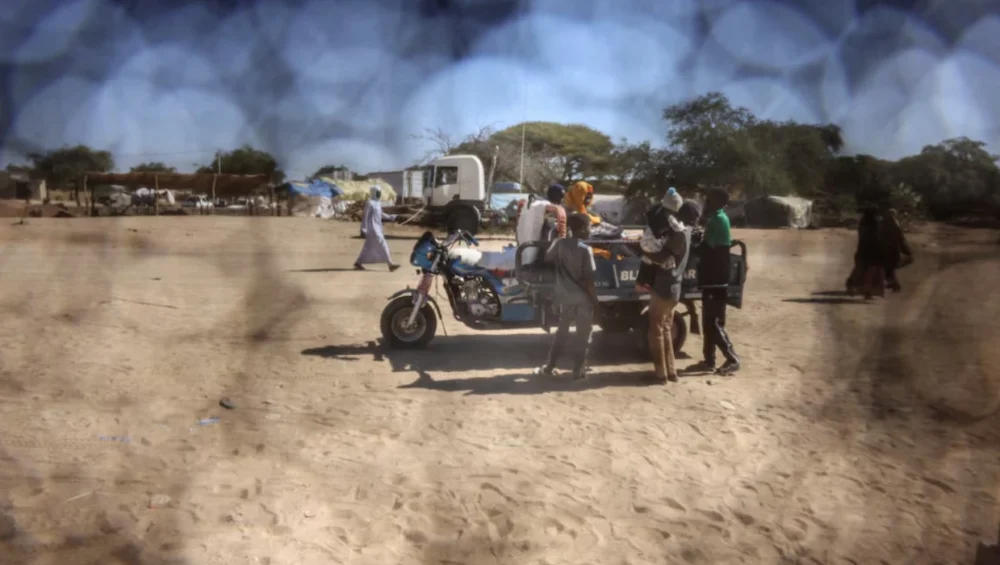
The war in Sudan is increasingly being shaped not only by the rival forces fighting for control of the country, but also by the foreign weapons, technology, fighters and supply networks that sustain them. A United Nations fact-finding mission has warned that external assistance has expanded the ability of both the Sudanese Armed Forces and the Rapid Support Forces to launch attacks deep inside civilian areas.
According to the report published on Thursday, the increased employment of drones and other sophisticated weapons systems has contributed to escalating risks for civilians. Investigators established that both parties violated humanitarian and human rights laws and there were cases when the violations amounted to war crimes. The report focuses on the allegations of providing the RSF with support through networks composed of individuals and organizations from the United Arab Emirates, Chad, Libya and Somalia. The UAE has dismissed the accusations saying it does not offer any military, logistics, financial and political assistance to the paramilitary force. Still, the report adds to growing international pressure put on those external players blamed for keeping Sudan at war. At the same time, the report brings up a general issue: can there be an end to the conflict while all parties have access to foreign weaponry and technology?
A war sustained from abroad
The armed conflict in Sudan broke out in April 2023 amid the rivalry between the SAF, whose commander is Abdel Fattah al-Burhan, and the RSF, whose leader is Mohamed Hamdan Dagalo, nicknamed Hemedti. The outbreak of hostilities took place after the failure of Sudan’s political transition and differences over the integration of the RSF with the SAF. What started as a conflict between the two security forces has now become a full-scale war throughout Sudan. Clashes have wreaked havoc across Khartoum, Darfur, Kordofan and other parts of the country, where the shortage of basic commodities like food, water, health care, and fuel emerged due to the collapse of public services. According to the findings of the UN mission, the involvement of external players in the situation has prevented both parties from depleting their military potential. With help of arms supplies, logistics and soldiers, the parties can fight while civilians face displacements, starvation, and destruction of infrastructure. Foreign intervention in the situation provided both parties with a better opportunity to conduct attacks not on the front line but at a considerable distance.
Drones extend the battlefield
Drones have become central to the Sudanese war. Their use allows commanders to monitor targets, identify movement and conduct attacks without placing pilots directly over hostile territory.
The UN mission said more than 1,000 people were killed in drone strikes during the first five months of 2026. The attacks reportedly affected hospitals, schools, markets, homes and displacement sites.
The figure is significant not only because of the number of deaths, but also because it illustrates the widening geographic reach of the conflict. Drones and loitering munitions can be used against targets far from the main battle lines, making it harder for civilians to identify safe areas.
Loitering munitions are designed to remain over an area before striking. Their ability to hover or circle while searching for a target can increase accuracy in some circumstances, but it does not remove the legal obligations of the attacking force. Operators must still distinguish between military objectives and civilian objects, assess expected civilian harm and take feasible precautions.
The UN mission’s findings indicate that these requirements may have been breached in several incidents. It said some drone operations by both forces raised concerns over unlawful attacks and possible war crimes.
Damage beyond direct casualties
Not only those killed or injured in specific drone strikes have been affected by drone warfare; attacks on energy, fuel and water infrastructure facilities can affect the whole city. Between May and July 2026, several attacks carried out by RSF drones destroyed the facilities for producing electricity and fuel in El Obeid, the capital of North Kordofan. The city was under army control and the situation was very difficult due to the pressure on the city from RSF, and according to the UN, it was already strained and partially besieged. Attacks were damaging the water, health care, transport and other infrastructure facilities in the city. A damaged electricity infrastructure may disrupt hospitals’ work, water pumps and food storage. Shortage of fuel may disrupt the movement of ambulances and humanitarian aid convoys. All of these facts become relevant in terms of the international humanitarian law since civilian infrastructure is protected by international law unless it is a military target. Even when the facility is connected to military infrastructure, the attack will be illegal if its impact on civilians is excessive in comparison with military gain.
The hospital strike in East Darfur
Among the most serious cases examined by the UN mission was an army drone strike on Ad-Da’ein Teaching Hospital in East Darfur. Investigators said at least 70 people were killed in the attack.
The victims included women, children and medical workers, according to UN reporting on the incident. The hospital was left non-functional after the strike.
The attack generated immediate international concern because medical facilities enjoy special protection during armed conflict. Hospitals must not be deliberately attacked, and parties to a conflict are required to protect patients, medical personnel and the wounded.
The UN Secretary-General’s spokesperson strongly condemned the killing of at least 60 people, including children and health workers, in the March 20 strike before later reporting placed the death toll at 70.
The difference in the reported figures reflects the difficulty of confirming casualties in an active war zone. It does not reduce the seriousness of the incident. The central legal questions include whether the hospital was deliberately targeted, whether the attacker knew its location and protected status, whether it was being used for military purposes and whether feasible precautions were taken.
A UN human-rights official said that continued attacks on civilians and civilian infrastructure raised serious concerns over the principles of distinction, proportionality and precaution and “may amount to war crimes”.
Alleged RSF supply network
According to the mission, investigators found reasonable grounds to believe that a network comprising persons and entities in the UAE, Chad, Libya and Somalia provided the RSF with weaponry, logistics, training and personnel. The network is said to have provided military technology and personnel that could operate and maintain the advanced weapons. The mission also made reference to the recruitment and deployment of Colombian contractors. The number of the Colombian contractors, as assessed by the investigators, could be close to 2,000. They were, allegedly, present during the RSF operations in the area around El Fasher in Darfur. It is the contribution of the Colombian contractors that reveals the internationalization of the war through the international labor and supplies.
Foreign personnel may provide skills that may be lacking among the armed group, such as drone operation, maintenance, vehicle handling, weapons training and combat. Officials in Colombia informed the investigators that Colombia condemned mercenarism and was taking actions to deal with the issue of its nationals’ participation in the foreign wars. Participation of the Colombians has been also analyzed by human rights organizations. Human Rights Watch stated that an Abu Dhabi based security company hired the Colombian contractors that were deployed.
The SAF investigation remains at an earlier stage
The UN report also examined foreign assistance to the Sudanese military, but investigators said that part of the inquiry remained at an early stage.
The mission, on the other hand, managed to find evidence of the deployment of foreign-provided combat drones and loitering munitions by the SAF. The technology provided an expansion of the army’s ability to engage targets from a greater distance and was reportedly employed during strikes targeting civilians and their locations. It is crucial that in this respect, the report does not view the RSF as the only party engaging in illegal activities. On the contrary, the report depicts a conflict between two forces using more and more sophisticated means that put civilians in danger. Such a balance, however, does not indicate that the actions undertaken by both parties are of equal nature.
El Fasher and wider atrocity concerns
The new findings also come against the background of earlier UN conclusions concerning El Fasher in North Darfur. A previous fact-finding report said that the RSF committed crimes against humanity, war crimes and genocide against non-Arab communities during the siege and capture of the city in October 2025.
The mission said the mass killings of non-Arab communities in and around El Fasher bore the hallmarks of genocide. The communities identified in earlier reporting included the Fur and Zaghawa.
Genocide is defined by the specific intent to destroy, in whole or in part, a national, ethnic, racial or religious group. This makes it legally distinct from war crimes or crimes against humanity. A finding that conduct bears the hallmarks of genocide signals grave concern, but a final legal determination still depends on the competent judicial process and the full evidentiary record.
The RSF has denied allegations of systematic abuses and has accused opponents of spreading false accounts. The SAF has also faced allegations of unlawful attacks and abuses.