
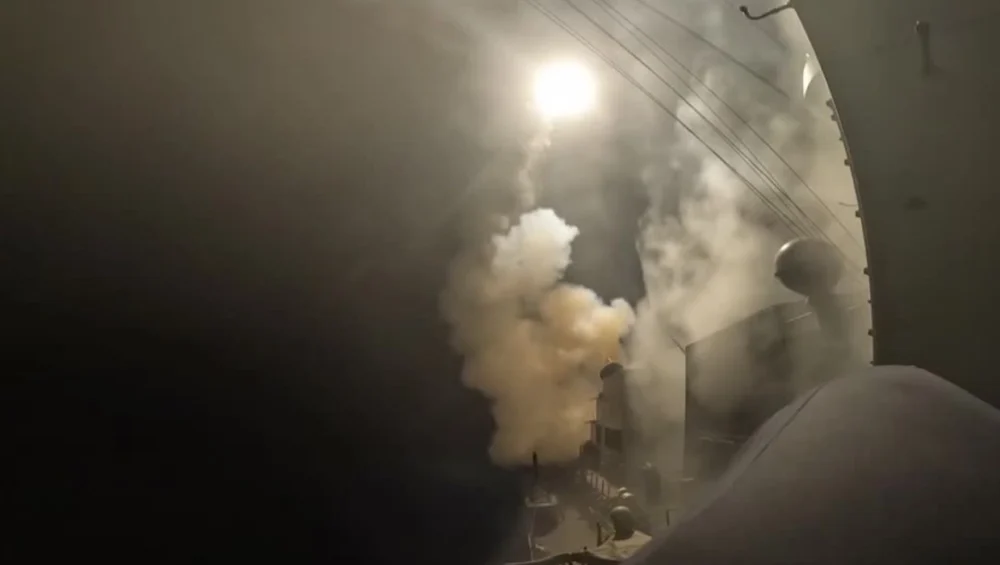
In the coastal county of Sirik, within Iran’s Hormozgan Province, a wedding gathering in the village of Kuhestak became the epicenter of a fresh humanitarian crisis after an airstrike that Iranian authorities say was carried out by the United States.
As reported by a number of Iranian officials and media agencies, at least five civilians were killed, including a four-year-old child and dozens more were injured with many being reported as women and children. While the Iranian Red Crescent reported four deaths and over 50 wounded, the organization revised the casualty figures to include five deaths and 63-68 injuries amid confusion in the aftermath of the airstrike. According to IRIB, the governor of Sirik County reported that 63 other civilians had been injured while 50 of the victims were women and children.
Ahmad Nafisi, the provincial deputy governor of Hormozgan, and Hossein Kermanpour, health official in Iran, confirmed the death and injuries of several civilians, citing the sources in their local hospitals. Sirik is located along the Strait of Hormuz, one of the world’s most vital waterways. This airstrike took place as the US and Iran have been accusing each other of attacks on their ships and military forces in the same region. In a matter of hours, the leaders of Iran interpreted the attack not only as an accidental one but as part of a series of airstrikes on civilians of Minab and Lamerd, promising a tough response.
What Iranian officials say happened
Iran’s account is consistent across ministries, provincial authorities, and parliamentarians: a U.S. missile or airstrike hit a residential home where families had gathered for a wedding, producing shrapnel injuries and structural damage that overwhelmed local clinics. Foreign Ministry spokesperson Esmaeil Baghaei condemned the attack as part of a broader “catalogue of atrocities” against Iranian civilians and pledged that Tehran would respond “with firmness.” In a post on X, Baghaei wrote,
“More than 50 innocent men, women and children were killed or injured,”
situating the Sirik incident alongside other strikes in Minab, Lamerd, and Qeshm.
Parliamentary figures sharpened the legal language. Hassan Ghashghavi, spokesman for the Iranian Parliament’s National Security and Foreign Policy Commission, asked publicly how Washington could have failed to distinguish between military targets and a civilian wedding, implicitly invoking the principle of distinction under international humanitarian law. Ebrahim Azizi, chairman of the same commission, called the strike
“the ultimate proof of the utter desperation of the fake defenders of human rights,”
echoing official narratives that portray the attack as evidence of U.S. disregard for civilian life. IRGC statements went further, describing the incident as a “blatant violation of human rights” and a war crime, and using it to justify retaliatory strikes on U.S. bases in Kuwait, Jordan, Iraq, and Bahrain.
The U.S. position: awareness without admission
The United States has not acknowledged striking a wedding. A CENTCOM spokesman, Capt. Tim Hawkins, told Axios that the command was
“aware of the reports, which originated from Iranian state media,”
and added a categorical denial:
“The U.S. military never targets civilians, unlike the IRGC.”
In tandem, CENTCOM claimed that its mission involved striking military assets linked to the IRGC, such as air defenses, radars, maritime capability, mine-laying, and communications centers, which was retaliation for IRGC attacks on civilian shipping in the Strait of Hormuz and on American troops. There is an obvious disparity here in terms of evidence, since the Iranian government has presented a clear-cut civilian location and list of casualties, whereas the American government has stated that it does not target civilians but has military targets in mind.
Why this raises acute human rights concerns
Under international humanitarian law, parties to a conflict must distinguish between combatants and civilians, avoid attacks that are indiscriminate, and ensure that any incidental civilian harm is not excessive in relation to the concrete and direct military advantage anticipated. The reported facts—a residential home, a family celebration, and a high proportion of women and children among the wounded—trigger core protections for civilians and civilian objects.
The Iranian Red Crescent Society (IRCS) stated that,
“Given the reported civilian character of the location as the venue of a family wedding ceremony, as well as the presence of civilians at the site, the incident raises serious concerns under international humanitarian law and warrants an independent, impartial, thorough, and effective investigation.”
It added that intentionally launching an attack knowing it would cause excessive civilian harm could, under the Rome Statute, give rise to individual criminal responsibility.
Even if the strike were aimed at a nearby military target, the principles of proportionality and precautions in attack require feasible steps to verify the target, choose means and methods to minimize civilian harm, and cancel or suspend an attack if it becomes apparent that civilian casualties would be excessive. The presence of dozens of civilians at a wedding, reportedly including many children, heightens the obligation to exercise those precautions.
Accountability pathways and what an investigation must address
In addition to knowing who carried out the attack, the primary issue for rights advocates and legal scholars is whether it was in accordance with the three primary laws of distinction, proportionality, and precaution. In order to carry out an adequate investigation, the first thing to be determined is the exact coordinates of where the impact took place; what kind of object it was that was attacked (civilian residential building or military object nearby); what kind of weapon was used; what kind of intelligence was available; how the decision was made to go through with the strike.
Iranian lawmakers have already signaled an interest in international legal scrutiny. A letter to the International Criminal Court prosecutor requested assessment of the Kuhestak incident under the Rome Statute, citing the principles of distinction, proportionality, and precautions in attack. Whether such a referral gains traction will depend on jurisdictional questions and the willingness of states to support an independent fact-finding process. In the meantime, the IRCS call for an
“independent, impartial, thorough, and effective investigation”
sets a clear benchmark for any credible inquiry.
The human cost behind the headlines
Aside from the legal and political ramifications, the Sirik wedding strike is a massive loss of humanity, where a family event is destroyed, one child dies, and there are numerous victims with bodily and mental injuries. The Iranian officials continue using this aspect in support of their claims that the incident was not a mere fluke, but a part of a larger pattern of attacks on civilians. In turn, the U.S. officials are adamant in their claims that the forces do not target civilians and attack only the military capacities related to the threats to the shipping and military personnel.