
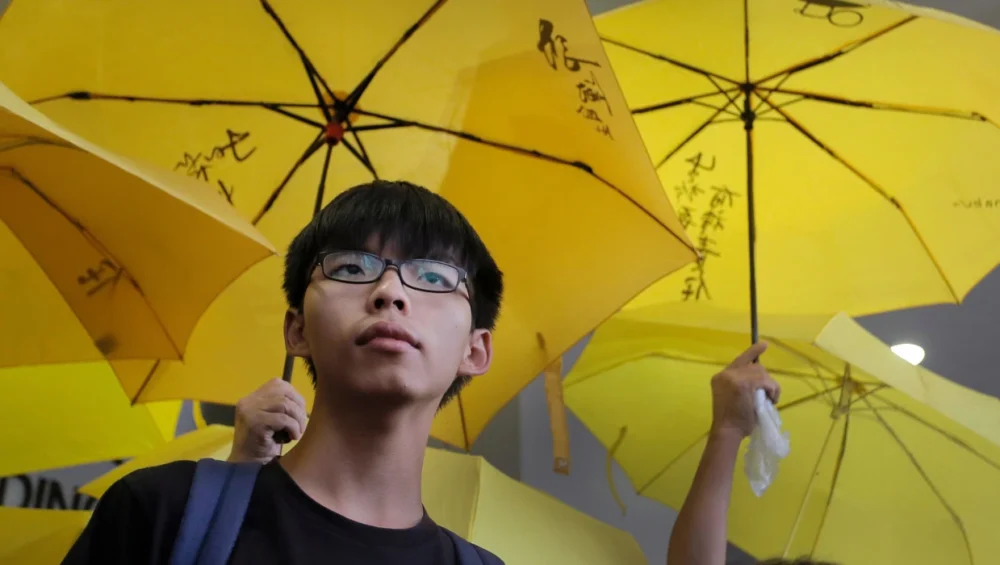
Joshua Wong’s guilty plea in Hong Kong’s second national security case is more than another legal development involving a prominent activist. It is a test of how far the city’s national-security framework can reach into political advocacy, international lobbying and peaceful opposition activity.
The 29-year-old Wong pled guilty on Wednesday to conspiring with foreign powers to collude with foreign forces to undermine national security. This charge entails a penalty of between three and 10 years in ordinary cases and possibly a lifetime imprisonment depending on whether the offense is considered serious by the court. A sentence for Wong had yet to be made at the time of the trial’s completion. Another important fact about this case is that Wong is currently serving four years and eight months of imprisonment as a result of his plea in the serious subversion case related to the unoffical Hong Kong primaries of 2020. Another conviction in the future could result in Wong staying in prison for a much longer time, perhaps beyond his expected date of release in 2027.
From the point of view of Wong’s supporters, the trial proves that the government is using the national security law in order to extend the imprisonment of Hong Kong’s famous democracy supporter. That conflict lies at the heart of the human-rights debate surrounding Wong’s prosecution.
What Wong admitted in court
This charge is connected to activities carried out between July 1 and November 23, 2020, a time when Beijing passed the National Security Law in Hong Kong. It is alleged by the prosecution that Wong conspired with Nathan Law, an exiled activist, and some other people to ask for sanctions, blockade, and other forms of aggression against China or Hong Kong from foreign nations, entities, institutions and individuals. The alleged campaign included the use of international media, contacts with political leaders abroad, and advocacy efforts aimed at foreign governments. Wong is also said to have incited foreign firms to abstain from investing in mainland China and from denying technology to the police in Hong Kong. The charge is founded on Article 29 of the National Security Law. This article makes it a crime to ask for or to conspire with a foreign nation or any external body to commit certain acts, which include sanctions, blockade, subversion of elections, and serious disruption of policy-making or implementation.
Wong’s guilty plea removes the need for a contested trial on the charge, but it does not settle the wider human-rights question. A guilty plea establishes criminal responsibility under the court process; it does not itself resolve whether the law is compatible with Hong Kong’s obligations to protect freedom of expression, association and political participation.
The government’s legal argument
Hong Kong authorities insist that Article 29 does not criminalise ordinary communication with people overseas. The Department of Justice has argued that the offence targets specific activities that endanger national security, rather than routine international contact or business dealings.
In a 2021 explanation of the provision, then-Secretary for Justice Teresa Cheng said,
“The proper approach would be to look at the relevant provision itself.”
She also argued that the law does not prevent Hong Kong residents from communicating with overseas individuals and organisations.
“It is clear therefore to any well-informed person when reading Article 29 of the National Security Law that it does not preclude any interaction or communication between a Hong Kong resident with others overseas,”
Cheng said.
The government’s position is that the distinction is between lawful communication and coordinated action intended to harm China or Hong Kong. It says sanctions and blockades are not simply opinions when they are actively sought through foreign governments as part of a political campaign.
A Hong Kong government spokesperson made the same argument in response to criticism of Wong’s prosecution:
“The lawful exercise of free speech must not be conflated with taking actions to collude with a foreign country to impose ‘sanctions’ to harm one’s own country.”
From the government’s perspective, the case therefore falls within a conventional state duty to prevent foreign interference. Officials in Hong Kong and Beijing say the National Security Law was necessary after the mass demonstrations and unrest of 2019, which they viewed as a threat to public order, sovereignty and national security.
The human-rights challenge
The human rights organizations disagree with the restrictive definition of the offense by the government. They believe that the language used in the offense of foreign collusion is wide enough to cover political lobbying and media relations along with seeking foreign governments to put diplomatic or economic pressure. The problem does not lie in Wong having contacts outside the country. The problem lies in turning those political activities like writing articles, interacting with media and politicians, and lobbying governments into security-related offenses because of calling for sanctions.
Amnesty International said the new charge demonstrated the continuing human-rights risks created by the law. Its China Director Sarah Brooks said,
“Hong Kong’s National Security Law is turning five years old at the end of the month, and these new charges against Joshua Wong show that its capacity to be used by the Hong Kong authorities to threaten human rights in the city is as potent and present as ever.”
Brooks further said,
“Once again, the vague and sweeping offence of ‘collusion with foreign forces’ is being weaponized to justify an attack on the freedoms of expression and association.”
Amnesty described the new prosecution as a possible mechanism for keeping Wong in prison after his original sentence.
“Wong, already jailed for his participation in informal primaries, would have been released in a year and a half. But if this case goes forward, he could face as much as a life sentence,”
Brooks said.
The organisation called for the charges to be dropped and for people jailed solely for exercising human rights to be released. Its position reflects a broader criticism that the National Security Law has created a chilling effect: people may avoid not only protests, but also public discussion, civic organisation, fundraising, journalism and contacts with overseas institutions.
Wong’s political history
Wong achieved international fame in his teens as part of the 2014 Umbrella Movement, where people occupied some parts of Hong Kong to protest for more democratic elections. He became a leading figure in the pro-democracy movement in Hong Kong and the secretary-general of the political party Demosisto. The generation of activists he belonged to grew up in a time when there was an organized opposition, active civil society and frequent protests in the city. The political situation changed drastically after the 2019 protests and the introduction of the National Security Law by Beijing on 30 June 2020. The law established crimes related to secession, subversion, terrorism and collusion with foreign powers. Additionally, it introduced a special procedure for handling cases related to national security, including restrictions on bail and appointment of specific judges. Wong was among 47 politicians and activists who were charged in connection with the unofficial primary election in 2020. The prosecution claimed that the primary was part of a strategy aimed at gaining a legislative majority, vetoing government budgets and possibly forcing the chief executive to step down. Wong admitted to the crime of conspiring to subvert state power and received a four-year-and-eight-month prison sentence.
His legal troubles illustrate the transformation of Hong Kong’s opposition movement from a visible political force into a largely criminalised and restricted activity.
The broader crackdown in figures
The human-rights implications of Wong’s case become clearer when viewed against the wider use of national-security legislation.
According to the US Consulate General in Hong Kong, by July 29, 2026, 304 persons were arrested on charges of violations of the National Security Law of 2020 and Safeguarding National Security Ordinance of 2024. There were 160 persons and organizations formally charged, 119 persons convicted, and 34 persons abroad whose arrest warrants and financial bounties have been issued. Figures provided by the Hong Kong government are somewhat wider. According to them, the National Security Department had arrested 385 persons by the end of 2025 from the introduction of the National Security Law and Safeguarding National Security Ordinance into effect.
The British government stated that Hong Kong authorities arrested an additional 69 persons in 2025, among other things for displaying political slogans, protesting peacefully and organizing petitions. They cannot be compared directly since different institutions use different definitions and reporting periods. The US Consulate focuses on tracking arrests and convictions of nationals in relation to national security. Figures presented by the Hong Kong government include arrests made under the legislation related to national security. But still, both sets of figures confirm the fact that enforcement has moved far beyond violence or classic espionage cases.
The US Consulate also recorded 34 overseas-based people targeted with arrest warrants and financial bounties. Nathan Law, named in Wong’s case, is among those listed.
Shrinking space for dissent
The effects of the security law are not confined to the courts alone; Hong Kong’s political system, media environment, and civil society are also different today. In the second half of 2025, according to the British government, the scope of application of the law grew further. They referred to arrest warrants and bounties issued on overseas dissidents, restrictions on access to prisoners, and arrest of individuals connected with peaceful political activity. Electoral system of Hong Kong underwent a major revision following the adoption of the National Security Law in order to guarantee that “patriots” run Hong Kong.
In the December 2025 elections to the Legislative Council, only 20 out of 90 seats were up for election by direct vote of the population, with the participation rate among the geographical constituencies at 31.9%. According to the British report, none of pro-democratic candidates contested those elections. Disappearance of any organized opposition was shown by the decision to dissolve the Democratic Party made in December 2025. At its extraordinary general meeting attended by 121 members, 117 voted for dissolution and four abstained.
The party said its political work had sought to expand elections and pursue universal suffrage while defending
“diversity, openness, transparency and accountability.”
It added that after 30 years,
“the convictions and perseverance of these three decades will leave their mark on Hong Kong’s history.”
For human-rights observers, the disappearance of major opposition parties and the prosecution of activists such as Wong point to a fundamental reduction in political pluralism.