
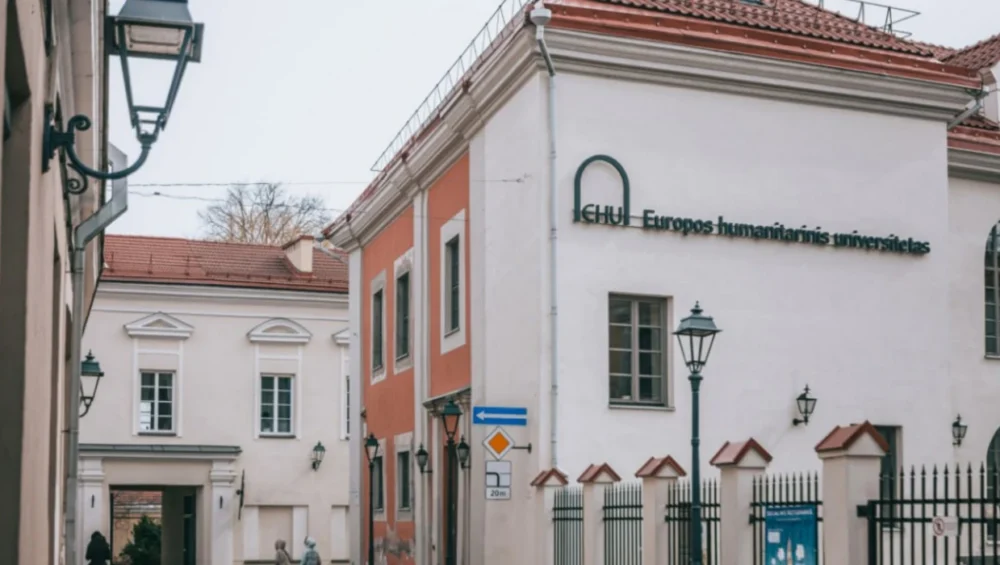
The European Humanities University (EHU) in Vilnius has long been a lifeline for Belarusians seeking independent, European-standard education. But since Minsk’s Supreme Court branded EHU an “extremist organization” in April 2026, the university has become the focal point of a sweeping, transnational repression campaign that reaches far beyond campus—into family homes, workplaces, and bank accounts across Belarus. What began as a legal designation has evolved into a coordinated operation of searches, interrogations, detentions, and ultimatums aimed at severing ties between students abroad and their relatives at home, signaling a new phase in the Lukashenko regime’s strategy to police dissent beyond its borders.
The legal trigger: from ban to criminalization
The turning point came on 14 April 2026, when Belarus’s Supreme Court ruled that EHU “encroached on the sovereignty of Belarus, the foundations of the constitutional order and public security,” and formally designated it an “extremist organization.”
In addition to making the institution illegal, this decree made the act of association a crime. According to Belarusian laws, participating in or funding an “extremist formation” could be punishable with up to six years of imprisonment. It turned ordinary activities such as paying tuition, sending money or even staying in touch into potential proof of a crime. This decree has become the basis for what human rights defenders now refer to as the “EHU case”, a large-scale criminal investigation against “assistance” and “financing” of extremism. Practically, it has allowed the security services to file dossiers on hundreds of people who had never been to Belarus after their enrollment in Vilnius.
Operation June: coordinated searches and the birth of a mass case
The offensive began in early June. Between 2-4 June 2026, Belarusian security forces conducted coordinated searches throughout the country aimed at students and graduates of EHU and other affiliated people, namely their parents and relatives. The raids were described as synchronized by rights organizations, meaning that they were planned centrally through the State Security Committee (KGB). They confiscated phones, laptops, and documents, often questioning the families regarding tuition payments. On 17 August 2026, at least 175 individuals were already affected, 110 of which were either students or family members of students, and 60 searches of homes were related to this persecution. According to other estimates on 31 August 2026, there were more than 180 cases of persecution of EHU-related persons.
The mechanics of coercion: ultimatums, arrests, and financial scrutiny
What makes the EHU campaign unique is the use of family pressure. The investigators do not just threaten the students but pressure the parents into getting them to withdraw. As per Viasna, the KGB officers give explicit threats to the families, telling them that they need to make sure their children leave the university within 10 days, failing which the parents themselves will be arrested in relation to a criminal case. Some of the relatives have already been arrested for 15 days as an example. Money transfers play a major part in the criminal process. The authorities are considering the payments to the university and money sent by parents as evidence of “financing extremist activities.”
Voices from the ground: rights groups and international observers
Human rights organizations have been vocal in condemning the campaign. Marie Struthers, Amnesty International’s Director for Eastern Europe and Central Asia, said the crackdown “has taken a disturbing new turn,” extending beyond students to “relatives and associates in Belarus.” She warned that authorities may pursue a demonstrative ‘anti-extremism’ trial involving students, graduates, staff, and relatives, and called on Minsk to “stop this campaign of persecution” and remove the “extremist” label.
Viasna has framed the operation as a mass criminal case for “assisting and financing extremist activities,” documenting 60+ searches and 175+ affected people by mid-August. The group reports that KGB officers are explicitly threatening parents with detention unless their children withdraw from EHU, turning family bonds into instruments of state coercion.
The human cost: families caught between fear and defiance
For many families, the EHU case has created an impossible choice. Parents face the prospect of detention or criminal charges if they continue supporting their children’s education, while students abroad confront the threat of lifelong bans from Belarus and potential imprisonment upon any return. Some relatives have been summoned for interrogations, their employers notified, and their financial histories scrutinized. One mother of an EHU graduate described the pressure in stark terms:
“I feel like someone who is pushing a child out of a burning train.”
Her words capture the anguish of parents forced to choose between their children’s safety and their right to education.
Why EHU matters: a symbol of independence in a closed society
The importance of EHU is not limited to its academic curriculum. Established as an independent private university in Minsk in 1992, EHU had its license revoked in 2004 and moved to Vilnius in 2005, becoming a major organization providing education for Belarusians according to the European standards. This designation of extremism in 2026 takes previous pressure against EHU to the level of criminal prosecution by associating oneself with the organization or financing its activities. In doing so, the Belarusian government shows how serious it is about punishing everyone who tries to get an education according to the European standards.
Transnational repression: a blueprint for control
In essence, the EHU campaign is one of transnational repression, a tactic by which authoritarian states expand their means of coercion beyond national boundaries to suppress opposition to their rule. By using kin as proxies for enforcement through a combination of threats and rewards, the state circumvents issues of extradition or cross-border legal procedures. Moreover, this is an inexpensive and emotionally taxing tactic to employ against individual freedom of choice. However, this is only the beginning. If the government of Minsk can make payment for education in Lithuania an illegal act, then how can it prevent itself from targeting other acts of assistance, such as donating money to independent media outlets or participating in online discussion groups?
Legal and diplomatic implications
The current campaign raises serious issues of academic freedom, freedom of expression and right to education in international law. The designation of the university in question as “extremist” organization and persecution of its representatives test the boundaries of overreach by the sovereign authorities in matters of jurisdiction. Even though Minsk can refer to the sovereignty of the state when it claims its rights over its citizens, its actions, especially the extraterritorial nature of its actions and coercion of family members, pose a problem in terms of proportionality and due process. In diplomatic terms, the situation creates tensions for Belarus’s relationship with the EU, including Lithuania, where the EHU is based, and has had good relations with civil society organizations in Belarus all along.
What comes next: show trials, chilling effects, and resistance
Human rights organizations have pointed out that the following stage may be one that involves show trials meant to serve as a deterrent. As stated by Marie Struthers from Amnesty International, the authorities could be pursuing a “show trial against extremism”, involving students, graduates, teachers, and family members of those implicated in such activities – a trial that would highlight the price tag of disobedience. However, resistance is alive and well. In spite of the dangers involved, there are still many students who attend the university, and their families are still doing everything they can to help them.