
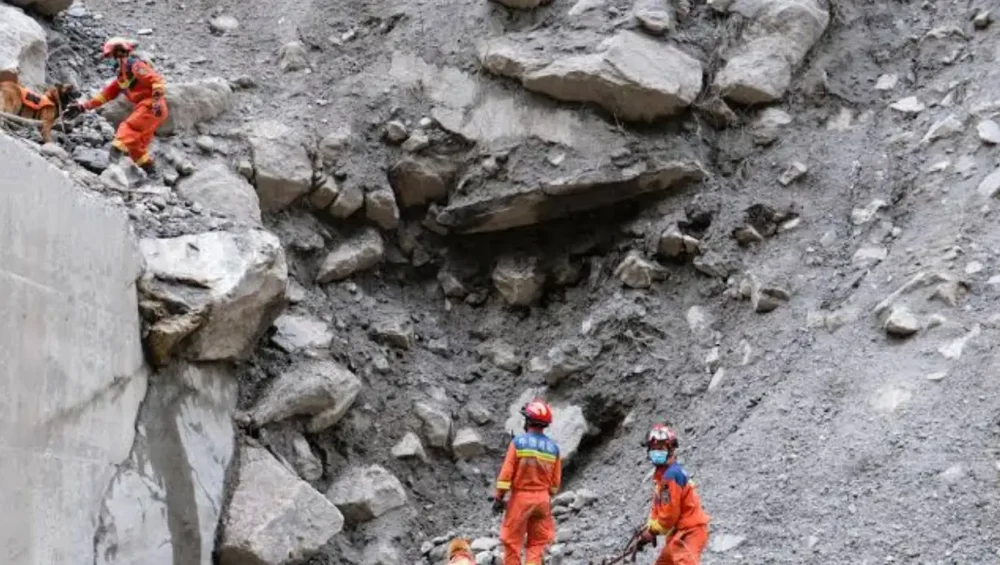
As rescue teams comb through the rubble of Himalayan villages and grieving families await news of missing relatives, a parallel crisis is unfolding in the realm of information. Exiled Tibetans and international advocacy groups are leveling serious accusations against Beijing, claiming that Chinese authorities are systematically downplaying the human and material toll of the devastating floods that struck the Tibet–Nepal border region in late August 2026.
A Catastrophe in the High Himalayas
A flood and landslide occurred in the border area between Nepal and China’s Tibet Autonomous Region on 26 August 2026. The catastrophe hit the Chinese region of Gyirong (Kyirong) County and Rasuwa district of Nepal. It is suspected to have been caused by a glacier incident such as glacier collapse or glacier avalanche, which caused an immense amount of debris to pour into rivers, destroying villages, roads, bridges, and hydroelectric facilities.
While the level of damage in the Nepal region has been well-documented with many villages, bridges, and even schools being washed away and seven hydroelectric power plants either damaged or destroyed, it is suspected that the number of victims in total was over 90,000. This is according to an estimate made by the Red Cross. However, whereas there have been continuous reports by the Nepalese government on the death toll and level of damage, information coming from the Chinese region has not been clear at all.
The Official Chinese Narrative
Chinese authorities have been fairly transparent in their releases of data, but generally speaking, the gist of the official story is that the number of casualties in Tibet has been quite low relative to Nepal and that all data is being released openly.
Initial estimates indicated that there were three deaths in Tibet, but the number has gradually increased first to five, then seven, and finally 16 in successive reports. The latest number of casualties officially reported has been 16 deaths in Gyirong County. Apart from the confirmed deaths, Chinese authorities have also said that around 546-558 people are missing in Gyirong, of which 260-261 are foreigners from various nations. Whereas Nepal has been fairly specific about the number of casualties by nationalities, the Chinese government has been giving only general estimates without specifying any nationality. What has been mentioned prominently in the official stories told by state media outlets and government reports is the rescue efforts, directives by President Xi Jinping, and the Communist Party’s leadership in the disaster relief efforts rather than the details of the casualties or conditions on ground.
Chinese Foreign Ministry spokespersons have insisted that their information release has been “open, transparent and timely.” State media coverage has focused on the deployment of hundreds of responders—firefighters, engineers, military personnel—and on reconstruction efforts, portraying the operation as
“swift, orderly and well-coordinated under the strong leadership of the Party Central Committee.”
However, this narrative is complicated by reports of information control measures. Chinese state media and security organs have reported penalizing at least 10 people for allegedly spreading “misinformation” online about higher death tolls or more severe damage than officially acknowledged. Multiple outlets report that videos and posts showing the scale of destruction inside Tibet were quickly removed from Chinese platforms, and that access for journalists and independent observers has been tightly restricted.
Activist Allegations: A Hidden Humanitarian Crisis
According to Tibetan exile groups, contacts among the Tibetan diaspora and international advocacy organizations, Beijing is minimizing the cost in terms of both human lives and resources while limiting any independent verification process. This assertion is primarily based on the fact that the number of deaths and damage caused by the earthquake are far greater than officially stated. In fact, the exile Tibet Radio, operating out of India, said it was receiving reports of around 25 deaths in Tibet itself—15 from the border region and 10 more coming from those who came there to do trade or business.
Tibetans who were exiled in India and contacted through Gyirong claimed that at least 24 people died in the quake and that they were observing the ritual of mourning in the affected areas. ICT, an international advocacy organization headquartered in Washington, DC, claimed that it had information from its sources in Tibet that the number of casualties “is much higher” than the official one, although the exact figure was not provided. Along with casualties, activists have accused China of downplaying the level of damage to houses and infrastructure. According to ICT sources, there are at least four villages worst-hit, where “over 300
The mechanisms of information suppression, according to activists, are multifaceted. ICT and other groups accuse Chinese authorities of deleting first-hand videos and posts, relocating local residents, barring journalists and independent observers, and preventing reliable information from emerging. Ryan Fioresi, ICT’s executive director, told the BBC and RFA that people on the ground describe a picture “far worse” than official reports, but fear punishment if they speak out.
Human-rights activists note that Tibetans can be detained for speaking to journalists or publishing information that contradicts the official account, which chills reporting from inside the region. Zoe Bedford of the Australia Tibet Council said:
“We believe they are minimising the scale of the damage,”
adding that Tibetans abroad fear calling relatives directly because it could endanger them.
The Disparity with Nepal
The contrast with Nepal’s approach to information sharing is stark and has become a focal point for activist criticism. Nepal’s authorities have provided more frequent, granular updates, which activists and journalists use to highlight the disparity in information flow.
There have been significant rises in the death tolls as estimated officially from 162 to above 500, then to 734 officially confirmed deaths by mid-August or early September, based on reports from Nepalese authorities and international reports. Approximately 2,498 people have been listed as missing on the Nepali side, thousands of whom have been rescued. Among the initial statistics, there were over 500 foreigners missing in Nepal and Tibet, and nationality-based lists of the foreigners who are missing have been released for Nepal—65 Americans, 53 Ukrainians, 51 Malaysians, 35 Australians, 33 Britons, and others. However, Beijing has only provided aggregate numbers (about 260-261 foreigners missing in Tibet) without listing their nationalities. This absence of information has caused frustration among families of missing foreigners.
Motivations and Implications
The advocates claim that the reasons behind Beijing’s attitude toward playing down the disaster are political. Advocates believe that China wants to play down the situation in order not to look like a government that is incapable of managing Tibet and does not want to be blamed for its infrastructure initiatives such as hydropower or river management, which allegedly increase the likelihood of disasters. These claims are related to a more general theme of freedom of information, treatment of Tibetans, and control of narratives by the Chinese state in minority territories.
Moreover, the disaster has reignited debates about cross-border coordination and disaster risk management in the Himalayas. Analysts argue that China’s tight control over data and limited early-warning sharing with Nepal make the region more vulnerable to future cross-border disasters. The call from advocacy groups for Beijing to
“disclose complete and verifiable information about the damage and casualties”
is not merely about accountability for this event, but about establishing precedents for transparency in a region prone to natural hazards.
The Road Ahead
As search and rescue operations continue and the international community grapples with the humanitarian response, the question of information transparency remains paramount. For the families of the missing, the lack of clear data is not an abstract concern—it is a source of anguish and uncertainty. For the broader international community, the handling of this crisis by Chinese authorities will be seen as a test of Beijing’s commitment to openness and cooperation in disaster management.