
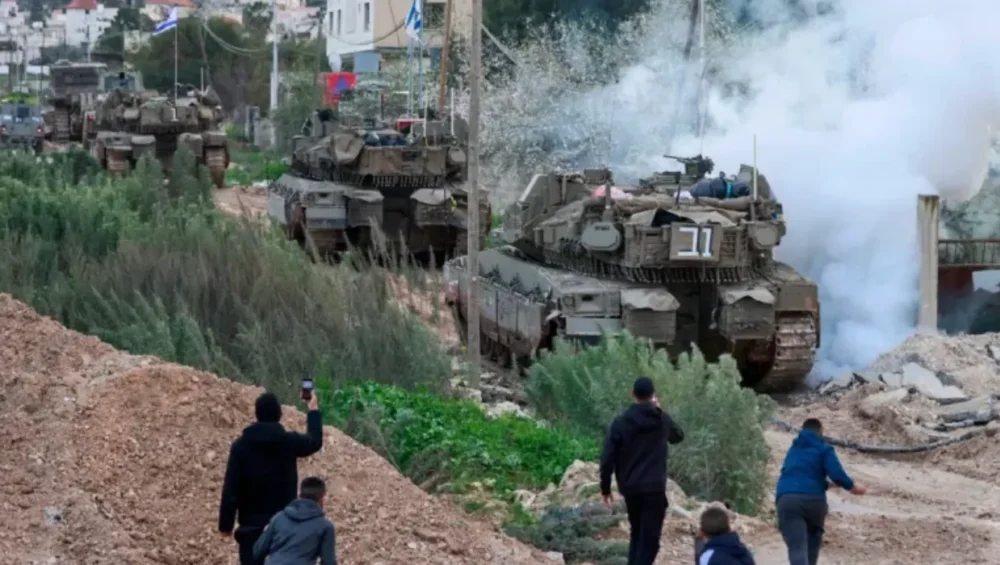
United Nations has issued a warning regarding what it calls possible “ethnic cleansing” in the occupied territory of West Bank, following an Israeli military operation that drove thousands of refugees out of three camps, and prevented them from returning home for over a year. According to a UN human rights office (OHCHR) report published in September 2026, the extent and systematic nature of displacement, in addition to the extensive destruction of property and infrastructure, amount to a crime against humanity of forced deportation and collective punishment under international law.
The report focuses on Operation Iron Wall, carried out in January–February 2025 in Jenin, Nur Shams and Tulkarem (Tulkarm) camps, where more than 33,000 Palestinians remain displaced as of mid‑2026. It is one of the sharpest legal warnings yet from the UN about Israel’s conduct in the West Bank, and it places the emptying of the camps within a broader pattern of rising settler violence, demolitions and forced displacement that UN officials have said has pushed the territory to a “breaking point.”
What happened in the camps: timeline and scale
Three of the camps of focus at the UN level – Jenin, Nur Shams and Tulkarem – are some of the 19 camps in the West Bank that were set up after the Nakba of 1948 to accommodate Palestinians who had been expelled in the process. These camps have always been highly congested, underserved areas managed by UNRWA and have often acted as hotspots of conflicts between armed Palestinian factions and the Israeli forces. From January to February 2025, Israel carried out operation Iron Wall in these camps using airstrikes, armoured bulldozers and controlled explosions. According to the report by the OHCHR, Israeli forces ordered residents to vacate their homes, shut off water and electricity and denied access to humanitarian agencies.
By the end of the major assault, 102 Palestinians were killed, out of which 21 were children, and the three camps alone made up for 46% of the total killings by Israeli forces in the West Bank during the same period. The UN argues that the killings took place amid a series of displacements of the camp population rather than killing the targeted combatants as per the requirements of international humanitarian law. The order was issued by Israel’s defense minister on 23 February 2025 to keep the army at the three camps and not allow the displaced Palestinians to return to their homes. As of July 2026, 18 months later, UNRWA reports that 33,362 people have been displaced from Jenin, Nur Shams, and Tulkarem.
Destruction that outlasted the fighting
The UN report documents extensive physical destruction that went beyond what would be expected from intense urban combat alone. By October 2025, 52% of structures in Jenin camp, 48% in Nur Shams and 36% in Tulkarem were recorded as destroyed or damaged. The OHCHR attributes much of this to the use of heavy weaponry, armoured bulldozers and controlled detonations that flattened blocks of housing and critical infrastructure.
Residents and witnesses told UN investigators that entire neighbourhoods were razed, leaving behind rubble‑strewn streets and collapsed buildings. In several cases, families reported returning briefly to retrieve belongings only to be turned back by Israeli forces, who maintained control over entry points and enforced a de facto ban on reoccupation. This combination of physical destruction and administrative barriers is central to the UN’s legal concerns.
Why the UN is using the term “ethnic cleansing”
The phrase “ethnic cleansing” is not a standalone crime in international law, but it is widely understood to describe policies intended to remove, by force or intimidation, a particular ethnic or national group from a given territory. The OHCHR report does not make a formal judicial finding of ethnic cleansing; instead, it says the facts on the ground
“appear to amount to collective punishment and raise concerns of ethnic cleansing.”
This language is significant because it links the West Bank operations to the most serious categories of violations under international humanitarian and human rights law. The report stresses that using airstrikes, bulldozers and detonations
“in the absence of imperative military necessity”
to make areas uninhabitable and prevent return
“is not permissible under international law.”
In the UN’s view, the pattern suggests an objective beyond temporary security control.
Volker Türk, the UN High Commissioner for Human Rights, went further in public statements, saying the conduct of Operation Iron Wall
“suggests its aim was to expel as many Palestinians as possible and to make way for more illegal Israeli settlements, in further violation of international law.”
He reiterated the International Court of Justice’s earlier determination that Israel
“must end its unlawful presence in the occupied Palestinian territory as rapidly as possible.”
Forcible transfer and crimes against humanity
Aside from the controversial use of terminology such as “ethnic cleansing,” the essence of the crime against humanity that forms the core of the report is the forcible transfer. In accordance with the provisions of the Rome Statute of the International Criminal Court, the forcible transfer refers to the coercive removal of people from territories in which they have lawful residence, and it occurs as part of a widespread or systematic attack targeting civilians.
OHCHR contends that the forced displacements in Jenin, Nur Shams and Tulkarem fit several criteria associated with this definition since they were large-scale (tens of thousands), long-term (no prospect of returning within more than a year), and systematic (using military tactics and destruction of homes and restricting access). Therefore, the above-listed characteristics “give rise to serious concerns of the crime against humanity of forcible transfer.” The reason why this classification is important lies in the fact that crimes against humanity are not restricted to wartime activities and could be prosecuted irrespective of whether there is an international armed conflict or not.
Voices from the camps: residents’ accounts
The UN report includes harrowing testimonies from displaced Palestinians that underscore the human cost behind the legal analysis. Some residents told investigators that Israeli officers explicitly told them
“there would be no more refugee camps”
and that they should “all go to Jordan.” Such statements, if verified, feed directly into concerns about intent to permanently remove a population from its homeland.
Individual cases cited in the report highlight the indiscriminate nature of the violence. Sondos Shalabi, eight months pregnant, was shot dead while trying to drive away from Nur Shams camp. In Tulkarem, 10‑year‑old Saddam Hussein Rajab was shot in the stomach while waiting to go to the mosque with his father. In Jenin, a two‑year‑old girl was shot in the head by Israeli forces while having dinner with her mother and aunt. These incidents are presented by the UN as part of a broader pattern of excessive force against civilians.
A West Bank at a “breaking point”
The evacuation of the three camps did not happen in a vacuum. UN officers and human rights groups have constantly issued warnings during the years 2025 and 2026 about the imminent “tipping point” facing the West Bank in light of the rising violence of settlers, demolition of homes and displacement. August 2026 saw the issuance of briefings in the UN Security Council on the state of affairs in the West Bank, which was described as a “breaking point” with attacks against Palestinians increasing to a record-breaking number and tens of Palestinian communities under threat of extinction. Separate reports in 2026 also mentioned ethnic cleansing dynamics taking place in parts of the West Bank, especially in Area C, as well as in villages facing continuous settler attacks assisted by Israeli forces.
International reaction and legal stakes
The report by the OHCHR adds to the increasing concerns in the international community about Israel’s behaviour in the occupied territories. Whereas some of the Western countries have been criticising the activities of the Israeli military in the West Bank area, most of them have refused to embrace the strong legal terms used by the United Nations to describe these actions. The discussion on crimes against humanity and possible ethnic cleansing creates more pressure on nations to re-examine their supply of weapons, trade relations and support for policies leading to forced relocation. For Israel, the report is an addition to other legal troubles facing it which include the ICJ’s advisory opinion declaring the presence of Israel in the occupied Palestinian territory unlawful as well as ongoing investigations in the International Criminal Court about possible war crimes and crimes against humanity in Palestine.