
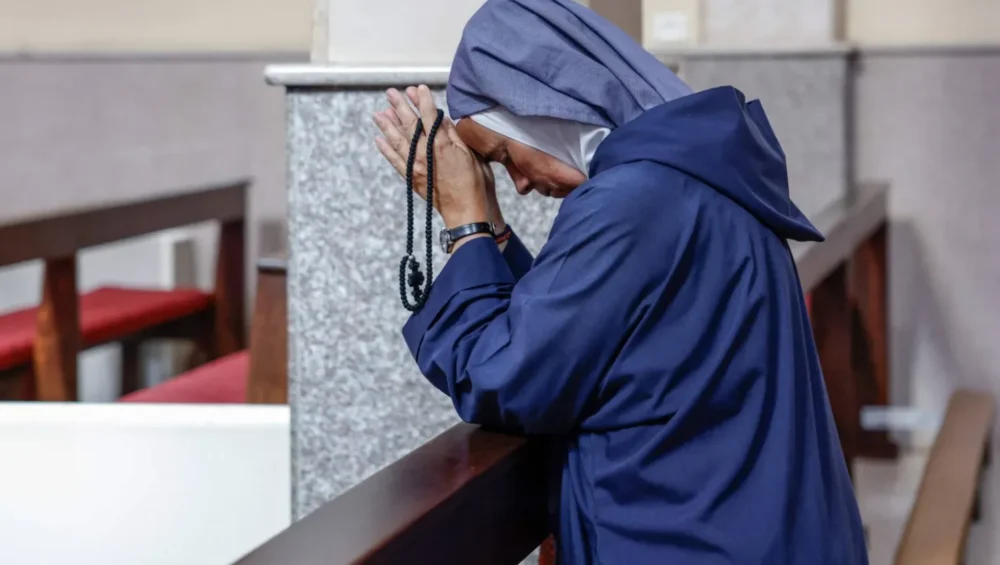
For about two millennia, Palestinians Christians have been present in the land considered by Christians everywhere as the birthplace of their religion. At present, however, this presence that has existed for such a long time is now encountering a demographic crisis that continues to intensify because of violence, war, difficult economic times, and restrictions on mobility. This crisis exists in Gaza, East Jerusalem, and the occupied West Bank.
The Palestinian Christians believe that they are not simply being forced out of their homeland and jobs but are being made to lose the very conditions needed to ensure the existence of their community and stay in touch with their communities in the towns and villages in which they have always lived. It is estimated that there are between 40,000 and 45,000 Christians living in the West Bank, including East Jerusalem. They constitute slightly over 1% of the population, compared to 6% in 1967 when Israel first began its occupation of the area.
The figures reveal a long-term decline, but church leaders warn that the pace of departure has increased since the Gaza war began. Reverend Mitri Raheb, founder and president of Dar al-Kalima University in Bethlehem, believes the current trend could ultimately make the indigenous Christian population unsustainable.
“If the current conditions continue, there will not be a single Palestinian Christian left by 2050,”
Reverend Mitri Raheb said.
Raheb’s prediction is a warning rather than an official demographic forecast. Yet it captures the concern among clergy, researchers and residents that the Christian presence in historic towns such as Bethlehem, Taybeh, Beit Jala and Beit Sahour could become largely symbolic if the political and security situation continues to deteriorate.
Violence turns insecurity into a reason to leave
An immediate concern for many Palestinian Christians is the prevalence of violence in the West Bank. Following the Gaza War in October 2023, the presence of settler attacks has been an increasingly common occurrence in Palestinian life, with military and checkpoint activities increasing. Christians are equally affected by attacks, movement limitations and economic hardships as other Palestinians. Church leaders claim that the consequences are particularly damaging for small Christian communities where even minimal emigration may undermine local organizations, businesses and parishes.
Taybeh, located east of Ramallah, is generally regarded as being the only remaining wholly Christian town in the West Bank. Since 2023 more than 15 families have already left the town, according to church documents. The population of Taybeh is currently thought to be about 1,200, compared to some 3,000 residents in the 1980s.
The town has repeatedly faced attacks allegedly carried out by Israeli settlers. Residents have reported damage to farmland, private property and religious sites. Father Bashar Fawadleh, the Latin parish priest in Taybeh, said the combination of insecurity and economic pressure was forcing families to reconsider their future.
“The daily suffering caused by the lack of security,”
Father Bashar Fawadleh said, is pushing residents to reconsider whether they can continue living in Taybeh.
The problem extends beyond one town. The United Nations Office for the Coordination of Humanitarian Affairs has documented widespread settler violence across the West Bank, including attacks causing Palestinian casualties and property damage. OCHA reported that more than 50 settler attacks occurred in a single week in May 2026, damaging homes, farmland, vehicles and a mosque.
In a July 2026 report, OCHA described continued displacement, military operations and deteriorating humanitarian access across the occupied Palestinian territory. Although the organisation’s statistics cover Palestinians as a whole rather than Christians alone, they demonstrate the wider environment in which Christian communities are attempting to survive.
Gaza’s Christian community nearly disappears
The most dramatic collapse has taken place in Gaza. Before the current war, estimates placed the territory’s Christian population at approximately 1,000 people. Current estimates indicate that only about 600 Christians remain in the enclave, whose total population exceeds two million.
There are three main churches in the community: the Greek Orthodox Church of Saint Porphyrius, the Roman Catholic Church of Holy Family and the Gaza Baptist Church. The years of blockade, high unemployment rates, isolation and constant warfare had already forced many Christian families to leave Gaza. The ongoing conflict has further increased the exodus of Christians due to the bombings, displacement of population, death, hunger, demolition of houses and places of worship.
The Greek Orthodox Church of Saint Porphyrius became a landmark of the risk faced by Gaza’s Christians when a bomb hit the vicinity of the church in October 2023. Displaced people sought refuge in the church. According to the report of the United Nations Commission of Inquiry, 19 people were killed, out of which 8 were children and 5 were women, and other people were wounded. Israel has justified the attack stating that the bomb hit a Hamas’ building near the church instead of the church. The Roman Catholic Church of Holy Family, the only Catholic parish in Gaza, was bombed in July 2025. There were 3 fatalities and some injuries including the parish priest.
The attacks intensified international concern over the survival of Gaza’s Christian community. The UN Commission of Inquiry has also investigated damage to religious and cultural sites across Gaza, raising questions about whether attacks were proportionate and whether civilians sheltering in protected locations were adequately safeguarded.
For Gaza’s Christians, departure is often not an abstract choice between two lifestyles. It is a decision shaped by survival. Families must decide whether to remain amid continuing danger or seek entry to countries where relatives can offer safety, accommodation and employment.
A crisis extending beyond violence
While violence may serve as a very strong motive, it would be erroneous to attribute the exodus of Palestinian Christians to only one factor. The problem has been evolving during several decades and relates to the combination of occupation, economic problems, instability, demographic changes, familial issues and other factors. A 2020 survey conducted by the Palestinian Center for Policy and Survey Research showed that 35% of Palestinian Christians living in the West Bank were thinking of emigrating.
Such motives for moving abroad as economic situation, educational possibilities, security, political stability and gaining more freedom have been stated. The survey also revealed that the tendency to emigrate was two times higher among Christians than Muslims. Besides, the Christian community is older than the Muslim one. PCPSR states that 39% of Palestinian Christians were over 50, while only 21% of Muslims were of that age.
Economic pressures are particularly important. Restrictions on movement make it more difficult for Palestinians to reach jobs, universities, hospitals and markets. The loss of access to land and employment has weakened traditional Christian centres that once relied on tourism, agriculture, small businesses and church-linked institutions.
OCHA reported that West Bank unemployment remained about 28% at the end of 2025, more than twice the pre-October 2023 level of 13.4%. Access to employment in Israel also remained sharply below its pre-war level, with approximately 50,000 West Bank workers regaining access compared with more than 177,000 before the war.
For young Christians, the calculation is increasingly practical. Remaining may mean limited employment, restricted travel and uncertain personal security. Leaving may mean access to universities, professional careers and a more predictable future.
The role of diaspora networks
Emigration among Christians from Palestine is not new. Many instances of emigration have occurred since the 18th century, especially to Latin America, North America, and Europe where substantial populations are now settled. It is estimated that there are at least 40,000 people of Palestinian origin in Chile alone, most of whom are Christians. Diasporic communities enable Christian families to emigrate easier compared to some other Palestinians because family members living abroad are able to offer financial support, sponsorship, lodging, and jobs. The Palestinian foreign minister of Armenians who is a Christian, Varsen Aghabekian Shahin, said that Christian families had better networks abroad.
“The decline in the Christian population in the West Bank, including east Jerusalem, should ring a very serious alarm bell for the Christian world,”
Varsen Aghabekian Shahin said.
The existence of these networks creates a cycle of departure. As young people leave, families become separated, schools lose students, parishes lose worshippers and local businesses lose customers. Those who remain may then find fewer reasons to stay.
Pressure in Jerusalem
East Jerusalem presents a separate but connected challenge. Christian clergy and institutions have reported spitting, verbal abuse, physical assaults, vandalism and attacks on religious property. The Rossing Center recorded 155 incidents targeting Christians or Christian institutions in Israel and East Jerusalem during 2025. The organisation’s report included 61 physical attacks, 52 attacks on church property, 28 cases of harassment and 14 incidents involving defacement of Christian signs.
Not all of these incidents targeted Palestinian Christians specifically. Some involved foreign clergy, pilgrims or Christian institutions. Nevertheless, church officials say the pattern creates a hostile environment for the wider Christian community.
Jerusalem’s Christian presence is also affected by political and territorial disputes, changes in property ownership, pressure on church institutions and restrictions on access. Christian leaders say that protecting holy sites alone is insufficient if the communities that maintain them are gradually forced out.
Competing political narratives
The crisis has generated sharply different explanations.
Palestinian officials and church leaders argue that Israeli occupation, settlement expansion, military restrictions and settler violence are central causes of the exodus. They say that policies affecting Palestinian land, movement, housing and economic access can produce displacement even when Christians are not explicitly targeted because of their religion.
Israel refutes the allegation that its policies are geared towards forcing out the Palestinian Christians. Israel always maintains that freedom of worship is respected while attacks by individual settlers are viewed as criminal activities and not government policy. When it comes to churches, Israeli officials maintain that military attacks were aimed at Hamas or other terrorist factions and not targeting the religious establishments. The Israeli military maintained that the Saint Porphyrius incident involved a target near the church.
After the attack at Holy Family Church, Israeli officials termed the incident as accidental and promised investigations. On the part of the critics, they maintain that an investigation will not provide answers on the issue of accountability, proportionality and the protection of civilians taking refuge at the religious compounds. The Palestinian Authority also gets criticized. Christians blame corruption, poor governance, unemployment, ineffective security agencies and lack of rule of law for the decline in the number of Christians in Palestine. In Gaza, the political and military domination by Hamas, frequent clashes and isolation of the area are also some of the causes of the Christian community’s decline.
The 2020 PCPSR survey reflected this complexity. While most respondents did not report routine harassment by Muslim neighbours, schools or workplaces, some expressed concern about hardline Islamic groups, armed factions and social pressures. Many also criticised Palestinian political institutions and questioned whether authorities could provide security or economic opportunity.
What is at stake
The situation facing Palestinian Christians is much more than a demographic problem. Churches are a very important part of the history, education and politics of Palestine. Many of their institutions including hospitals, charities, schools, churches and civic groups have helped to serve both Christians and Muslims. The churches and other Christian institutions in Bethlehem have also been an important element in the identity of the city as a tourist destination.
If the number of local Christians keeps declining, it is possible that churches will become historical landmarks with no locals to maintain them as functioning institutions. The most crucial issue then is not whether Palestinian Christians will be able to continue practicing their religion in the Holy Land. It is whether they will be able to live in peace, have a voice in the government, opportunities for work and a future for their kids. The existing evidence suggests that the situation faced by Palestinians is quite difficult. Violence is helping them leave the country, but the main problem is structural – occupation, war, movement restrictions, economic decline, political failure and demographic aging are working together.
Unless those conditions change, the departure of Palestinian Christians will continue—not as one dramatic evacuation, but as a steady erosion of one of the oldest Christian communities in the world.