
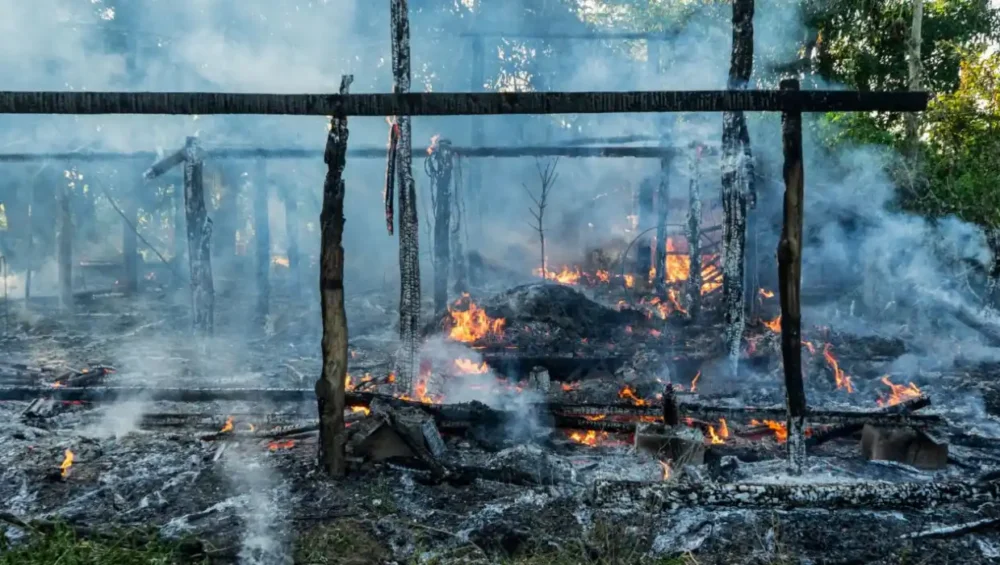
Myanmar’s military intensified air attacks on civilian areas in the months before and during the country’s military-managed election, creating a stark contradiction between the junta’s claims of political normalisation and the reality of continuing war crimes.
Elections were carried out in three stages from December 2025 to January 2026, almost five years after the military coup against the democratically elected government in February 2021. These elections were carried out amid a war situation where the army, along with ethnic armed groups and several anti-junta resistance forces, were part of an ongoing fight. Certain areas of the nation were out of bounds for the voting process due to war-like situations and being under either military or resistance administration. The Independent Investigative Mechanism for Myanmar, which is an investigation mechanism that has been formed by the United Nations for gathering evidence for future prosecution, mentioned that there had been attacks on civilians throughout the year till June 2026.
This finding is important since it links the military campaign of violence with the political process the junta claimed would bring back civilian rule. Instead of providing the opportunity for political participation, the election period has been characterized by airstrikes, arrests, intimidation, and the exclusion of major opponents. Credible sources have confirmed a minimum of 702 civilian deaths in the period from the military’s announcement of the election in August 2025 to its completion in January 2026.
Among those who died, 476 perished as a result of airstrikes with 111 civilian deaths in the period prior to voting starting in December 2025. From December 2025 to January 2026, 228 civilian deaths were confirmed by the U.N., out of which 183 deaths occurred as a consequence of airstrikes. The UN Human Rights Office found that there were more than 400 military airstrikes in the period of voting with 170 civilians killed in the attacks.
Civilian targets and low-altitude attacks
The IIMM said the military increasingly used low-cost aircraft, including paramotors, gyrocopters and drones, to conduct low-altitude attacks with unguided explosives. These weapons are particularly dangerous when used in or near populated areas because they are less accurate and provide civilians with little warning.
Investigators are examining reports that pilots in Sagaing Region switched off their engines before reaching their targets, allowing aircraft to glide silently toward villages. If confirmed, such tactics would raise serious questions about whether the attacks were designed to maximise surprise and civilian casualties.
The mechanism has further found instances where there were attacks on areas where there did not seem to be any apparent military target. According to international humanitarian law, the warring parties have an obligation to make distinctions between civilians and combatants as well as between civilian and military targets. Attacks on civilians, indiscriminate attacks, and disproportionate attacks might amount to war crimes. The alleged attacks did not confine themselves to individual villages.
As per the IIMM, the aerial campaign of the military had impacted the schools, places of worship, health facilities and the displacement camps – all places where the civilian population is highly vulnerable and children, medical practitioners, and displaced persons can be expected to be present. Between June and September 2025, in Karenni State and the Karenni-Shan State border, Fortify Rights found 12 airstrikes which resulted in the deaths of at least 55 civilians, injuring over 40 individuals and damaging schools, churches, medical clinics, displacement camps, and houses.
The U.N. has also reported that children remain among the principal victims of the military’s air campaign. The IIMM said children had been killed or injured in at least 640 airstrikes between the February 2021 coup and 2025, although the available figure is likely an underestimate. In May 2026, the mechanism said an attack on a village playground in Chin State killed at least five children, including a five-month-old baby.
Torture, sexual violence and killings
The aerial attacks form only one part of the alleged abuses documented by U.N. investigators. The IIMM said all sides in Myanmar’s civil war had committed war crimes and serious violations during the reporting period, including torture, sexual violence and unlawful killings. The military and allied militias were accused of arbitrary arrests, prolonged detention, torture, sexual violence, executions and attacks on civilian communities. Investigators are examining allegations of rape, including gang rape, in military-run detention sites and conflict-affected areas.
Political prisoners and people suspected of supporting resistance movements have reportedly faced beatings, electric shocks, deprivation of food and medical treatment, forced confessions and other forms of abuse. These allegations are particularly serious because many detainees are held incommunicado, making independent verification difficult and increasing the risk of further mistreatment. The mechanism is also investigating the killing of civilians and detained combatants. Its mandate requires it to examine crimes committed by the military as well as by armed groups fighting against the junta. In one earlier assessment, IIMM head Nicholas Koumjian said there was evidence that both military and opposition forces had summarily executed civilians accused of being informers or captured combatants.
In the context of the broader investigation, Koumjian said,
“Civilians must not be targeted and captured fighters must not be tortured or executed.”
His statement underlined the principle that the alleged crimes of one side cannot legally justify similar violations by another.
Rakhine State and the Rohingya
Rakhine State remains among the most hazardous battlefields. As per the report from the International Independent Investigative Mechanism for Myanmar (IIMM), it was investigating claims of violations involving the Myanmar military, Arakan Army and other parties. These violations include bombardment by air, torture, rape, killings, using civilians as human shields and denial of humanitarian aid. In particular, the Rohingya minority is most vulnerable. As indicated in the UN report, around 150,000 Rohingyas have recently fled to Bangladesh. Others are trapped in the state, living under restrictions on movement, insecurity, lack of basic necessities and humanitarian aid.
There is a resemblance between these violations with those carried out against Rohingyas in 2017, which resulted in the flight of over 700,000 people to Bangladesh due to military crackdown, with genocide motive according to UN reports. However, the recent allegations cannot be used to confirm the same legal classification; however, these abuses have raised concerns of another humanitarian crisis.
The humanitarian consequences extend across the country. The post-coup conflict has displaced approximately 3.6 million people, according to figures cited in reporting on the election and the continuing war. Airstrikes have destroyed homes and essential facilities, while restrictions on aid have intensified the effects of displacement and food insecurity.
Election, repression and military rule
The election produced an overwhelming victory for the military-affiliated Union Solidarity and Development Party. State-media results cited by Reuters showed the party winning 232 of 263 lower-house seats and 109 of 157 declared upper-house seats at the time of reporting. The military also retains a guaranteed 25% of parliamentary seats, preserving its constitutional influence over the legislature.
Voting took place in only 263 of Myanmar’s 330 townships. Major opposition parties, including Aung San Suu Kyi’s National League for Democracy, were dissolved or excluded. Many ethnic areas and conflict zones were unable to participate, while Rohingya communities were largely denied meaningful political representation. The U.N. said the vote was conducted in an atmosphere of fear. A military-imposed election-protection law was used to criminalise criticism of the process, including online speech. The U.N. reported arrests involving 324 men and 80 women under the law before the final voting phase. In one case, a person reportedly received a 49-year prison sentence for posting anti-election material. More than 100 villagers in Sagaing Region were reportedly detained and forced to cast advance ballots. If confirmed, such conduct would demonstrate how coercion and military control were used to manufacture participation while armed attacks continued outside the polling stations.
U.N. rights officials therefore rejected the idea that the election represented a credible democratic transition. James Rodehaver, head of the U.N. rights office’s Myanmar team, said,
“These elections did not prevent violence from continuing throughout 2025.”
He added that 2025 was the deadliest year for civilians killed by airstrikes since the coup.
According to the U.N. High Commissioner for Human Rights, Volker Türk, the army is trying to maintain its hold on power through oppression. He pointed out that the junta was
“using violence to entrench its rule, having forced people to vote at gunpoint.”
He added that compulsion, exclusion and ongoing insecurity made the election
“incompatible with the enjoyment of civil and political rights protected internationally.”
For the military, however, the election was an
“indispensable part of establishing stability and eventually transferring the administrative duties to an elected government.”
It has considered the opposition to the coup as a terrorist movement and carried out military actions as counterinsurgency operations. This does not release the military from its international responsibilities. In military action against such organizations, precautions should be taken in order to minimize civilian casualties.
Accountability remains the central challenge
The IIMM cannot be considered a court of law. It basically aims at collecting, preserving and analyzing evidence so that this evidence can be used later by prosecutors and courts. The investigation is not only conducted regarding the attacks, but also the structures and chain of command which could possibly link high-ranking officials to crimes committed by subordinate units. The Mechanism claims that it managed to collect evidence from over 1,600 sources, including 756 testimonies, and provided 146 packages of evidence and analysis for the national and international authorities.
This information consists of photos, videos, satellite images and forensic evidence. The legal issue is not just about whether civilians died or not. The investigators have to prove that the commanders either knew about or should have known about the illegal actions, that attacks were planned or predictable, and whether those involved in them tried to take measures to prevent or punish the crime. The possible crimes under investigation include murder, torture, rape, sexual violence, deportation or displacement, persecution, imprisonment and attacks on civilian objects.
The IIMM has shared evidence with authorities connected to proceedings before the International Criminal Court, the International Court of Justice and national courts. However, prosecutions face major obstacles, including limited access to Myanmar, the absence of suspects before courts, witness-protection concerns and the continuing risk of evidence destruction. The mechanism has also faced funding and staffing pressures. Its July 2026 bulletin reported a reduction in regular-budget staff positions and a significant decline in personnel funded through voluntary contributions compared with the previous year. Such constraints could slow investigations at a time when the alleged crimes are expanding.
Myanmar’s election has therefore changed the political framework without resolving the war. The U.N. evidence indicates that the military used air power, detention and legal repression to control territory and restrict dissent, while some anti-junta and ethnic armed groups also face allegations of serious violations.
The central conclusion is clear: the election was held under conditions in which civilians were not protected from attack, political opponents were excluded or imprisoned, and millions remained displaced. For the U.N. investigators, accountability cannot be postponed until the conflict ends. The evidence being collected today is intended to determine who ordered the attacks, who carried them out and whether Myanmar’s victims will ultimately see justice.