
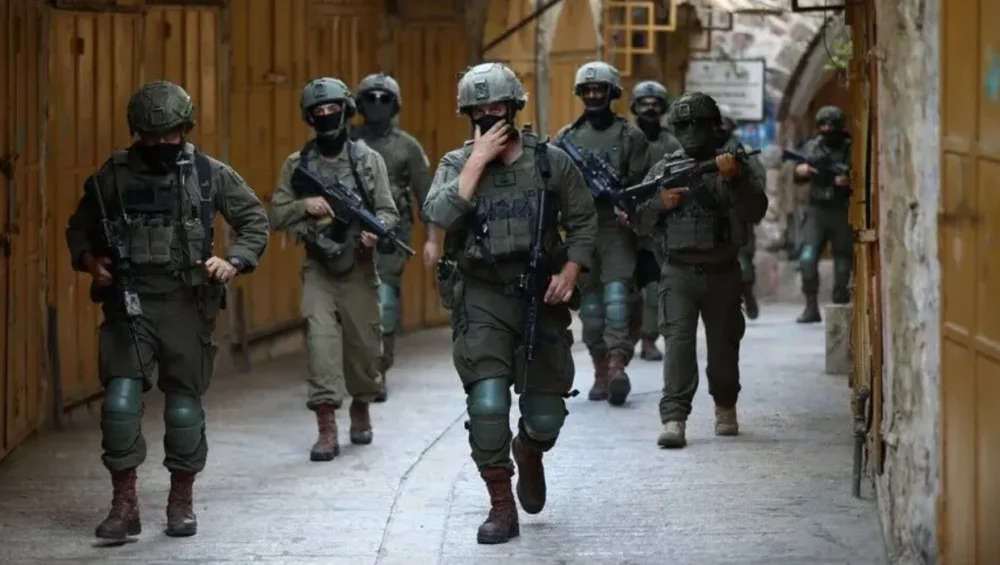
In the pre-dawn hours of August 11, 2026, Israeli forces blew up the third floor of a residential building belonging to Farouk Ramadan in the West Bank town of Tal (Tell), southwest of Nablus, less than three weeks after he was killed while confronting Israeli occupiers and settlers. The operation came after soldiers raided the area, forced residents of several nearby homes to evacuate, and then detonated explosives inside the structure, according to Anadolu’s correspondent and local monitors.
The destruction is regarded by Palestinian sources as an act of punishment, as a result of a fatal shooting on July 24 in the village of Tal, in which four Palestinians have been killed and four others wounded in a shooting by Israeli security personnel and settlers. According to local sources, Ramadan, who was not armed, got a weapon from the hands of a settler in the course of the conflict and shot two Israelis until he himself was killed.
The incident that triggered the order
The July 24 incident in Tal has come to represent a flashpoint between competing narratives around violence, accountability, and collective punishment within the occupied West Bank. According to Palestinian accounts, the incident was precipitated when settlers, together with Israeli military forces, entered the village and were engaged in a confrontation resulting in four Palestinian casualties, identified locally as Farouk Adnan Ali Ramadan, 41, Ibrahim Hussein Ali Ramadan, 32, Jawad Hussein Ali Ramadan, 27, and Imran Ahmad Ali Ramadan, 37, and four wounded, some seriously. According to the Israeli account, there were two Israeli casualties: IDF officer Maj. Yuval Ezra, 27, and civil defense squad member Master Sergeant (res.) Benayahu Mellet, 32, killed in the crossfire exchange.
The IDF states that Ramadan “grabbed a weapon from an Israeli security officer and shot him.” It is thus portrayed as a lethal incident which necessitated punishment according to pre-established policy. In the context of Palestinian families and human rights organizations, the demolition of Ramadan’s house is not simply a single incident; it is one example among many where houses of whole families are demolished as punishment for actions of a single person, often deceased.
How the demolition unfolded
On the night of August 10 and into the morning of August 11, Israeli troops moved into Tal with dozens of military vehicles, surrounding the three-story building and deploying engineering units to plant explosives, according to reporting and Palestinian media. Residents described being ordered to evacuate within 72 hours after earlier notices, with some families given only hours to leave before the detonation.
According to Anadolu’s reporter,
“soldiers forced residents of several nearby houses to evacuate before demolishing the third floor of Ramadan’s house.”
Pictures and reports from the site revealed smoke and debris caused by the explosion, with damage sustained by the upper floor where Ramadan’s family resided, although their parents’ lower-floor apartments were untouched except for the effects of the blast. The demolition was done in accordance with an order made by Maj. Gen. Avi Bluth, the chief of the IDF’s Central Command, who authorized the demolition after Ramadan’s family appealed their demolition decision. Their appeal was rejected by the IDF, giving them the only choice to file an appeal before Israel’s High Court, an effort that seldom stops demolitions after the arrival of engineering units.
A policy of punitive demolitions
Israel’s practice of demolishing the homes of Palestinians accused of deadly attacks is a longstanding security policy that rights groups and UN bodies condemn as collective punishment prohibited under international humanitarian law. The military’s stated rationale is deterrence:
“As a matter of policy, Israel demolishes the homes of Palestinians accused of carrying out deadly terror attacks,”
the IDF said in statements around the Tal operation.
But for Palestinian communities, the effect is displacement and trauma. In Tal, the demolition notice required the family to evacuate their three-story house, upending daily life and leaving the structure partially uninhabitable even where it was not fully destroyed. Similar operations have been documented across the West Bank, including in Qalqilya, East Jerusalem, and Hebron, where homes of accused attackers have been razed even after the alleged perpetrators were killed in confrontations.
Human rights organizations argue that these demolitions punish families who had no role in the alleged act, violating the principle of individual responsibility. The Norwegian Refugee Council noted that Israel carried out 37 punitive demolitions in 2025, matching the 2023 record, underscoring how the practice has intensified alongside broader West Bank violence.
Escalation of demolitions across the West Bank
The Tal demolition sits within a wider surge in the destruction of Palestinian homes and structures across the occupied West Bank, occurring alongside illegal settlement expansion and the establishment of new outposts, according to Palestinian sources and UN monitors.
During the same time, Israeli troops started to destroy an estimated 20 Palestinian shops and houses in the village of Anza, located south of Jenin, on the grounds of unauthorized construction without Israeli permits. According to activists, such claims are commonly made despite the fact that Israeli permit procedures make it almost impossible for Palestinians to acquire permits under the planning system in Area C and East Jerusalem. UN and NGOs’ figures indicate a dramatic increase in demolitions and displacement since the outbreak of the Gaza war on Oct 8, 2023.
According to OCHA, from January 1, 2023 to April 30, 2026, a total of 805 Palestinian structures have been destroyed in the West Bank, leading to the displacement of at least 2,040 Palestinians. In just the first six weeks of 2026 alone, an estimated 312 residential and agricultural structures have been demolished, impacting some 21,000 Palestinians, according to Amnesty International and Jerusalem Center for Legal Aid and Human Rights. Analysis of satellite images by Human Rights Watch showed that in the northern refugee camps of Jenin, Tulkarem, and Nur Shams alone, at least 850 homes were either destroyed or seriously damaged in Israeli operations in 2025-2026.
OHCHR has repeatedly warned that such demolitions, combined with settlement expansion, are part of steps to consolidate annexation of the West Bank, including East Jerusalem.
Casualties, arrests, and the human cost
Palestinian figures cited in local and international reporting indicate that since the start of Israel’s Gaza war on Oct 8, 2023, Israeli forces and occupiers have escalated attacks in the West Bank, killing more than 1,183 Palestinians, injuring around 13,000, and arresting nearly 25,000. These tallies include deaths from raids, settler attacks, and clashes, with UN human rights experts condemning a sharp escalation in killings and demolitions during July 2026 alone.
The human cost extends beyond fatalities. Families displaced by demolitions face loss of shelter, livelihoods, and community networks, while arrests and detentions disrupt education, employment, and family stability. In Tal, the demolition of Ramadan’s home not only erased a family residence but also sent a signal to the wider community that confrontations with settlers and soldiers can trigger collective penalties long after the immediate violence ends.
International reactions and legal framing
UN human rights experts have condemned the sharp escalation of attacks on Palestinian civilians across the occupied territories, noting that systematic destruction of homes and barriers contributes to forced displacement and annexation dynamics. OHCHR has stated that mass demolitions and settlement expansion in the West Bank violate international law and amount to steps toward annexation, urging Israel to halt such practices.
According to Amnesty International, the massive demolition of camps and evacuation of residents in Jenin and Tulkarem is a result of forced mass displacement caused by making areas uninhabitable and a violation of civilian rights during occupation. On their part, the Norwegian Refugee Council and other NGOs point out how permits and demolitions combine to create displacement of Palestinians and aid the growth of settlements, especially in Area C, which is fully controlled by Israel regarding planning and building activities. The Israeli side insists that demolitions are legal actions to combat illegal building or security actions to prevent attacks on the part of Palestinian civilians.