
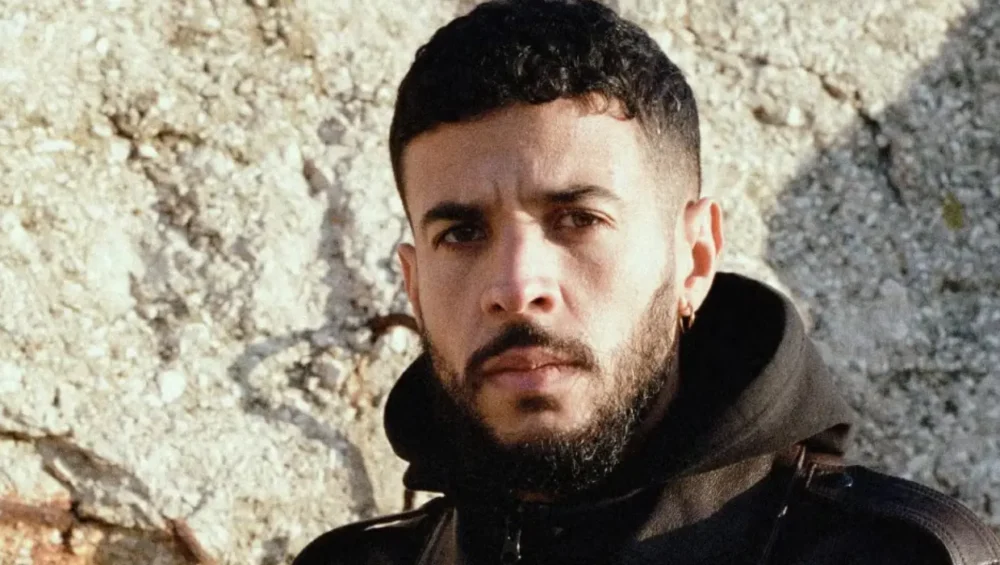
The pre‑trial detention of Moroccan rapper and documentary filmmaker Mehdi Lyoubi, better known as Mehdi Black Wind, has become a sharp test of Morocco’s tolerance for dissenting voices and artistic critique. The 34‑year‑old artist, now Mehdi Lyoubi imprisoned for insulting royalty, is being prosecuted under speech‑related offenses that human rights organizations describe as fundamentally incompatible with basic freedoms of expression.
Lyoubi’s story from being a Marseille rapper to becoming a figure representing the tensions of authority in his homeland shows that artistic discourse can be as quickly tied up with the one issue that remains the most explosive topic in Morocco: the monarch himself. This case does not arise in a vacuum but in a context where tensions arise between the younger generation of bloggers and social media activists and an old regime.
A Rapper, Filmmaker and Political Critic
Mehdi Black Wind’s Profile and Work
The reputation of El Mahdi Lyoubi over the last decade has been built around his status as a musician and a filmmaker who does not hesitate to incorporate personal narrative into political commentary. Most of his works were created from France, primarily Marseille, where he has developed a unique personality that is, on the one hand, firmly grounded in Moroccan reality, but, on the other hand, openly critical toward the state of the country and its ruling hierarchy. The very name, “Mehdi Black Wind,” testifies to his dark and stormy creative identity, which he applies both in his music lyrics and in his films. Social exclusion, corruption, and oppression imposed by the oppressive system become common topics of his musical performances and documentaries. The monarch himself is not portrayed in them as a detached figure but as an integral part of the system of inequality and oppression.
Engaging with Youth Movements and Digital Dissent
Most recently, however, Lyoubi became known as part of the rising youth protest movements, including the generation Z-led protest trend that challenged economic stagnation, unemployment, and power centralization. The support Lyoubi gave to the movements went further than just the music itself since he commented on the way the protests were managed by the police and more generally on the environment of fear when speaking out against the royal prerogatives. It means that the social media comments and statements made by the rapper in this context were not only the artistic ones. When a popular rapper makes references to the symbols of violence perpetrated by the state such as Tazmamart, the effect is additionally strengthened by the digital network dynamics.
The Arrest in Casablanca: Timeline and Procedure
From Airport Interception to Police Custody
Lyoubi’s current legal ordeal began while he was in Morocco for documentary work. As he prepared to board a flight back to Marseille, police blocked him at the airport and served him with a summons. The move signaled that whatever had been circulating online had crossed a threshold in the eyes of the security services; he was no longer just a vocal artist abroad, but a suspect now physically within reach.
He was ordered to report to the National Brigade of Judicial Police (BNPJ) headquarters in Casablanca, where he underwent interrogation. After the questioning, he was placed in police custody rather than released, a decision that immediately raised concern among rights advocates who follow freedom of expression cases in the country. Pre‑charge custody in such contexts often indicates that prosecutors intend to rely on broad, speech‑related provisions to justify continued detention.
Transition to Pre‑Trial Detention
In less than a week, Lyoubi appeared before the public prosecutor and a judge in Casablanca. The court sentenced him to pre-trial detention in Oukacha prison, which has often been in the news regarding political or freedom of speech cases. Pre-trial detention is crucial as he has not been sentenced yet but his freedom is restricted based on the allegations against his speech and art. His next hearing was rapidly set up, showing how swiftly the judicial system works in such cases when it comes to the monarchy and the monarchy’s image. But swift action does not mean openness in terms of information. The authorities have been very careful regarding the full list of the indictment as they prefer to keep silent about it, leaving rights organizations and his lawyers to speculate on it based on articles of the penal code and his work.
Charges and Legal Framework: Criminalizing Critique of Royalty
Offending the King and Inciting Offenses
The heart of the case lies in charges related to insulting or offending the monarchy. Moroccan law includes specific provisions that criminalize “offending the king or crown prince,” with penalties that can extend to multiple years in prison. In addition, prosecutors can rely on articles that punish “offending a constituted body” and “inciting the commission of offenses” in relation to public institutions and authorities.
Applied to Lyoubi, these provisions transform expressions of critique into legally actionable offenses. His lyrics, visual storytelling and social media commentary are treated not as political speech or artistic exploration, but as attacks on the dignity of the king and incitement against the constitutional order. In effect, the law elevates the protection of royal reputation above the principle that citizens, including artists, should be free to question and challenge those who wield power.
Human Rights Perspective on Speech‑Related Charges
On the human rights front, such offenses are generally regarded as being against international standards. The idea that the head of state needs protection from any form of sharp or offensive criticisms is inconsistent with human rights instruments such as the International Covenant on Civil and Political Rights. To the organizations such as Human Rights Watch, the above case provides a good example of the above conflict. As per HRW, the use of criminal laws for the purpose of protecting insult on royalty makes healthy political discussion a crime of police. According to their views, what happened to Mr. Lyoubi is just one instance where defamatory and “insult” laws are used to deter any form of criticism of the monarchy.
Invoking Tazmamart: A Dangerous Historical Memory
Tazmamart and the “Years of Lead”
The most symbolically charged element in Lyoubi’s case is his invocation of Tazmamart, the notorious secret prison that operated in Morocco from the mid‑1970s through the early 1990s. Tazmamart housed officers and political prisoners accused of plotting against King Hassan II, particularly after failed coup attempts. For years, its very existence was officially denied, even as testimonies and investigations exposed its reality.
Conditions inside Tazmamart were extremely harsh. Prisoners were confined to tiny, dark cells, deprived of adequate food, healthcare or basic human contact. Many died from illness, starvation, or the cumulative effects of systematic cruelty. The site was a physical embodiment of the “years of lead,” a period marked by enforced disappearances, torture and heavy‑handed clamping down on opposition. The eventual closure of Tazmamart and release of survivors did not erase its memory; it became a shorthand for the monarchy’s most brutal phase of dealing with dissent.
Why Referencing Tazmamart Is Politically Explosive
In that context, Mehdi Lyoubi’s reference to Tazmamart carries a charged meaning. By invoking the prison in the course of criticizing royal power and contemporary repression, he effectively draws a line of continuity between past secret‑prison abuses and current methods of silencing critics. He suggests that the mentality of the “years of lead” has not disappeared, even if the building itself has.
Politically speaking, this constitutes a challenge to a prevailing paradigm where Morocco is presented as one that has emerged from this era, undertaken reforms, and developed a new image with regards to respect for its citizens’ rights under King Mohammed VI. By making a comparison between the current situation and the Tazmamart era, an artist challenges the legitimacy of King Mohammed VI and the morality of this state’s claims of progress. For a monarchy which draws much of its strength and identity from symbolic capital and foreign recognition of its reforms, such comparisons are out of the question. They do not challenge just internal image but external perception. Hence, a provocative statement turns into a reason to file criminal charges against the artist. The sensitivity of the regime to this memory proves that this chapter of history is far from being solved.
Competing Narratives: State Justification vs. Rights Critique
Authorities’ Rationale for Detention
From the authorities’ perspective, Lyoubi’s arrest and detention are justified under the existing legal framework. Prosecutors argue that his statements and content cross into deliberate offense against the king and incitement against public institutions. They cast their actions as enforcing the law rather than suppressing expression, insisting that the monarchy, like other institutions, must be protected from slander and destabilizing attacks.
In official discourse, stability and respect for constitutional institutions are often presented as paramount values. When a high‑profile artist criticizes the monarchy in harsh terms or draws inflammatory historical parallels, the state can claim it is acting to prevent erosion of public order. In that framing, pre‑trial detention becomes a tool of lawful discipline, not political intimidation.
Human Rights and Civil Society Response
But members of civil society have a different take on the matter. In their view, the case represents the classic example of the application of broad speech offenses in the suppression of dissenting voices. The human rights groups demand the release of Lyoubi and the abolition of the laws that define offending the monarch as a criminal offense. The latter, according to them, should be protected as an indispensable part of democracy, which implies the right of citizens to criticize those who represent the political system. Besides, there is another aspect that should be mentioned here, namely that the case of Lyoubi is just one more example in the series of cases of journalists, activists, and other artists. There have been numerous prosecution cases based on the posts or commentary on social media and even satire on sensitive issues recently.
Youth, Monarchy and the Future of Free Expression
Generational Fault Lines
The controversy around Mehdi Lyoubi highlights generational fault lines in Moroccan politics. Younger citizens, raised in a digital environment and exposed to global debates on rights and accountability, are less inclined to accept absolute taboos around criticising power, including royal authority. For them, drawing parallels with Tazmamart or questioning the sanctity of the king’s image can be part of legitimate discourse.
The state, however, still operates with a legal and political culture shaped by earlier decades, in which the monarchy’s status is quasi‑untouchable. While constitutional reforms and public messaging have updated the formal narrative, the underlying reflexes—especially when dealing with harsh criticism—remain conservative and punitive. Lyoubi’s case thus becomes a high‑profile moment where these contrasting expectations collide.
Implications for Artistic Freedom and Political Space
The implications for artists and authors from this legal action could not be more clear. If citing historical injustices or calling into question the monarch’s accountability results in a prison sentence before trial, the parameters of acceptable artistic expression will have been severely curtailed. Censorship from oneself will become the logical choice, and room to ask hard questions through art will have been eliminated. From a political perspective, this legal battle may well chill free speech, but it may also serve to unite activists. In the case where the artist’s arrest is widely viewed as unfair treatment, it could very well spur activists to scrutinize the rights afforded to their king in terms of international human rights laws.
A Symbolic Case at the Intersection of Memory and Power
Mehdi Lyoubi’s imprisonment for allegedly insulting royalty is about far more than one rapper’s controversial statements. It sits at the intersection of historical memory, legal structures and a changing social landscape. By invoking Tazmamart, he forced a between the legacy of Morocco’s “years of lead” and the monarchy’s current narrative of reform and modernization. The state’s response—deploying criminal charges and pre‑trial detention—suggests that some memories remain too dangerous to be freely articulated.