
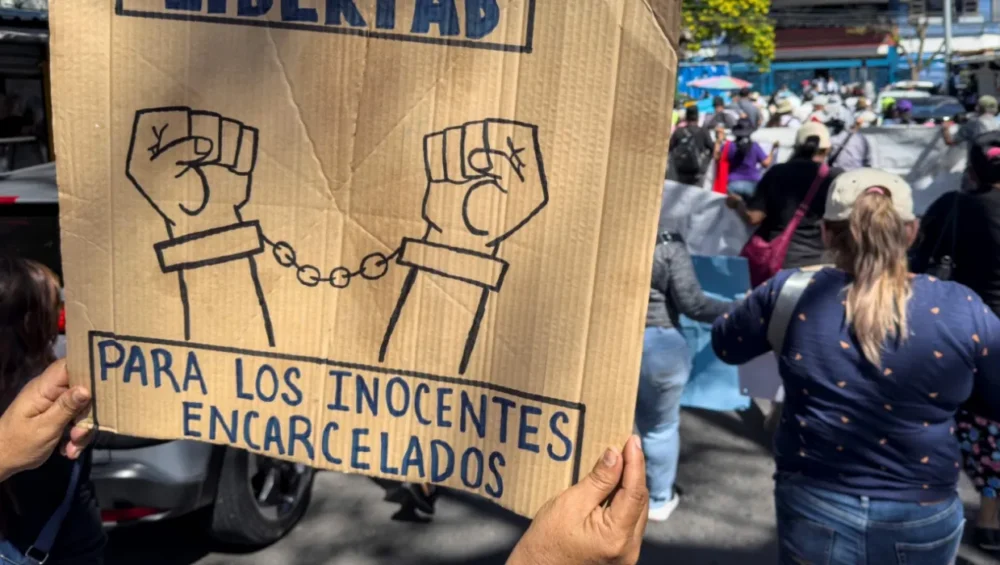
El Salvador’s state of exception has moved from being presented as a hard-line public security response to becoming the subject of one of the gravest accusations international human rights law can raise: that it could amount to crimes against humanity. The controversy is no longer limited to domestic politics. It now sits at the intersection of security policy, mass detention, prison conditions, and legal accountability, with experts warning that the emergency framework may have enabled a systematic pattern of abuse.
The reason why this case is unique is that of the magnitude and duration of the crisis in which the state of exception emerged. The state of exception was declared back in March 2022 when there was an outbreak of murders committed by the gangs in the country. Since then, it has become an essential part of the rule by President Nayib Bukele. While proponents of the state of exception claim that the reduction in murders has brought back order to the society, its opponents say that the security has been achieved at the cost of human rights violations.
A Policy Born From Crisis
Emergency powers were decreed following the murder of 87 individuals over the weekend of March 2022, a shocking event for the nation, which enabled the government to pass such measures and provided it with some political leverage to do so. These measures include the ability to bypass certain parts of the constitution in order to detain more people in an unprecedented manner. The logic presented by the government is simple; there was an urgent need to take action against gang violence in the nation and the only means to end the power of gangs was through emergency measures.
This has been the narrative followed by Bukele and has formed much of his public image, domestically and internationally. Indeed, it has been one of the key elements behind his political popularity, as his administration has often portrayed its policy of emergency measures as the only anti-crime success of his government through the drastic reduction of homicides. This has been one of the reasons why he enjoys much support in a country tired of extortion, fear, and gang violence. Yet, the situation has led to another problem.
What the Expert Report Says
The latest controversy stems from the findings of the International Group of Experts for the Investigation of Human Rights Violations under the State of Exception in El Salvador, known as GIPES. The experts concluded that there are “reasonable grounds” to believe crimes against humanity are being committed under the state of exception, according to the information presented to the Inter-American Commission on Human Rights. That is not a casual accusation. It suggests the experts believe the alleged abuses are serious, repeated, and linked to state policy rather than isolated misconduct.
According to the report, there is a trend of abuse that entails such serious violations as torture, murder, enforced disappearances, etc. Notably, the violations are not depicted as acts of a handful of rogue officers, but rather as an element of a greater public security strategy that is being realized under the state of exception. This is especially important since in law, crimes against humanity are normally viewed as attacks against civilians which are committed as an organized policy with full knowledge and support of the organization.
Why the Allegations Are So Serious
The language used by legal and human rights experts carries weight because crimes against humanity are among the most serious offenses recognized in international law. They are not limited to wartime atrocities. They can also arise in peacetime if a state or organized force carries out widespread or systematic attacks on civilians. In this case, the concern is that the emergency regime created the conditions for mass abuse while shielding officials from meaningful scrutiny.
These numbers are indeed shocking. More than 90,000 people have been put in detention during the period of the state of exception, based on the news summaries of the report. In total, 500 people who were in detention have passed away in the custody of the state, adding an additional level of significance to the accusations. As Amnesty International described it, the period leaves a legacy of repression, arbitrary detentions, torture, and deaths in custody. Once the scale of the system of detentions reaches such dimensions, the issue becomes not only the decrease in the number of the crimes committed.
It becomes about whether the state stepped across the boundary from law enforcement to systematic abuses. The conclusion made by the experts about the existence of “reasonable grounds to believe” crimes against humanity to be taking place is particularly important as it is a critical point in terms of credibility.
Bukele’s Security Defense
Bukele’s government rejects the allegations and strongly denies that it has pursued a policy of forced disappearance, torture, sexual violence, or arbitrary execution. Public Defender General Rene Escobar said the administration rejects any such claims, according to the Reuters summary of the report. The government’s position is that the emergency has been a necessary and effective response to gang domination and violence that once made everyday life dangerous for millions of Salvadorans.
This argument hinges entirely on success. Reports show that homicides have dropped by more than 90% during the tenure of President Bukele, an achievement which is seen as evidence of success for the strategy implemented by the government. This is precisely what the politics of El Salvador centers on. The government claims that it managed to offer safety when other governments could not. However, opponents point out that any substantial reduction in violence does not mean the use of torture, illegal detentions, and killings while in custody. In short, this is an argument both about outcome and methods employed to obtain them. The problem for the government is that its security policy and human rights record seem incompatible today.
Amnesty and Rights Groups Raise Alarm
Amnesty International has been among the most vocal critics of the state of exception. It said that one thousand days into the emergency, El Salvador had been left with a legacy of repression, arbitrary detention, torture, and deaths in custody. That language is important because it reflects not a one-off incident, but an assessment of a prolonged policy environment. Amnesty has also previously said that the authorities were systematically committing human rights violations during the first year of the emergency.
The results suggest that the criticism goes beyond viewing the situation of the state of exception in El Salvador as a tough-on-crime approach with minor violations here and there. Rather, the complaint is about the way in which the emergency has transformed into a model of governance where due process and individual rights take second place after mass imprisonment and political control. This is why the discussion has shifted from one of national security to one of international legal responsibility. In human rights circles, the question is whether the authorities can use the decreased crime rate as justification for large-scale imprisonment and alleged violations. And the answer would be no. The rationale is that the state does not have the right to ignore the rule of law indefinitely just because of fear of crime.
The Human Cost Behind the Numbers
The numbers themselves only reveal a partial picture of the situation. Over 90,000 arrests might be seen by some as a sign of determination, but for others, this indicates that the system of justice is being pushed to its limits. Arbitrary arrests mean that people may be arrested despite there not being enough evidence against them or without taking the particular case into consideration. Torture claims bring to light what takes place behind the bars of detention centers. Deaths in detention are especially disturbing as they indicate that the state may have failed to carry out its primary function.
This is what gives the controversy around El Salvador such lasting force. It is not simply a debate over public policy effectiveness. It is a moral and legal test of whether a government can trade broad repression for public safety and still claim legitimacy. For many Salvadorans living under the emergency, the answer depends on whether they personally feel safer. For human rights lawyers, the answer depends on whether the state respected the law while pursuing that safety. The current allegations suggest it did not.
At this stage, the accusation that El Salvador’s state of exception could amount to crimes against humanity is still an allegation, albeit one backed by legal experts and reinforced by human rights organizations. The report submitted to the Inter-American Commission on Human Rights is likely to intensify international scrutiny. It also places further pressure on Bukele’s government to defend not only the success of its security strategy, but the legality of how that success was achieved.
The greater importance lies beyond El Salvador. Should the claims receive wider acceptance, they will serve as a lesson for other states that seek to abuse their powers in cases of declaring states of emergencies in order to increase their security. The central issue that needs to be addressed here is whether it is possible for a government to bring down its criminal rate to such levels, and still be compliant with the laws of international human rights standards. As far as the case of El Salvador is concerned, the critics insist that there is less and less chance of compliance. Presently, it is difficult to know whether El Salvador sees its state of emergency as a saving grace or an instrument for perpetrating crimes against humanity.