
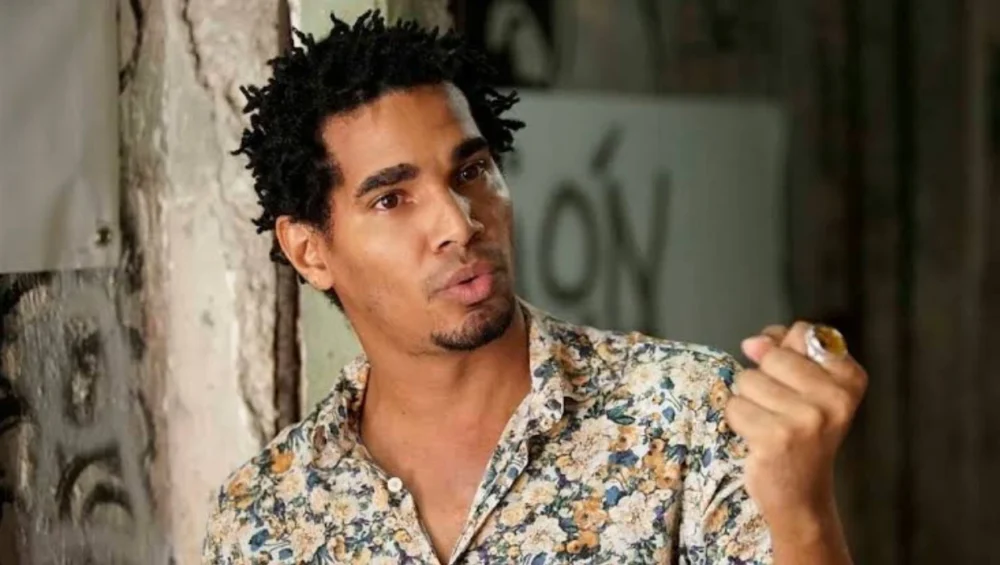
Cuba’s treatment of dissident artist Luis Manuel Otero Alcántara has once again drawn urgent international scrutiny, with human-rights defenders saying his disappearance from prison custody amounts to an enforced disappearance. The case has become a stark test of how far Cuban authorities will go to control dissent, especially when a prominent cultural figure completes a prison sentence but still does not reappear in public view.
The latest reports indicate that Otero Alcántara was taken from Guanajay Prison on July 7, 2026, just days before his five-year sentence ended on July 9. Activists and legal groups say the authorities have not disclosed where he is being held, while his family and supporters say they have been left in the dark.
What happened to Otero Alcántara
As per the reports carried in human rights groups and independent media, Otero Alcántara has been taken out of jail by state security forces, and there has not been any public confirmation of his whereabouts ever since. This chain of events has been responsible for claims that he was not officially released once his sentence was over, but rather became a part of the closed circle of state control. It is important here to note that he completed his sentence on July 9, 2026, but he had become inaccessible to the outside world. He did not respond to lawyers, activists, or even his family members.
Human-rights defenders say the state’s silence has transformed a prison release issue into a broader political and legal crisis. If a person can complete a sentence and still not be allowed to re-enter society or even have their location disclosed, they argue, then the prison term becomes less relevant than the state’s power to hold someone beyond formal judicial process.
Why the date matters
The reported July 7 transfer and July 9 sentence completion give the case a highly charged legal and symbolic meaning. Rights advocates argue that Otero Alcántara was effectively held in a state of limbo right when his sentence expired, which strengthens the claim that this was not a routine prison procedure.The timing also made the case easier to frame internationally, because the question was no longer whether he would one day finish his sentence, but why he was not being allowed to emerge once that sentence was complete. That shift is what pushed the issue from a Cuban prison matter into a global human-rights story.
Legal and human-rights response
Cubalex, one such advocacy group, filed a habeas corpus petition for the disclosure of Otero Alcántara’s whereabouts. Judicial authorities are required to act on a habeas corpus petition within 72 hours. A habeas corpus is significant because it compels the government to provide justification for detention or even the whereabouts of the detainee. In the current case, what makes the filing significant is the possibility that Otero Alcántara might have been taken outside of all legal processes. Amnesty International has added its voice to those advocating for the freedom of the artist, declaring that he has been subjected to an enforced disappearance because of lack of public release at the end of the sentence. The use of such terminology is significant in that it shifts the allegation of arbitrary detention to a more extreme accusation of enforced disappearance.
“Luis Manuel Otero Alcántara has been forcibly disappeared since July”
— Cubalex reporting cited in the coverage.
“The regime” did not provide a public explanation or release him at the end of his sentence, according to Amnesty International’s characterization of the case.
The legal and advocacy response also shows how quickly the case has moved beyond a single detention issue. It now sits at the intersection of criminal procedure, political repression, and international human-rights law, with groups demanding transparency from a government that has not yet offered one in the reporting available.
Who Luis Manuel Otero Alcántara is
Otero Alcántara is not a small-time dissident. He is arguably one of the most prominent Cuban artists and a prominent member of the San Isidro Movement, a group of people who have spoken out against censorship and freedom of speech in Cuba. This is just another aspect of his story which gives his case such a big impact outside of the art community. His activism has been causing tension between him and the authorities for quite some time now. The reporting on his previous arrests and conflicts with the government indicates that for years he was seen not only as an artist, but as a political threat by the government. His name has become synonymous with the fight for independent art in Cuba.
A long record of pressure
Earlier reporting from PEN America noted that Otero Alcántara had been released after nearly a month in hospital detention in 2024, highlighting the repeated cycles of pressure and release that have defined his public life.
That context matters because it shows the current case is not isolated. It follows years of confrontation between an artist who uses performance and public protest as political expression and a government that appears willing to use detention as a response.
Broader political meaning
It is important to mention that this case raises the question not only about the whereabouts of one person. In fact, it touches upon the issue of political prisoners in Cuba, limitations for freedom of speech, and the way the government responds to criticism. According to one of the articles, Otero Alcántara’s story takes place against the background of the fact that there are over 800 political prisoners on the island. Such a number is very important, as it shows that this case should be seen within a larger framework of repression, not an isolated story. Human rights activists find the accusation about disappearance of one of them even more worrying considering the fact that there is a pattern of repressions against activists. The unwillingness of the state to provide any information about the whereabouts of Otero Alcántara also plays an important role from the political perspective.
Cuba’s stance in the reporting
There have not been any official statements made about Otero Alcántara’s whereabouts or explanation for his non-release in accordance with protocol. The lack of such an explanation is very much at the heart of the controversy, as the situation would not be nearly as volatile were there at least one verifiable statement. Indeed, the public discussion is now driven by human rights organizations, relatives, and the independent press. This means that the Cuban authorities are letting go of their ability to control the narrative and thus define the event.
Activist Anamely Ramos pushed back on media framing by insisting that
“Luis Manuel Otero is missing, not released”,
a statement that captures the central dispute in the case. Her remark reflects a broader concern among supporters that language matters here: to call him released would normalize a situation they say is anything but release.
In any event, at the present moment the question of Luis Manuel Otero Alcántara’s whereabouts should be answered straightforwardly and without delay in order to bring the situation back to a normal level. Otherwise, the case of enforced disappearance will keep being open until authorities provide enough evidence and clear answers. At the same time, the filing of habeas corpus is already a legal challenge for the state authorities and failure to give convincing answers could only make the situation worse, since there would emerge more and more allegations against Cuba, and the country would face even more accusations by human rights groups, artists, and other people concerned with his fate.
In the end, the controversy over Luis Manuel Otero Alcántara is about more than a prison transfer. It is about whether a state can make a person vanish from public view at the exact moment a sentence ends, and then refuse to say where that person is. That question now sits at the center of the story, and until it is answered, the allegation of forced disappearance will remain the dominant interpretation.