
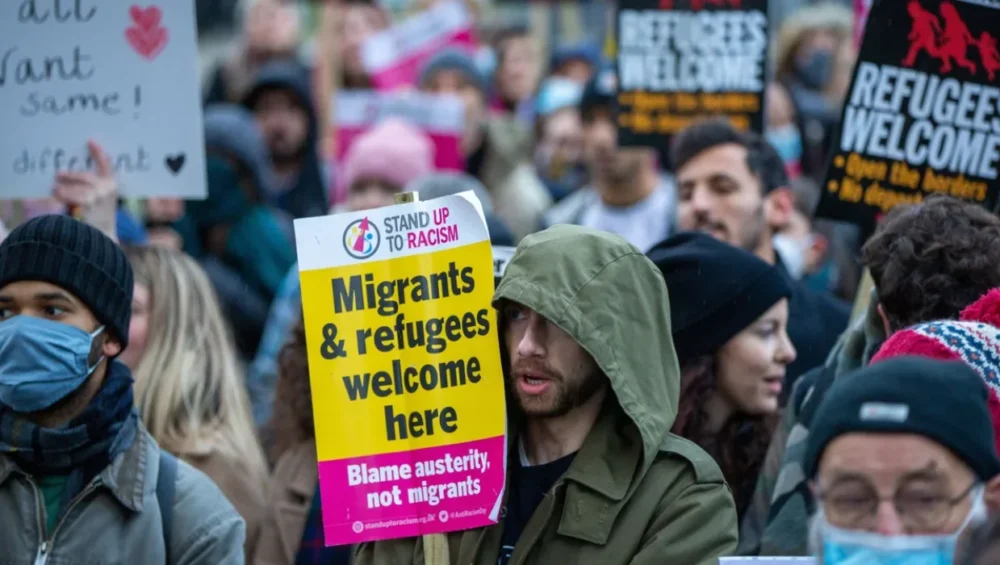
The UK government has begun planning new legal pathways for refugees and asylum seekers in what may be one of the most substantial changes to its migration policy in recent times. This initiative tries to achieve two purposes that have been perceived separately due to their political difficulty of implementation. They include creating safer and more organized pathways for genuine refugees while simultaneously tightening the asylum process in order to stop the misuse, illegal entries, and other loopholes of the existing structure. The initiative itself revolves around Home Secretary Shabana Mahmood who has defined it in terms of being an enforcement and humanitarian effort on the part of the government. It seeks to provide organized and legal means of entry for refugees while at the same time preventing any misuse of the process through prolonged appeals and other tactics.
What the new routes mean
The intended approach is aimed at ensuring that there are capped and safe ways to bring in asylum seekers and refugees to the UK towards the end of this year. According to reports from the public domain, these approaches will largely be based on the Canadian sponsorship program that has always been in existence, providing private bodies with the capacity to assist refugees in their settlement process upon arrival in the country. These include sponsorship routes via community organizations, universities and employers among others. In the intended approach, churches, charitable bodies, communities and other civic institutions will play a sponsoring role in the resettlement of refugees while universities will do so through sponsored admissions.
This is a notable departure from a system that has often been criticized for relying too heavily on crisis response, backlogs and enforcement after arrival rather than structured legal entry before arrival. The new approach appears designed to channel humanitarian migration into more orderly and pre-screened routes.
Home Office stance and statements
The Home Office has presented the policy as a way to restore public confidence in asylum while still protecting people with legitimate protection claims. According to reporting on the plan, the department intends to launch these pathways later this year, with the first arrivals expected through some routes in 2027.
Mahmood has been particularly direct in setting the tone.
“I will open new legal routes for genuine refugees, while closing loopholes that have been too often abused,”
she said, making the government’s dual message unmistakable: compassion for those in need, but greater control over who qualifies and how they enter.
A further line adopted by the government has been that of “genuine refugees.” This indicates the government’s intention of tightening the criteria and leaving no room for ambiguity. It is an important political term since it distinguishes between individuals who have been escaping persecution and those whom the government considers to be exploiting the asylum process for economic gain.
Canada-inspired model
The other key element of the political frame is the comparison with Canada. According to the media reports, through the community sponsorship program of Canada, around 400,000 refugees have been settled since 1979, and now the UK ministers are using this experience of Canada to prove that a resettlement policy based on sponsorship can be effective at a larger scale. The advantage of the Canada approach is that, under this scheme, some burden of resettling refugees will not fall on the shoulders of the government but the selected sponsors in the local community, who will also provide necessary assistance in the practical aspects of integration and settling down.
The UK government appears to believe that a similar structure could improve public trust, because the arrivals would be selected, capped and supported by organizations that can be held accountable. At the same time, it allows ministers to claim they are not simply expanding immigration, but creating a disciplined pathway for people who genuinely need protection.
Universities and employers
One of the peculiar aspects about this proposal is the involvement of universities in this process. It appears from public reports that trusted universities will be allowed to sponsor refugees to migrate to the UK, thus offering them a way to sponsor students or others whose claims are part of the larger humanitarian umbrella. This will be a strong indication that educational institutes could be involved in formulating policies of refugees’ resettlement. Employers are also likely to figure in this system in the future, although it might come a bit later down the road. The economic element of the sponsorship of refugees could be ensured through such a measure.
These elements matter because they suggest the government is not just thinking about border control, but about integration after arrival. The policy is being built around the idea that legal access, local support and employment pathways can reduce pressure on the asylum system over time.
Tougher enforcement
New legal options, therefore, represent just one part of the policy package. The second part relates to an increased enforcement approach, involving new provisions with regard to human rights and deportations. It has been reported that the government also plans to restrict the scope of the definition of “family” in the European Convention on Human Rights, thereby reducing some of the arguments migrants put forward in resisting deportation. This, of course, is politically charged given the fact that human rights have increasingly become the field where immigration issues are being fought out in the UK. The argument from ministers is that too many claims are held up by appeals regarding the interpretation of family and private lives.
The government also plans to make it easier to deport people and to restrict some appeal channels. In parallel, earlier reporting this year indicated that Britain was considering measures to strip accommodation and financial support from asylum seekers who work illegally, break the law, refuse removal or can support themselves. Taken together, the policy package suggests a much tougher posture than the one often associated with traditional asylum administration.
Political message and pressure
The politics behind the announcement are as important as the policy itself. Immigration has become one of the most politically combustible issues in the UK, especially amid public frustration over small boat crossings, delayed asylum processing and the perception that the system lacks control. By combining new safe routes with stricter enforcement, ministers are trying to occupy the political center ground.
That balance is difficult. If the new routes are too generous, the government may face accusations that it is creating a new pull factor. If they are too narrow or heavily capped, they may be criticized as symbolic rather than meaningful. The government’s messaging suggests it wants to avoid both traps by promising compassion without open-ended expansion.
Mahmood’s line about “genuine refugees” is important in this context because it speaks to both humanitarian credibility and political reassurance. It implies that the government will keep the door open, but only in a way that is tightly managed and demonstrably fair.
What the figures show
The headline figure most often linked to the policy is the Canadian sponsorship record of nearly 400,000 refugees resettled since 1979. That number is being used to show that non-state sponsorship can work over decades, not just as a pilot or temporary measure.
But one striking fact is that the UK government has not yet released a final quota for the new routes. That means there is still no public answer to the most important practical question: how many refugees will actually be admitted under the new system each year. Without that figure, it is hard to judge whether the plan is a meaningful expansion of safe routes or a relatively small pilot designed mainly for political optics.
The current reporting does, however, make clear that the scheme will be capped and phased. That suggests the government wants control first, scale later. The likely result is a carefully monitored program that can be expanded if it works, or limited if it becomes politically controversial.
Likely impact
Under such implementation, the policy would certainly change the approach to asylum and refugee protection in the country. It would offer an officially recognized avenue for those seeking refuge in the country, particularly those who have their sponsors. It would also give the state the opportunity to increase its regulatory power over illegal immigration. As a result, refugees who would use the channel would enjoy an easier access to the UK, while those attempting to migrate without following official avenues would be faced with stricter legislation. The effectiveness of the policy would depend on its implementation. Given adequate regulations for the sponsors and the flexibility of the process, the policy would become a reliable alternative to irregular migration. Otherwise, it would prove ineffective.
The government is clearly trying to signal that it can do both things at once: protect refugees and control borders. Whether voters, courts and advocacy groups accept that balance will determine how successful the policy becomes.