
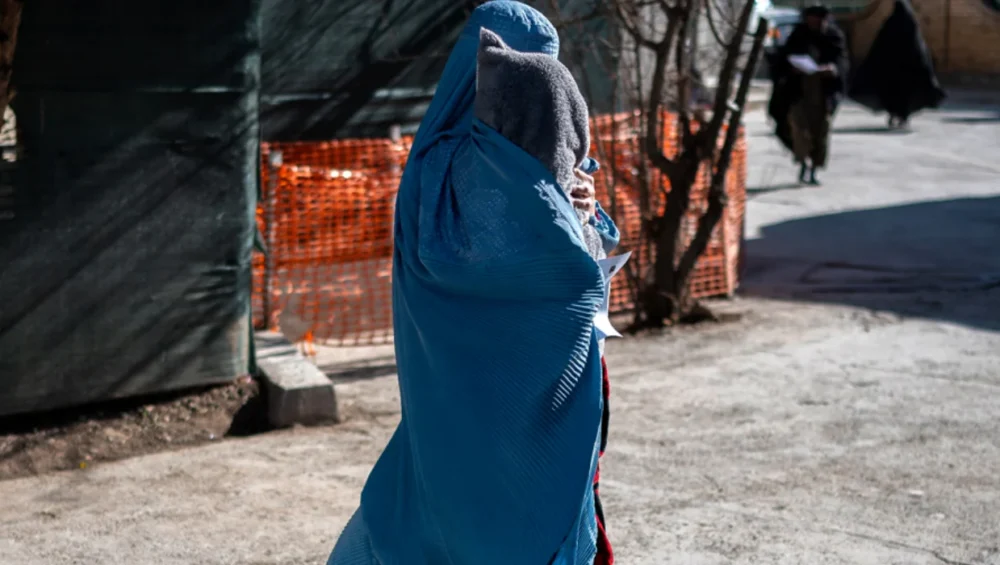
This incident of arresting women and girls for violating the dress code in Herat can be considered one more drastic measure taken by the Taliban regime in their efforts to regulate the freedom of Afghan women. The alarming thing about this incident is that what is most frightening is not the high number of arrested women; rather, it is a tendency in a more general sense of the enforcement of strict policies in an atmosphere of intimidation and humiliation, which forces women to leave the public sphere.
In relation to reports emerging from Herat, it seems that there has been a widespread campaign of the Taliban morality police as soon as the new dress code went into effect and started arresting women who were not adhering to the necessary requirements set out by the Taliban hijab dress code. The campaign seems to involve street raids, threats in mosques, as well as arresting people in crowded public places, which shows that it is not an individual act but rather a widespread campaign against those failing to adhere to dress codes.
Arrests in Herat
The most pressing matter to be considered regarding this issue is the arrest of at least 21 women and girls in Herat, and an allegation that one of the women held was pregnant. This has added to the public outcry since it clearly shows how bluntly this order is being enforced and how vulnerable the people who have been ordered arrested are. Some women have been arrested, while others were warned, showing how arbitrary this action by the Taliban officers was.
The reported arrests happened following a raid carried out by the Taliban’s religious police in western Afghanistan, where residents claim that the government is going from street to market, enforcing the rules on wearing burqas. According to one report, the women are being forced inside the car in public; the image has become symbolic of the fear and embarrassment of such raids. Even though there is some video evidence of what happened available online, its veracity is yet to be verified independently.
The presence of a pregnant woman among those detained has drawn particular concern because it suggests the Taliban are willing to apply the policy without regard to health, safety, or humanitarian considerations. In a broader sense, the arrests signal that the dress rule is not just symbolic rhetoric from the Taliban leadership; it is being operationalized through the arrest and detention of ordinary women in public spaces.
Dress Rule and Enforcement
The enforcement campaign came after a new Taliban decree by its Supreme Leader, Hibatullah Akhundzada, reportedly prohibiting women from going out in public without wearing a “proper hijab,” a term which, when applied by the Taliban, apparently means that they are expected to be far more covered than their cultural traditions normally require. According to eyewitnesses in Herat, the announcement was made through local mosques on Fridays when women were instructed to avoid showing their skin, wearing makeup, etc.
This is no triviality of choice when it comes to clothing. By turning clothes into a test of legality and morality, the inability to pass may be met with consequences ranging from imprisonment, humiliation, and exclusion from everyday activities by the Taliban regime. In putting pressure on the dress code of women, this is a method of avoiding the blame for bad governance but rather focusing on the policing of women’s bodies. This is one explanation as to why this debate has been able to generate such international interest.
The Herat operation also reveals how the Taliban rely on local enforcement networks. Provincial officials and religious institutions appear to have been used to pass the order from leadership to the streets, creating a chain of compliance that gives the policy an appearance of legitimacy while leaving women with little room to resist. In that context, the dress rule functions as both a religious claim and a political mechanism.
Human Rights Alarm
Reactions from the United Nations and Human Rights Groups have been prompt and harsh. UNAMA expressed its concern over the arrests and detentions of women in Herat who are reportedly not adhering to the new dress code rules, stressing that the de facto authorities must recognize fundamental freedoms. The United Nations reminded the Taliban that everyone has the freedom of movement and equal rights under the law regardless of gender. Such comments are essential since they make the case not cultural but human rights-based.
Human rights organizations have long warned that Taliban policy toward women is becoming more systematic, more punitive, and more difficult to reverse. Restrictions on education, work, dress, travel, and access to public services have steadily reduced women’s presence in public life. The Herat arrests fit this broader pattern and suggest the Taliban are tightening enforcement rather than softening it in response to criticism.
The phrase “affront to human dignity” is not rhetorical excess in this context. It reflects the basic reality that women are being stopped, questioned, and detained for appearance-related violations while being denied the agency to decide what to wear in public. That kind of coercive control is particularly severe because it is not limited to a single institution; it extends to markets, streets, hospitals, transport, and educational settings.
Burqa and Public Services
The recent incident in Herat cannot be separated from the previous instances where the Taliban had made the wearing of a burqa mandatory for women in all public places, particularly hospitals. News stories earlier in the year indicated that the Taliban had barred women from accessing hospital services unless they covered themselves with the burqa, whether it is patients, visitors, caretakers, or healthcare workers.
What this means is that the imposition of strict regulations about dress on people becomes even more serious when these relate to accessing healthcare facilities. This is because women will not only delay seeking treatment or forgo treatment but may completely avoid going to the doctor. Rights groups have said that when dress regulation becomes a condition of access to medical treatment in an oppressive state structure, this is bureaucracy of violence.
The debate over burqa enforcement also illustrates the difference between voluntary religious observance and state-imposed compulsion. Many Afghan women may choose modest dress for cultural or religious reasons, but the issue here is coercion backed by detention. That is why international observers have interpreted the policy as an attack on autonomy rather than a neutral dress standard.
Taliban’s Broader Agenda
Herat arrests are an example of a trend that has become evident ever since the Taliban have returned to power – limiting the roles of women in public spheres by increasing the extent of moral policing. Previously, the Taliban regime has implemented many restrictions regarding education, employment, travel, and even leisure activities. However, recent events prove that clothing issues remain one of the most critical battlegrounds for this political force.
This fact is crucial because it demonstrates that the Taliban utilize female visibility as a political tool. Thus, controlling how women dress, move around, and appear in public unaccompanied by men is a means of emphasizing that it is only their vision of morality that dominates within public spheres. It implies that such a strategy can be considered a type of everyday domination.
There is also a strategic dimension. The Taliban know that dress codes are highly visible and emotionally charged, which makes them powerful tools for asserting authority. They can be enforced quickly, explained in religious terms, and used to show that the state is present in everyday life. For a movement that still seeks internal cohesion and external legitimacy, this kind of symbolic governance can be politically useful even as it deepens international isolation.
Statements in Context
UNAMA’s language is especially significant because it moves beyond general concern and directly invokes rights principles.
“All people have the right to freedom of movement,”
the mission said, while also stressing that
“all persons, both women and men, are entitled to equality before the law.”
Those statements matter because they challenge the Taliban’s claim that the restrictions are simply local moral rules. Instead, they define the matter as one of legal equality and personal freedom.
The Taliban’s own message, as described in local reporting, was starkly different. Women were told not to show skin, not to wear make-up, and to comply with the regime’s idea of a “proper hijab.” That language places the burden entirely on women to conform, while leaving the state’s role in coercion largely unacknowledged. In effect, the Taliban position is that women’s public presence must be disciplined through appearance.
The contrast between the two positions is important. On one side is the language of rights, equality, and freedom of movement; on the other is the language of compulsion and moral policing. The Herat case sits at the center of that conflict.
Why This Case Matters
This story is significant because it shows that the Taliban are becoming accustomed to using imprisonment as a means to enforce proper dress. When people start being detained for what is considered to be in violation of the regulations regarding clothing, the possibilities for abuse become much greater. Any woman can potentially fall victim based on the interpretation of a local authority.
The other aspect is that Herat is an important city in Afghanistan and not some backwater town that can have its own unique traditions. By conducting a crackdown in Herat, the Taliban have effectively shown their willingness to enforce regulations in more metropolitan areas. This story is especially significant to journalists because it actually demonstrates policy implementation rather than just policy itself.
From a reporting perspective, the case also offers a clear example of how the Taliban’s governance affects daily life. Rather than focusing solely on elite politics, this story shows how women experience the regime directly through fear, restriction, and public humiliation. That human dimension is what gives the article weight beyond a simple law-and-order report.
Bigger Human Rights Picture
The Herat arrests should be seen in the context of what many advocacy groups now describe as a system of gender-based repression in Afghanistan. The Taliban’s policies have not been limited to one sector or one city; they have been steadily embedded into the structure of public life. Women are stopped from studying, working, traveling freely, and in some cases entering essential services unless they comply with dress rules.
This creates a cumulative effect. Each new restriction reinforces the previous one, making it harder for women to participate in society in any meaningful way. Over time, that does not simply limit freedom; it changes what public life looks like. The result is a society in which women are increasingly invisible unless they obey a rigid code of conduct.
That is why the Herat operation is more than a local policing story. It is a window into the Taliban’s larger project and the consequences that project has for half the population. When dress becomes a reason for detention, the issue is no longer cultural sensitivity. It becomes state power exercised over the body.