
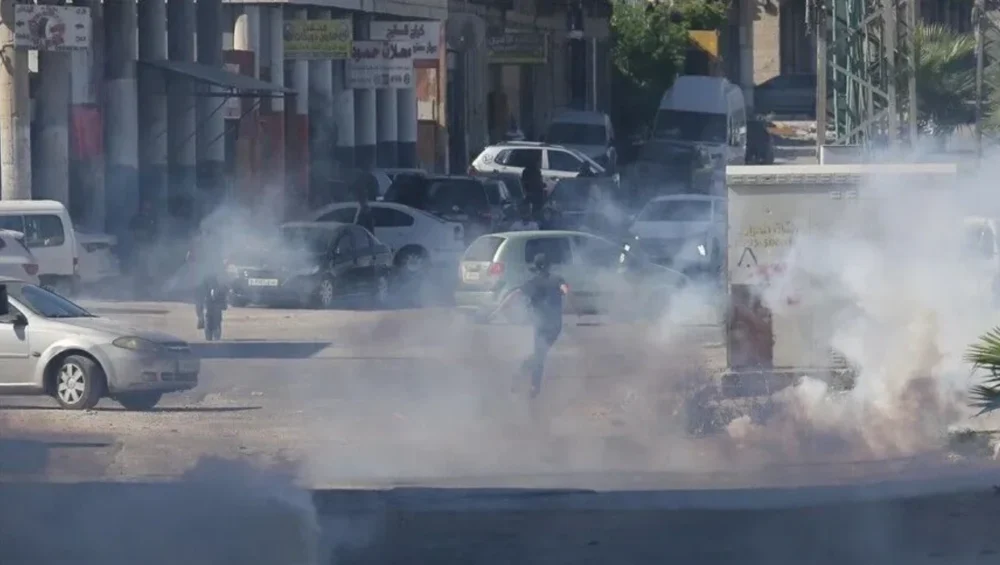
Several Palestinians, including children, suffered breathing difficulties after Israeli forces fired tear gas during a raid on Al-Mughayyir, a village northeast of Ramallah in the occupied West Bank, according to the Palestinian official news agency WAFA. The incident took place on Saturday morning, 15 August 2026, in the Sha‘ab al-Luz neighborhood, an area described in Palestinian reports as having experienced repeated confrontations involving settlers and Israeli forces.
According to WAFA, who referred to local sources, dozens of Israeli settlers attacked the neighborhood and tried to break into several Palestinian houses. Following this, Israeli troops arrived at the scene and started firing tear gas canisters. Suffocation and other breathing problems were noted among those present, including children. This particular event is important not only because of the immediate injuries caused to civilians but also because it highlights the growing overlap between the actions of settlers and Israeli troops in the West Bank. According to Palestinians, the process involved settlers being the initiators of the attack, followed by the arrival of Israeli troops with their use of crowd control weapons in a residential area. Unfortunately, there was no statement from the Israeli military regarding this operation.
Civilian exposure inside a residential area
The allegation of tear gas being used inside or around residential properties is key to the significance of the incident. Authorities typically describe tear gas as a non-lethal crowd-control agent, yet its effects can become more serious when it is discharged in confined areas or where the targets have trouble escaping. Youngsters, elderly, and those suffering from asthma or other breathing problems are particularly susceptible. In their reports, Palestinians did not provide specific information on the number of people affected, on the identities and ages of the children, or on whether the residents were hospitalized. Nor did Palestinians give information on the chemicals contained in the gas, the number of canisters used, and the period of time that the exposure lasted. These details are crucial to the determination of how serious the incident was and whether the force used was proportional to the security situation as claimed by the authorities. The term “suffocation from tear gas” in the Palestinian reports typically means the signs and symptoms such as coughing, burning eyes, sore throat, tightness of chest, wheezing, dizziness, and difficulty breathing. However, the term alone does not constitute evidence of injuries.
The missing Israeli account
The reports available at the time of writing did not contain a statement from the Israeli military, the Israeli government, or Israeli police. As a result, several basic questions remain unanswered. It is not clear why Israeli forces entered the Sha‘ab al-Luz neighborhood, whether soldiers were responding to a specific threat, whether clashes had taken place before the tear gas was fired, or whether anyone was arrested.
An Israeli military response would also be expected to clarify whether the soldiers regarded the operation as a law-enforcement intervention, a response to an attack, or part of a planned raid. It could also address whether soldiers entered Palestinian homes, whether weapons or other objects were seized, and whether the use of tear gas near residential structures is under review.
The absence of an Israeli statement means the facts must be presented with careful attribution. WAFA’s account provides the principal description of the event, but claims regarding the conduct of settlers and soldiers should be identified as Palestinian-source allegations until independently corroborated.
A pattern broader than one village
The Al-Mughayyir incident occurred against a backdrop of intensifying violence across the West Bank. Palestinian authorities and international observers have reported a combination of military raids, settler attacks, arrests, property destruction, land seizures, demolitions, and displacement. These developments have placed increasing pressure on rural Palestinian communities, especially those located near settlements, outposts, bypass roads, and contested agricultural land.
A report was based on data from United Nations showing that, starting from the beginning of 2026, there have been more than 1,430 attacks against about 260 Palestinian communities. In addition, according to the same report, 3,800 Palestinians have been displaced, almost 50% of whom are children. Such statistics show that the effects of the conflict do not stop on a certain incident. Repeated attacks will result in disruption of access to land, schools, medical facilities, roads, and water. Without mentioning deaths and injuries of any kind, a repeated incident will cause insecurity and forced displacement. Al-Mughayyir is one of those Palestinian communities which are constantly referred to in reporting cases of violence of settlers and actions of Israeli military forces. Previously, there have been reports of attacks including Palestinians, settlers, and Israeli forces within and around the village. A report on 11 August stated that six Palestinians, including three children and two women, were injured in an attack by Israeli settlers, protected by Israeli forces.
The proximity of these incidents is important. It indicates that the 15 August raid did not occur in isolation, but followed a period in which residents had already faced repeated threats and physical attacks. The available reporting does not establish that every incident was connected, but it shows a continuing pattern of instability in the same locality.
July figures point to escalation
The Palestinian Wall and Settlement Resistance Commission, cited by WAFA, reported 2,256 attacks against Palestinians, their land, or their property during July 2026. According to the commission, 1,458 incidents were attributed to Israeli forces and 798 to settlers.
The commission’s figures also showed a significant geographic concentration of reported incidents:
- Ramallah and al-Bireh: 260 attacks.
- Nablus: 247 attacks.
- Jenin: 190 attacks.
- Bethlehem: 185 attacks.
- Hebron: 170 attacks.
These numbers are from the Palestinian Authority and have not been verified by an independent audit in any of the documents referenced in this article. Nonetheless, they give us an idea about the way in which Palestinians are gauging the levels of violence. There is also a political and legal difference between military attacks and settler attacks, even though Palestinian officials maintain that both of these acts take place under the broader umbrella of military protection, settlement growth, and lack of accountability. The 798 settler attacks in July further emphasize the fact that the acts of violence carried out by civilians living in Israeli settlements have come to define the situation in the West Bank. When Israeli troops are said to be accompanying or protecting the settlers, the Israelis are held accountable not just for their own actions, but also for allowing the attacks to occur.
Arrests, injuries, and the wider cost
The broader West Bank figures cited in the reporting are even more severe. Since the Gaza war began in October 2023, Palestinian sources have reported that more than 1,183 Palestinians were killed in the West Bank, approximately 13,000 were injured, and nearly 25,000 were arrested.
These figures encompass a much wider period and territory than the Al-Mughayyir incident. They should not be interpreted as casualty figures from this single raid. Their relevance lies in showing the environment in which the village incident took place: one marked by frequent security operations, large-scale arrests, lethal confrontations, and rising civilian vulnerability.
For Palestinian residents, a raid involving tear gas is therefore not necessarily experienced as an isolated policing action. It may be understood as part of a continuing cycle: a settler attack, an Israeli military deployment, the use of force, injuries or arrests, and renewed fear of another confrontation. For Israel, however, military operations in the West Bank are generally framed through security concerns, including attacks, armed groups, and the need to prevent violence.
The central journalistic challenge is to acknowledge both the immediate event and the competing frameworks used to explain it. The Palestinian account emphasizes civilian protection, settler impunity, and the use of force in a populated area. The Israeli security framework, where offered, typically emphasizes threats to soldiers and civilians. In this case, the absence of an official Israeli explanation prevents a full comparison of the two narratives.
International law and accountability questions
Use of tear gas close to houses occupied by Palestinians prompts issues relating to necessity, proportionality, and the safety of civilians under international humanitarian law as well as human rights. The legal evaluation will be made based on various aspects, such as the existence of imminent danger, the availability of any other less harmful means of control, entry of the gas into homes and targeted firing at civilians. The use of tear gas does not necessarily violate the international laws and regulations.
It is a common practice among police forces when controlling crowds, yet the use of tear gas should be evaluated depending on the type of threat and possible consequences of its application. Firing tear gas into homes is a more serious issue because civilians might have no way out. Investigation needs to consider the location of the canisters, direction of firing, presence of the settlers and soldiers, the state of the damaged houses and health effects on residents.
Accountability is particularly difficult in the West Bank because Palestinian residents and rights groups have repeatedly alleged that settler violence is rarely punished effectively. Without transparent investigations and prosecutions where wrongdoing is established, each new attack can deepen perceptions of impunity and encourage further escalation.
Why Al-Mughayyir matters
The significance of this event can be seen in the context of the worsening conditions of security and human life in the West Bank. Children exposed to tear gas in the safety of their home are not simply victims of one isolated incident but an illustration of the manner in which the conflict is spilling into the lives of civilians. The statistics reported for 2026 make it clear that violence is occurring on a widespread scale and affecting hundreds of communities and forcing thousands to flee their homes. Repeated reference to Al-Mughayyir in reports of settler violence and Israeli incursions makes clear that the residents of the area are facing ongoing security problems and not an isolated instance. The immediate concern is the health of the individuals exposed to tear gas and the safety of residents from additional acts of violence. The longer-term questions involve investigations of settlers and soldiers, and the protection of Palestinian residents.