
Five years after the Taliban’s August 2021 seizure of power, Afghanistan sits at a stark crossroads: its human-rights record has deteriorated to the point of drawing fresh sanctions and deep aid cuts, yet a growing number of states are concluding that some form of Taliban Afghanistan engagement has become unavoidable. The paradox defines the moment.
On one hand, United Nations agencies and human rights organizations talk about a formal mechanism for gender persecution, which consists of over 100 orders adopted since 2021 that have completely taken away from society women and girls. On the other hand, capitals of neighboring countries and even Western officials begin to establish contact with the new leadership of Afghanistan on the basis of counterterrorism, migration, and trade – matters of pragmatic concern that cannot wait until there is formal acknowledgment. The consequence of such a policy is ambiguous diplomacy when states claim that they do not recognize the “Islamic Emirate” but at the same time receive envoys, formally appoint ambassadors, and conduct talks on matters of mutual interest.
The Human-Rights Record: Decrees, Bans, and a Generation Lost
The most visible and impactful aspect of Taliban rule is the stripping away of women’s and girls’ rights. UN officials say that there exists a pattern of policies issued by the de facto government that have resulted in a form of gender-based persecution which can be considered a crime against humanity. It involves restrictions on education, work, mobility, and involvement in social activities. The prohibition on education is the most detrimental of all. UNESCO says that the number of girls who are kept out of secondary schools stands at 2.4 million as of 2026 and has increased by around 200,000 since last year.
The agency’s message is uncompromising.
“Afghanistan remains the only country in the world where girls and women are formally banned from secondary and higher education,”
said Hoda Jaberian, UNESCO’s program coordinator for education in emergencies, adding that
“Five years is not a temporary interruption in a child’s education. It is clearly almost an entire secondary school cycle.”
She reiterated that
“UNESCO continues to call for the immediate and unconditional restoration of girls and women’s right to secondary and higher education. It is not negotiable. It’s a basic human right and we reiterate that there is no substitute for this.”
Education emergency cannot be viewed in isolation but is part of an overall architecture of control. According to the Human Rights Watch, the Taliban has “entrenched one of the world’s worst human rights crises” and produced a timeline for the last five years, where the curtailment of freedom started from schools to universities, workplaces, NGOs, and even public spaces. UN human rights experts have made the argument even more explicit by asserting that this institutionalized structure of discrimination, domination, and oppression constitutes a crime against humanity in terms of persecution on gender grounds.
“There should be no moves to normalise the Taliban de facto authorities, including by accepting diplomats or holding meetings in capitals, without demonstrated, measurable progress against human rights benchmarks, particularly for women and girls,”
they said in August 2026. The human cost is audible in the voices of those locked out.
“It has been five years since I was deprived of my education. It is deeply depressing to feel that you cannot move forward but are stuck where you were five years ago,”
one Afghan girl told UN experts, a sentiment echoed by millions.
Humanitarian Collapse: Aid Cuts, Frozen Assets, and Rising Need
The rights crisis intersects with a looming humanitarian catastrophe. In 2026, an estimated 21.9 million people—about 45% of Afghanistan’s population—will need humanitarian assistance, with more than 14 million suffering from food insecurity. But funds have dried up. Humanitarian funding for Afghanistan is down by almost 70% compared to 2022 as donors cope with fatigue, other crises, and politics. The US, which was once the largest donor of humanitarian funds, discontinued its humanitarian aid for Afghanistan in January 2025 as part of its wider foreign-aid freeze, reducing a flow of resources that constituted approximately 45% of the humanitarian aid package.
It is an unending cycle where needs increase while resources dwindle due to the de facto administration’s limitations. Other than fiscal constraints, frozen central bank accounts and sanctioning of top Taliban officials further hamper humanitarian aid to the country. There are billions of Afghan dollars that remain frozen overseas while travel and financial restrictions on important figures impede the regime’s access to the international financial system through formal channels. Humanitarian workers say the vulnerable Afghans are paying the price of dwindling Western assistance and lack of engagement with the Islamic Emirate.
The Diplomatic Turn: Why Engagement Is Growing Despite Non-Recognition
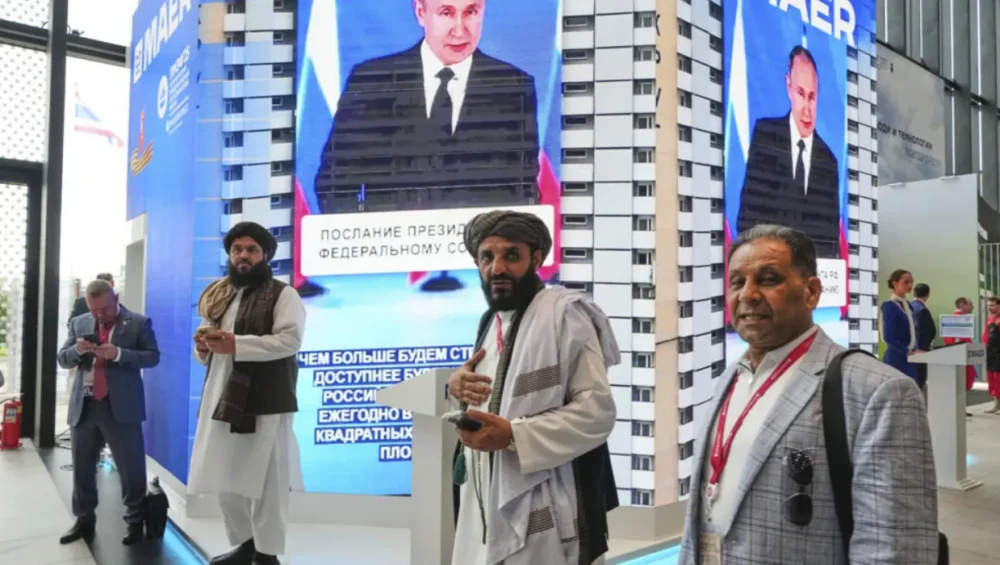
Against this backdrop, a quiet but significant shift is underway in foreign policy. While most countries still refuse to officially recognize the Taliban government, they are expanding working ties for reasons that range from security to migration to trade. Russia stands apart as the only country to have granted de jure recognition to the regime, doing so in July 2025, and later signing a military-technical cooperation agreement in May 2026—the highest degree of diplomatic normalization by any state.
Elsewhere, the approach is that of pragmatic engagement without recognition. The Taliban’s foreign policy approach includes hosting envoys in Kabul—often printing the pictures—involving diplomats from China, Japan, Turkey, Saudi Arabia, and Great Britain, as well as seeking accreditation of their own ambassadors overseas. Regionally, the equation is clear. The neighboring capitals have been engaging with Kabul because of the need for regional trade routes, transit corridors, and development initiatives that simply cannot succeed without the de facto authorities’ assistance.
Central Asian states, which include Kazakhstan, Kyrgyzstan, Turkmenistan, Uzbekistan, and Tajikistan, have been engaging to reduce security threats, including the removal of the Taliban from the Kazakhstan terror list in December 2023 and increased engagement of Uzbekistan with them. The European Union, too, which has been linking engagement to human rights benchmarks, held talks with the Taliban delegation in Brussels on June 22, 2026 on deportation matters—the first ever engagement at that level. Western and regional officials have also been discussing counterterrorism, border security, and intelligence cooperation with the regime, as well as deportations of failed asylum seekers.
The logic is clear: isolation has not yielded rights concessions, and the costs of disengagement are rising. As one analysis put it, many states are engaging
“driven largely by practical considerations,”
even as they demand domestic reforms before considering formal recognition. The Taliban, for its part, says it
“seeks relations with all countries”
and has used high-profile meetings to signal a desire to end its international isolation.
The Tension: Rights Leverage vs. Pragmatic Necessity
This focus on engagement has led to a heated debate among rights activists, diplomats, and aid workers. One group of these actors believes that closer diplomatic ties may result in the dilution of calls for better human rights practices, especially as concerns women and children. The logic of their argument is based on the fact that normalization through the presence of diplomats, meetings in capital cities, or increasing economic relations without noticeable progress amounts to rewarding the regime and stripping away any leverage. The other side of the debate includes those who believe that some coordination with the de facto regime is necessary to provide humanitarian relief and deal with security challenges.
This tension is most acute in the education sector. UNESCO’s call for the “immediate and unconditional restoration” of girls’ and women’s right to education is unambiguous, yet the reality on the ground is that schools and universities cannot operate without some form of accommodation with the authorities. The same dilemma plays out in health, nutrition, and livelihoods programs, where access depends on permissions, travel approvals, and staffing rules set by the de facto authorities. The policy challenge is to design engagement that preserves leverage—through benchmarks, targeted sanctions, and conditionalities—while preventing the civilian population from bearing the full brunt of isolation.
What the Numbers Say: A Snapshot of Crisis and Constraint
The scale of the crisis becomes evident from the numbers that tell the story of Afghanistan’s fifth year of Taliban rule. Approximately 2.4 million girls are denied access to secondary education, the figure rising further and potentially reaching 4 million by 2030, depending on the policies that remain in place. Over 100 policies enacted since 2021 have focused on depriving women of their rights, resulting in what the UN calls the institutionalization of gender persecution. The humanitarian needs are huge: 21.9 million need help in 2026, and over 14 million are food insecure. There is no funding for aid projects; it fell by almost 70% since 2022. Meanwhile, the US suspension of aid at the start of 2025 cut off the donor responsible for around 45% of all humanitarian aid. Diplomatic activities have increased, however, with the Taliban hosting diplomats from many continents, the neighborhood increasing its economic and security cooperation, and the EU organizing its first-ever high-level conference on deportation issues.
The Road Ahead: Benchmarks, Conditionality, and the Limits of Isolation
The path forward is narrow but not nonexistent. Rights groups and UN bodies urge governments to move beyond expressions of concern and adopt measurable human-rights benchmarks tied to engagement, including specific milestones on girls’ secondary education, women’s employment, freedom of movement, and access to justice.
They also demand that there must be selective accountability—punishment that singles out the individuals involved in abuses while exempting humanitarian activities—and continuous funding in order to avoid a full collapse of all services. In any case, regional powers and Western capitals will most probably increase their pragmatic contacts in the field of counterterrorism, migration, and trade, claiming that those issues cannot be postponed. The main issue is whether engagement can be organized in such a way that it results in real achievements in terms of human rights protection rather than just maintaining the status quo. The experience of the first five years shows that isolation has not succeeded. The challenge for the next phase will be whether selective and conditional Taliban engagement can give the opportunity for women and girls to come back to schools and work without undermining this leverage.