
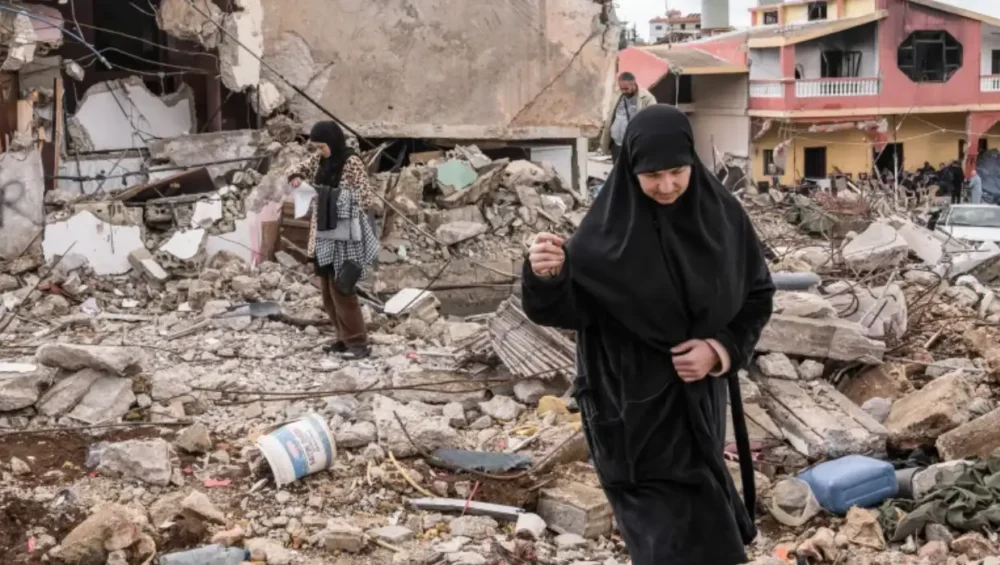
The southern villages of Lebanon have been bombed to dust, turning what was once a closely-knit community into a desolate wasteland of concrete debris and twisted metals. But the cost of this destruction cannot be measured just by the number of homes that have been demolished; the mental scars of those people who had to flee their village under constant bombardments also have to be counted. The mental trauma grows more acute as the fact of Israeli destruction of Lebanese villages takes on its full meaning for tens of thousands of families.
Lebanon was already suffering from years of economic, political, and social breakdown. The new phase of war on the borders of southern Lebanon has made many communities reach their limit of endurance. What is happening here is no mere repetition of cross-border conflicts, but an organized attempt to destroy the places which hold people’s history, memory, and identity. In these places – which have been destroyed – lies centuries of history, which cannot be recreated through mere bricks and mortar.
Villages turned to rubble
The scale of physical erasure
Testimonies from official Lebanese sources and foreign media reveal a grim scenario of the destruction that occurred in the south. According to local sources, thousands of housing units have been destroyed since the start of cross-border attacks by the beginning of 2025, causing the displacement of populations living in border regions that were previously the foundation of rural communities. Pictures taken via satellites and videos captured by reporters reveal entire blocks of houses flattened with streets of markets, schools and mosques now resembling piles of rubble.
In several villages near the border, journalists describe scenes where
“not a house remains standing”,
highlighting that this is not damage in isolated pockets but near‑total erasure of residential neighborhoods. The landscape is repeatedly likened to a “moonscape” — empty, gray, and hostile to life. Municipal buildings, schools, clinics and community centers have been flattened alongside private homes, stripping communities of both their social infrastructure and their sense of continuity.
The demolition of cemeteries and graves is another detail that is common in all these accounts. The village cemetery for many Lebanese families is a holy site where members of different generations rest next to each other. It is not only an act of vandalizing the dead but also an act that separates generations from one another. People have to come to terms with the fact that both their past and their present have been destroyed.
Human cost: casualties and displacement
From homes to temporary shelter
Behind the figures of destroyed homes lies an immense human cost. Thousands have been killed in the offensive in southern Lebanon, while many more have been injured or disabled, often in areas that residents insist were civilian in character. Those who survive face long journeys into displacement: leaving under bombardment, crowding into relatives’ apartments, schools turned into shelters, or unfinished buildings in safer towns and cities.
Families describe panicked evacuations, grabbing only documents, a few clothes or a child’s school bag as shells and air strikes hit nearby. Many have been displaced multiple times, forced to move again whenever new evacuation orders or bombardments reach what they hoped would be safe ground. This repeated uprooting compounds their distress — each move is a reminder that stability has evaporated.
The aid organizations operating in Lebanon have pointed out that if the same tactics are used, hundreds of thousands of people will become unable to go back to their homes forever. The destruction of the residential areas makes sure that the signing of a cease-fire agreement cannot make things any better in such a way. Some areas along the borders are under threat of turning into no-go places for a long period of time.
The psychological toll: life without anchors
Trauma that does not end with the ceasefire
The most devastating impact of this war may not show up in casualty statistics or satellite images, but in the minds of those forced to flee. For many displaced Lebanese, the psychological toll mounts as Lebanese villages erased by Israel in ways that touch every part of daily existence. People speak of living in a permanent state of tension, sleeping lightly or not at all, flinching at loud sounds, and feeling a constant dread that the next strike could target wherever they now shelter.
They are especially susceptible to this problem. It has been noted that children suffer from nightmares, wetting their beds, aggressive behavior or withdrawal, as well as anxiety when planes or drones pass above. An entire generation, which experienced previous threats in Lebanon, is subjected to what psychologists refer to as ‘complex trauma’: exposure to violence and displacement without any proper processing of the events that took place.
Adults express their trauma differently but just as deeply. Many describe a crushing sense of loss that goes beyond material possessions. One displaced villager puts it bluntly:
“They did not only destroy our houses; they destroyed our memories.”
Photographs, books, family heirlooms — all gone. But more than objects, it is the village itself — the familiar paths, the neighbors, the seasonal rhythms of agriculture and celebration — that has disappeared. In the words of another resident,
“We have lost the place where we became who we are.”
Identity rupture: when home no longer exists
Villages as emotional maps
Lebanese villagers carry more than just their addresses with them; they carry with them maps that contain emotions. These villages house memories of childhood, family bonds, traditions, and unspoken laws of society. Villagers know what family resides in each house, whose grandfather owns what olive tree, and even where each individual took his first steps. When such villages cease to exist within a few weeks, it is not just dislocation but identity crisis that victims experience.
Psychologists and social workers in Lebanon warn that the destruction of entire villages creates a “void” that is difficult to fill. In their accounts, many displaced people do not simply say they are homeless; they say they are unmoored. One therapist summarizes what she hears daily:
“They feel their past has been annihilated, and with it, the future they imagined.”
This feeling is especially strong among the elderly, whose lives were rooted in the same village for decades. For them, the loss is not something that can be fixed by relocating to an apartment in the city.
The erasure of communal spaces adds another layer to this rupture. Mosques, churches, schools, and small cafés where people met to talk politics or play cards were the social heart of village life. Their destruction dismantles social networks in a way that is hard to reconstruct elsewhere. Even when displaced families find shelter together, they often feel that the community’s “soul” has been fractured, because it no longer has a physical center.
Israeli rationale and Lebanese anger
Security narrative versus lived reality
The demolition of villages along the border is considered a security requirement in Israel. According to Israeli authorities, these villages are utilized by Hezbollah as launch pads for rockets, tunnels, and weapon storage. The implication is that the infrastructure around the border area is part of an enemy military environment, and thus demolishing villages close to the border is necessary for the security of Israelis. In various public pronouncements, some Israeli officials have related the demolition campaign in Lebanon to what happens in Gaza.
One notable comment, widely reported, referred to demolishing all houses in border villages
“according to the model of Beit Hanoun and Rafah in Gaza”,
underlining a deliberate strategy of comprehensive destruction rather than targeted strikes.
For displaced Lebanese, this rationale rings hollow. Residents repeatedly stress that their villages were primarily civilian spaces, and that whatever armed presence may have existed does not justify flattening entire communities. One villager’s bitter summary captures the sentiment:
“They call this security; we call it erasing people from their land.”
Lebanese commentators and officials view the scale and pattern of destruction as intentional “domicide” — the systematic killing of home — aimed at long‑term depopulation of the border region.
International concern and legal questions
Domicide and international humanitarian law
Human rights groups and legal analysts have become increasingly concerned about what they are witnessing in southern Lebanon. Domicide, which was used in the context of Gaza, is now being considered in relation to Lebanon as well. It means the destruction of dwellings and environment intentionally and systematically, rather than incidental destruction, and not as an end, but as an aim. Making a village uninhabitable and preventing people from going back there is a serious question for international humanitarian law.
Legal analysts point to provisions that prohibit forcible displacement of civilians and destruction of property that is not justified by concrete and direct military necessity. They argue that turning whole residential areas into rubble, especially after ordering or forcing evacuations, appears to move beyond battlefield targeting into territory that may constitute war crimes. As one rights advocate states,
“When you erase communities, not just positions, you are re‑drawing the map by force.”
Notwithstanding increased documentation, the international political reaction has been subdued. It is a recurring theme in Lebanese political discourse that there has been a lack of action against those accused because the condemnations were not matched by accountability. The worry is that this will serve to normalize the tactic of community cleansing as a means of waging war.
Strained health systems and limited mental‑health care
Trying to heal amid ruins
The Lebanese healthcare system has been suffering from a financial crisis and infrastructure deterioration for a long time. This devastation in the southern part of the country has affected those medical institutions that were in poor condition in the first place: clinics, small hospitals, and primary care centers have been affected or destroyed when the demand for their services is increasing. Doctors themselves are displaced, treating people in makeshift conditions with minimal resources. Mental health assistance is in even worse condition. Some NGO organizations and international institutions offer psychological first aid, group therapy for children, and family counseling sessions, but they admit that they cannot help everybody.
One field psychologist notes,
“We are putting bandages on deep wounds with very few hands.”
In many shelters, basic needs such as food, sanitation and schooling understandably take priority, leaving trauma unaddressed.
The Lebanese professionals insist that the situation requires more than quick fixes. Such trauma is not episodic or isolated; it has been accumulated through time as a result of a series of problems that range from war to destruction of Lebanese villages by Israel, economic difficulties, and identity crisis. It calls for continued efforts toward building up community infrastructure and counseling services, but in the present economic and political context it appears to be more of an unattainable wish rather than reality.
A future built on uncertainty
Living without a horizon
For many displaced Lebanese, the most painful aspect of this war is the collapse of the future. When asked about their plans, answers are often hesitant or bitterly ironic. Some say they will return and rebuild, even if it takes years, because they have nowhere else to truly belong. Others quietly admit that they do not believe they will ever see their villages again in any recognizable form. A middle‑aged farmer sums up his dilemma:
“If I stay here, I am a refugee in my own country. If I try to go back, there is nothing to go back to.”
The uncertainty poisons our daily existence. Parents doubt whether they should send their kids to schools in unfamiliar places, as they know that yet another relocation may shake them up once more. Young people find themselves unemployed as local industries go bankrupt; the land that sustained agricultural production is unreachable or destroyed, while small enterprises that operated through local markets no longer exist. The elderly, who were confident about spending the last years of their life in the house that they built themselves, now live their last years in someone else’s rented rooms.