
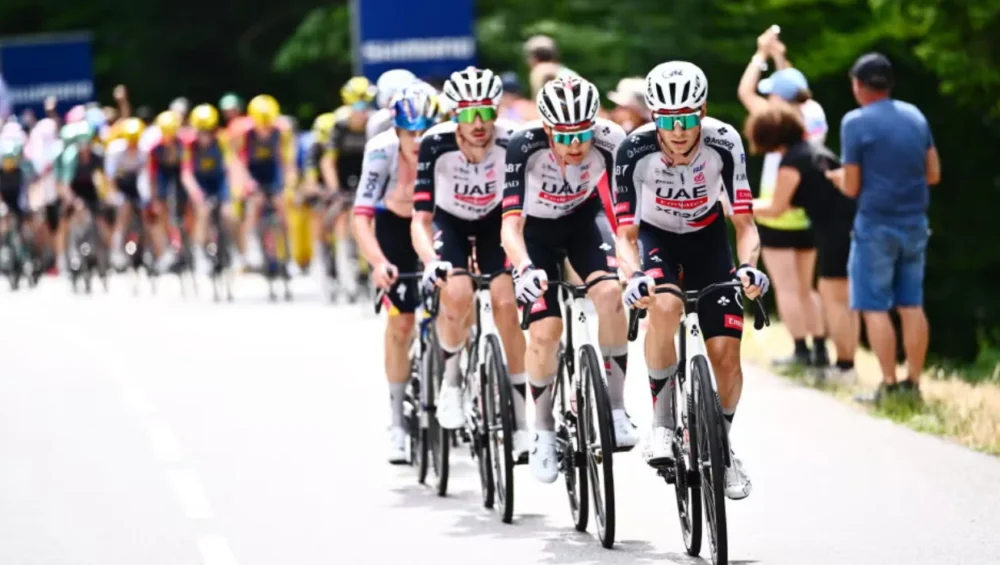
UAE Team Emirates-XRG has become the center of a growing human-rights controversy, with Human Rights Watch warning that the squad risks helping the United Arab Emirates “sportswash” its record through elite cycling. The dispute goes beyond branding: critics say the team’s structure, sponsorship base, and national messaging turn it into a platform for state image management at a time when the UAE faces serious allegations tied to Sudan’s war and wider repression.
At the heart of the issue is a simple but powerful contradiction. The team has said its aim is
“representing an entire nation, the UAE”,
while rights groups argue that the same nation is accused of backing forces in Sudan accused of genocide and other atrocities. That tension is what gives the story its force, because the team is not being attacked for winning races, but for appearing to help convert sporting success into political polish.
Why the criticism is escalating
According to Human Rights Watch, “UAE cycling team may ‘sportswash’ UAE’s atrocious human rights record.” HRW maintained that the team has been putting up government logos of the UAE in major cycling competitions around the globe despite growing evidence suggesting that the UAE supports the Sudanese Rapid Support Forces militarily. Timing is crucial here since HRW’s statement was made during the peak performance period of UAE Team Emirates when the Tour de France was already on, beginning July 4 and running until July 26, 2026. This was indeed an opportune time for HRW’s critics of the UAE to point out the reputation gain the UAE is gaining through its sponsorship of the cycling team.
Joey Shea, senior UAE researcher at Human Rights Watch, said,
“Even as evidence of the UAE’s military support to Sudan’s abusive Rapid Support Forces mounts, UAE Team Emirates-XRG is prominently displaying UAE government logos in the world’s biggest cycling races,”
and added,
“As Sudan faces yet again the imminent risk of further atrocities, international cycling’s top team risks sportswashing egregious abuses in Sudan by failing to speak out about the UAE abuses.”
Those remarks frame the team not as a neutral sports brand, but as a reputational shield for a state under intense scrutiny.
Sponsorship and state links
The structure of sponsorship is critical to the analysis since most of the sponsors backing the team are associated with the Emirati government. Human rights activists argue that Emirates airlines belong to the government of Dubai, while XRG, the team sponsor, is the arm of the national oil company and owned by the government of Abu Dhabi. The team itself has been argued to be financially and politically backed by the UAE government. According to human rights groups, this means that the cycling project goes beyond being just a private sporting enterprise given its connection to the government.
The background of the team is also another major issue to consider. When the project was founded in 2017, one of the sponsors behind it was the International Golden Group, a UAE military contractor. It is noted by human rights groups that this military contractor has been reported by a United Nations panel of experts for providing weapons to armed groups in Libya in violation of a United Nations’ arms embargo.
Taken together, these details have given critics a broader argument: that the team’s commercial success, elite visibility, and state-linked funding create a textbook sportswashing model. The team’s achievements then become part of a wider political communications strategy, not merely a sporting story.
Sudan connection in focus
The Sudan war is the sharpest and most sensitive part of the controversy. Rights groups say there is now a large and irrefutable body of evidence showing that the UAE is the primary financial backer and arms supplier to the Rapid Support Forces, the paramilitary group accused of committing genocide in Sudan.
According to Middle East Eye, the letter sent by rights groups to the UCI was concerned with “irrefutable evidence” of the UAE’s involvement, adding that the team allowed the state to exploit the biggest racing events to make its public image better while at the same time allegedly supporting the RSF. The connection drawn here is that of the cycling issue being connected to the war which has caused death and destruction so far, and in which there are fears of even worse atrocities. The issue thus has implications beyond mere damage to reputation. It concerns whether a major sports team can be exploited to improve the image of a state alleged to support one side in a catastrophic war.
Push for UCI action
The issue has moved from criticism to formal pressure on cycling’s governing structure. A coalition of rights groups, including FairSquare, has asked the Union Cycliste Internationale to suspend UAE Team Emirates-XRG from competition over the UAE’s alleged role in Sudan.[
The coalition argues that the team is being used to project a positive image of the UAE that stands in marked contrast to what it calls the violence and repression underpinning the country’s power. In its letter, the coalition also urged an immediate review of UCI licensing policies.
Alex Carlen of FairSquare said,
“We know that the UAE uses sports teams to project a positive, sanitised image of itself while at the same time offering material and political support to the RSF in Sudan, who stand accused of genocide, and who may commit further atrocities in El-Obeid,”
while Sayed Ahmed Alwadaei of Bird said the UCI could not claim to uphold human rights while allowing governments like Bahrain and the UAE to “sportswash their records.”
Those statements matter because they shift the dispute from moral criticism to institutional accountability. If the UCI does nothing, critics can argue that cycling’s governing body is tolerating a state-backed reputational operation inside its own licensing system.
The team’s counter-image
The identity of the team itself is one factor that makes it a target in this case. By asserting that it is “representing an entire nation, the UAE,” the team makes its athletic performance an indicator of its state’s prestige. While such an assertion helps with the creation of a strong brand, it also makes the critique of the state’s politics more difficult to dismiss. Usually, during sponsorship controversies, teams maintain their distance from the sponsors’ politics, but the way the controversy was presented by the team itself leaves little room for such a maneuver. That is why the situation raises many issues that are far from just about professional cycling.
Wider pattern in sport
The UAE example is also one that is a part of a broader trend of controversial states investing in top teams and events in international sport. Such criticisms have been brought forward against other Gulf-based sports projects, as there is usually a link between funding, visibility, and politics in those projects. In this respect, the UAE Team Emirates-XRG case cannot be viewed in isolation and is actually a part of the larger discussion on whether athletic success can help to improve the reputation of controversial states. Human Rights Watch, along with its partners, believes that it is the very thing that is going on with the UAE in the Sudan context and with the team in question. However, it does not imply that every sponsor of top teams is problematic and that every state-sponsored team is a controversial case by default.