
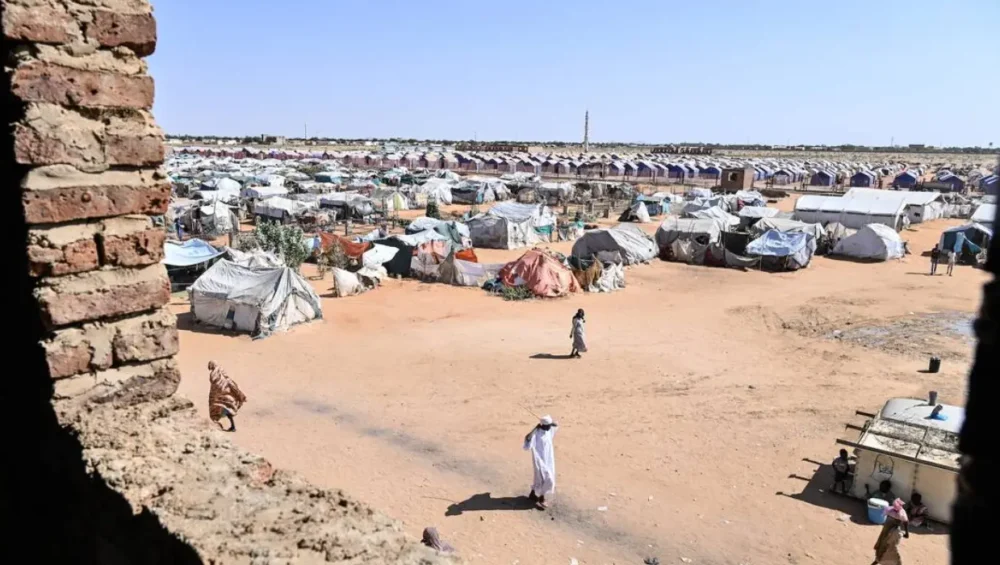
The warning from the United Nations human rights chief over Sudan’s el-Obeid has added new urgency to a war already marked by mass displacement, drone warfare, siege tactics and mounting civilian suffering.
The assertion by Volker Turk does not merely represent yet another diplomatic warning; it indicates that the struggle in the region surrounding the strategically important city is taking a turn wherein the likelihood of atrocities is becoming more imminent and visible. The case in point, el-Obeid, is only one of the many instances from the ongoing war in Sudan, wherein the achievements of armies are being quantified on the basis of civilian damage done.
The strategic location of El-Obeid, capital of North Kordofan, which connects the west, under RSF control, which includes Darfur, to eastern zones controlled by the military, makes the city a valuable military and humanitarian target. The fear of an imminent attack by the RSF has led the UN to warn that a second phase of violence and deprivation is looming should the city fall under attack or siege. This is of particular importance since El-Obeid is not a lone example of a conflict flashpoint but an indicator of how the civil war is moving deeper into central Sudan.
Why el-Obeid is strategically critical
The significance of el-Obeid can only be captured by looking at more than just its military maps. El-Obeid is a city filled with civilians, internally displaced persons, and overwhelmed civic infrastructure. According to the United Nations, the city has experienced siege-like conditions for a period of 18 months, long enough for all aspects of everyday life to be affected, from electricity and water to mobility and access to healthcare facilities. Such a sustained period of stress suggests not just an active battle ground but also a strategy of debilitating a city in preparation for an attack.
El-Obeid’s location has amplified its vulnerability. As a key junction in central Sudan, it connects supply lines and transport corridors that are important to both the Sudanese army and the Rapid Support Forces. In that sense, control of the city would carry both symbolic and operational value. But the greater cost would likely be borne by civilians, who have already lived through drone strikes, blackouts and the collapse of local infrastructure. When a city becomes strategically important in a war like Sudan’s, humanitarian needs often become secondary to military calculations, and that is exactly what the UN warning is trying to prevent.
Drone strikes and civilian deaths
The most alarming immediate figures are those provided by the UN human rights office: at least 45 people killed and 41 injured in 15 drone attacks in and around el-Obeid between June 6 and June 28. Those numbers are not just statistics; they suggest a pattern of repeated, concentrated attacks on an urban area already struggling to survive under siege-like conditions. The scale and frequency of the strikes indicate that civilians are not only caught in the crossfire but are likely being exposed to sustained targeting that threatens everyday survival.
The reports of drone strikes on the key power stations and fuel storage facilities in the city take on particular significance. Not only are they vital for military operations in the technical sense, but they are also indispensable for civilian activities. Without electricity, water pumping systems fail to work, communication networks become weaker, and hospitals are put at greater risk. The lack of fuel leads to further complications as transport operations and generator operations come to a standstill, along with the transportation of supplies. In other words, a drone attack can lead to a domino effect resulting in humanitarian catastrophe in the city without any ground attack whatsoever.
UN warning and legal implications
Volker Türk’s language was intentionally strong, and that choice matters. He said the signs from el-Obeid were “clear and unmistakable,” a phrase that reflects not just concern but a sense of urgency built on evidence from recent attacks and the broader trajectory of the war. He also warned that an assault could lead to “serious international crimes,” placing the situation in a legal and moral frame that goes beyond ordinary battlefield violence. The UN is signaling that what happens next may carry accountability implications under international law.
In his June 17 statement to the UN, Türk warned that an imminent attack on El Obeid would further deteriorate an already disastrous humanitarian situation. He highlighted the importance of the world watching and making sure that the guilty are made to account for their actions. This is a warning not just to those who are fighting on the ground but also to the external players who have not been able to contain the complete failure of civilian protection in Sudan. It is a warning both in a preventive and accusatory sense – a preventive one because it tries to prevent future violations, an accusatory one because it says that things are heading towards a crime.
Civilian life under siege
The human cost in el-Obeid extends beyond deaths and injuries. The UN reports that attacks on infrastructure have caused blackouts and severe water shortages, which can be as dangerous as shelling in a protracted conflict. A city cannot function without electricity and water, and when those systems fail, children, the elderly and the sick become the most exposed. Hospitals lose reliable power. Water systems stop pumping. Food storage becomes harder. Families are forced to make impossible choices about whether to stay, flee or wait for a corridor that may never open.
The very fact that el-Obeid had already provided shelter to almost 100,000 refugees along with its native population of around 500,000 makes the situation even graver. It would be easier to attack those places, where citizens have taken shelter. This makes shelters overcrowded and stretched in terms of providing aid in form of food or other facilities. In most of the civil wars, these cities become safe havens as well as targets of attacks simultaneously. UN’s warning was quite precise in identifying this paradoxical aspect of the conflict: a city which became the shelter for civilians could become the next ground of massive humanitarian disaster.
Sudan’s wider war context
The crisis in el-Obeid is part of Sudan’s broader war, which has already created one of the world’s most severe displacement emergencies. The conflict has affected millions, driven food insecurity and damaged education and health systems across large parts of the country. In that wider landscape, el-Obeid is important because it shows how the war is evolving from a contest between armed factions into a campaign that increasingly threatens population centers far from the original front lines.
The employment of drones also reflects the changing nature of the conflict. Drones make the use of force against cities and infrastructures easier, often from afar, and generate fear even outside the radius of the explosions. The UN warning issued in June 3 about the increase in the employment of armed drones in Sudan applies perfectly to el-Obeid. This means that the city does not endure a mere outbreak of violence but is rather an example of a larger trend that exposes civilians to danger and makes reconstruction harder. Drone warfare and sieges together create a kind of pressure that empties a city without necessarily destroying it right away.
What this means for the conflict
The warning over el-Obeid is significant because it may indicate a new phase in Sudan’s war. If the RSF moves ahead with an assault, the likely outcome is not just a military battle but a further breakdown in civilian protection and urban stability. If the city falls under tighter siege without a direct assault, the humanitarian consequences may still deepen through shortages, displacement and infrastructure collapse. In either scenario, the civilian population will likely bear the greatest burden.
This is why the UN’s language about possible atrocity crimes is so important. It reflects the fear that the next stage of the war may not only involve casualties, but also acts that could later be examined under international legal standards. Sudan’s conflict has already produced widespread allegations of abuses, and el-Obeid now appears to be at the center of a warning that the international community can no longer treat as abstract. The city represents a convergence of military strategy, civilian vulnerability and legal risk.
A crisis demanding accountability
What stands out most in this UN alert is the fact that el-Obeid is now not just a city with disputed claims, but a possible place where a disaster can be avoided. Just based on the statistics provided by the UN—45 fatalities, 41 injuries, 15 strikes from drones, 18 months under siege-like conditions—enough evidence exists to prove that the situation is real, not theoretical. In addition, the influx of thousands of displaced people only makes the situation more urgent. How events unfold depends not only on the conflicting sides, but also on whether outside pressure helps delay further escalation.
For journalists, human rights monitors and policymakers, the el-Obeid story is a reminder that Sudan’s war is now entering areas where the line between military action and mass civilian harm is becoming dangerously thin. The warning from Türk should be read as a call to attention: the conditions for atrocity are not distant, they are already forming. And in a city like el-Obeid, that means the difference between warning and tragedy may be measured in days, not months.