
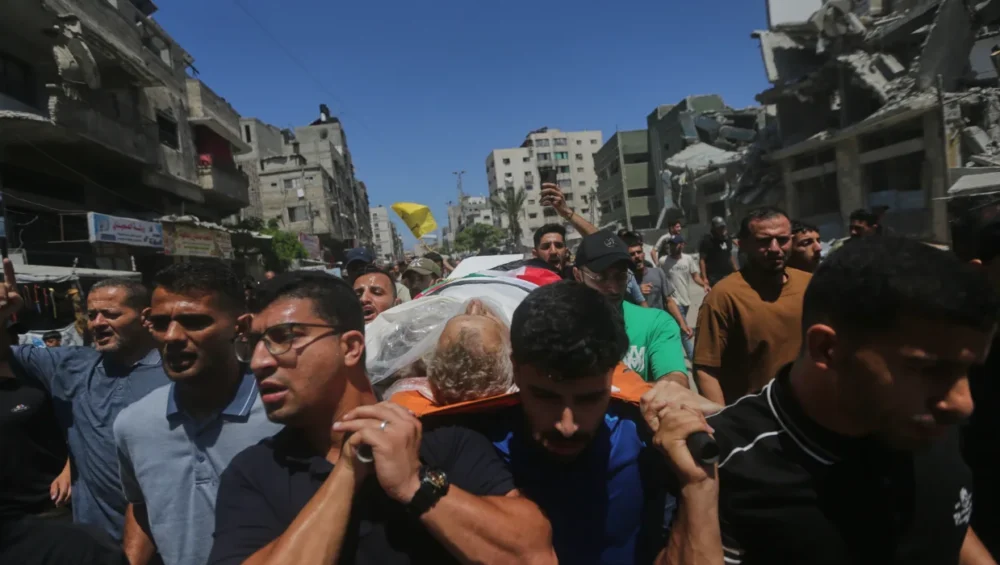
An Israeli strike in Gaza has once again placed civilian suffering at the center of the conflict, with reports saying the attack killed a Palestinian aid official who helped organize public World Cup screenings, along with other civilians including children. The timing of the strike, just before kickoff of the Egypt-Argentina match, has intensified criticism because it hit a moment tied to communal life, shared distraction, and rare public relief in a war zone.
This particular incident, as reported in the Sabra area of Gaza City, has been characterized by local health officials as an assault on a vehicle that resulted in the death of Mohamed al-Wahidi, the public relations officer for the Egyptian Committee in Gaza, along with two other boys and the driver. The death of a civilian organiser who had been connected to the screenings of World Cup matches has transformed this battlefield account into a wider condemnation of the continuing relationship between military operations and everyday life in Gaza.
Why this strike stands out
It was not only another name added to the endless tally of casualties in the death toll of Gaza. Its significance lay in the fact that the person who died was connected to the screening of sport events for the general public, which itself signified morale, socializing, and a small reprieve from the destruction surrounding the citizens in the enclaved area. In this way, the attack was not only about taking lives, but destroying an already vulnerable aspect of civilian life. It is for this reason that the attack has received much criticism beyond its actual facts. Even in war there must be a difference between military necessity and civilian harm, and the death of the public relations official arranging the screening of the World Cup raises many difficult questions.
Reported facts and casualties
As per the reports, the incident occurred in the Sabra area of Gaza City where there was an attack on a vehicle during the evening hours, before the start of the Egypt-Argentina FIFA world cup game. According to health authorities in Gaza, Mohammed al-Wahidi died due to the strike while according to the hospitals’ sources, the other people who were killed included two boys who were approximately 10 and 8 years old and also a driver by the name Ahmed Daghmush at 33 years of age. Regardless of the spelling difference in the victim’s name in various reports, the fact remains that a civilian official linked with arranging public screening of football games was killed in the strike where children were also killed.
The reports do not describe a battlefield engagement. They describe a vehicle strike in a residential area. That distinction is crucial in assessing the ethics and consequences of the attack, because it shifts the focus from combat between armed actors to the lethal exposure of civilians living in one of the world’s most crowded and precarious war zones.
Competing narratives and missing clarity
Another disturbing thing about this attack is the discrepancy between the facts provided by Gaza’s health authorities and the lack of any details in the reporting on the official military response of Israel regarding the reasons for the attack. In such situations, there often appear two different versions of what happened, but regardless of that, it does not release the country using the force from the necessity to justify how and why civilians got killed. The sources available contain information from Gazan authorities and hospital workers about the death toll and identity of those who were killed. However, the reports lack any explanations from the Israeli military side regarding the mission, target, and the rationale behind the attack. This is an important issue, especially if an attack leads to the killing of a civilian organizer and several children.
This is where criticism of Israeli forces becomes especially sharp. If the strike was intended to hit a legitimate target, then the question becomes whether the intelligence was accurate, whether the risk to civilians was considered, and whether the attack was lawful and necessary. If no such target existed, then the attack becomes even harder to defend and looks like part of a pattern in which civilian life is too easily sacrificed.
Human cost of the war
The death of Mohamed al-Wahidi carries a heavy human and political meaning. He was not described as a fighter, commander, or armed participant. He was an aid and public relations official, someone involved in coordinating a civilian-facing activity around World Cup screenings. That is the kind of role that should place a person outside the logic of military targeting.
The fact that the children who died with him makes the strike even more morally compelling. The loss of their lives is not merely a statistical occurrence. It shows how quickly war can turn regular movement through a city into death, particularly in Gaza, where strikes regularly hit dense urban areas with little or no civilian immunity. Where children die in such circumstances, it is difficult to distinguish between the operational and the human tragedy. World Cup viewing stands for much more than simply sports here. It is respite in a besieged area, a building of normality. In destroying the man responsible for this endeavor, it would seem that the strike took not just the lives, but an element of social resilience with them. This is why the occurrence made such an impact in the media, and has generated criticism on all sides against the Israeli forces.
The wider accountability question
Any fair analysis must acknowledge that war reporting often relies on local authorities in the immediate aftermath of a strike, and casualty details can be updated later. But that does not diminish the responsibility of Israeli forces to explain attacks that hit vehicles in civilian neighborhoods and kill children. In fact, the burden grows heavier when reporting suggests the victim was a civilian organizer rather than an armed participant.
The ongoing trend of lethal attacks in densely populated areas of Gaza has brought into question the credibility of Israeli military assertions on accuracy. Civilians being killed, particularly in cases where it seems they have nothing to do with actual fighting, creates doubts about any such claim by the military. The problem is not just with one attack. The issue lies in the entire process of force application, targeting, and responsibility which underlies each particular case. This is why the death of the World Cup screening organizer has a political importance. It sheds light on the discrepancy between official justifications for military necessity and the reality of civilian deaths. For the attacks to be perceived as legitimate, the military needs to justify itself.
What this means politically
This particular strike comes into the spotlight under very sensitive circumstances of an information environment. It should be noted that the World Cup is a global event which means that any story regarding the connection between the event and the death in Gaza will be spread rapidly. This means that the choice of target and consequences of the strike have a special importance since this particular attack is perceived by people not only as a tactical step but also as a demonstration of values put on the civilian lives. To the opponents of the policy of Israeli forces, this story will be the new proof of their insufficiency in the matters of restraint. To those who support the actions of Israeli forces, the main issue will be the aim of this particular strike directed not to civilians but to someone else whose name was not specified yet.
That combination is what makes the incident so difficult for Israeli forces to defend. In the absence of clarity, the narrative is shaped by the dead, not by the attackers. And in a conflict already marked by immense civilian loss, the burden of explanation should sit squarely with the side using lethal force.