
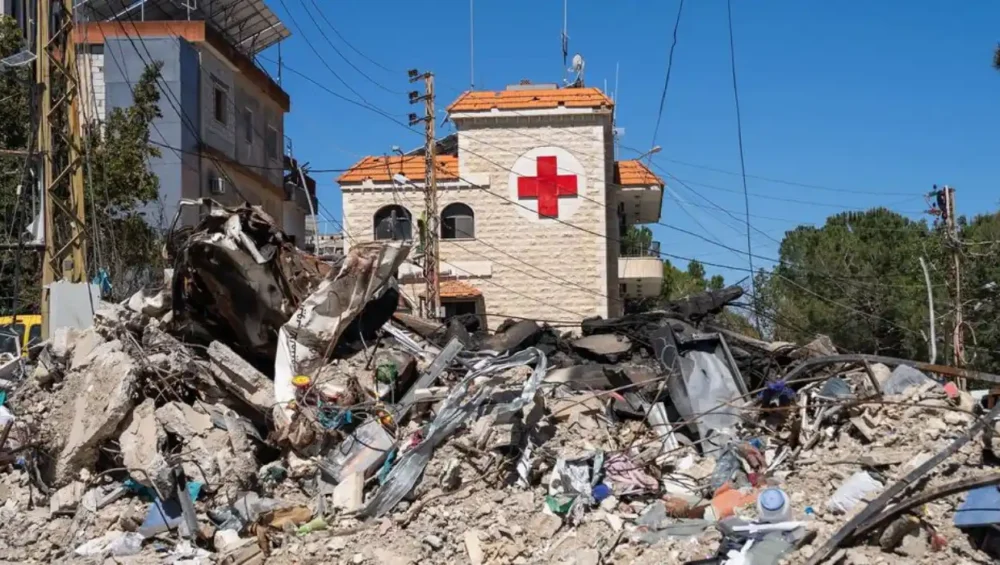
The warning from UN Human Rights Chief Volker Türk has added fresh legal and political weight to the escalating crisis in Lebanon, where Israeli strikes have already triggered widespread displacement, destruction, and alarm over civilian protection. Speaking at the end of a two-day visit to the country, Türk said the pattern of violence and denial of return for displaced residents could cross the threshold into grave violations of international law. His remarks are significant not only because of the authority of his office, but also because they place the conflict in a sharply defined legal framework at a time when the human cost is still rising.
It is no longer just the issue of casualties on the battlefield or of military gain. The issue is also the wider impact of the bombings on residential areas, critical infrastructure, and the capacity of the population to return home. This is precisely why the UN terminology is important; it is not just criticizing the destruction caused but rather warning that the behavior could actually constitute international crimes, based on how it was conducted and who was affected.
Türk’s legal framing
Türk’s message was deliberately cautious in legal terms, but firm in its substance. He did not declare that a court had already found Israel responsible for war crimes. Instead, he warned that the scale and pattern of destruction, forced displacement, and the denial of returns
“could amount to international crimes”
according to the standards of international humanitarian law.
This phrase is critical since it shows doubt in the nature of possible violations but leaves room for an actual investigation and verdict. In practice, the UN rights chief is emphasizing the basic principles of warfare – civilians should be safe, their objects cannot be destroyed, and all strikes should be proportional and necessary. Once these principles are not followed, or once the result of attacks is an evacuation of an area and its residents’ impossibility to return, the situation takes another turn.
Thus, Türk is shifting the discussion from the realm of warfare to the one of responsibility. He emphasized the connection between the violation and civilians by adding that it is not something random, but the main point which needs to be investigated. The point about “denial of returns” is particularly interesting since it implies that the conflict is going to bring not only evacuation, but also a long-lasting humanitarian and legal disaster.
Scale of displacement
The numbers attached to the UN’s concern paint a stark picture. According to the information cited in the reporting, Israeli warnings and displacement orders have covered approximately 14 percent of Lebanon. That is a large geographical footprint for a country of Lebanon’s size and population distribution, and it helps explain why the issue has moved beyond isolated border incidents into a broader national emergency.
Additionally, the UN pointed out that almost 30,000 people left the area due to the attacks and joined another 64,000 people who were displaced at an earlier stage of the escalation of hostilities. Those numbers show the speed with which the humanitarian situation became more challenging. Moreover, they show that the problem of displacement is not secondary in importance to the strikes – this issue constitutes one of the primary results of the current situation.
From the viewpoint of conflict studies, displacement on such a large scale means much more than just a military impact; it signals the presence of civilian vulnerability. The importance of those numbers can be understood through their meaning. People do not merely move to another place; they lose homes, places to study, jobs, and other amenities provided by the community. When displacement becomes prolonged, it gets harder to tell evacuation from expulsion by circumstances.
Civilian harm and destruction
The UN’s earlier and current statements suggest a pattern of killing and destruction in Lebanon that has raised urgent alarm across the rights system. In an April update, the UN human rights office said at least 71 civilians had been killed by Israeli forces in Lebanon since the 27 November 2024 ceasefire. That figure matters because it shows that the violence has not stopped at the level of political agreement. Instead, civilian death has remained part of the conflict’s aftermath.
Türk had also previously described the scale of killing and destruction in Lebanon as “nothing short of horrific”.
That wording encapsulates the emotive reaction of the UN, but it also indicates the legal significance of the gravity of the issue at hand. If an officer in the United Nations uses such wording, then it normally indicates that the office considers the behavior to be tragic as well as potentially illegal. The destruction is particularly relevant in light of the fact that international humanitarian law recognizes the difference between targets that are legal and those that are civilian in nature. If attacks are conducted on any civilian objects in violation of legal principles, then they will constitute unlawful attacks.
UN legal stance
The UN’s position, as reflected in the reporting, is careful but pointed. It is not saying every strike is automatically unlawful. Rather, it is warning that the combination of large-scale destruction, mass displacement, and denial of civilian return could meet the threshold of international crimes. That is a standard that invites investigation, documentation, and possible judicial review.
A related UN human rights declaration was more specific and articulated the relevant laws. It declared that the civilians and civilian objects enjoy protection under the law of war and all states as well as the armed groups have to respect the relevant rules. It also demanded that all sides must show maximum restraint, avoid further escalation, and take all necessary measures to protect the civilians and critical infrastructure.
As far as the legal analysis is concerned, it is quite clear that failure to make a distinction between civilians and combatants or excessive damage caused by one compared to the military advantage obtained may become criminally significant. The same UN declaration insisted that returning to negotiations is the only way out of the killings, destruction, and hopelessness. This is a very significant message from the point of view of policy since it gives priority to diplomacy over escalation.
Lebanon’s wider crisis
Lebanon’s vulnerability is a major part of the story. The country has endured years of political instability, economic collapse, and institutional strain, which means its civilian population has far less resilience than a more stable state might have in the face of repeated strikes. In such a setting, even limited military actions can generate outsized humanitarian consequences. Mass displacement in a fragile country can quickly become a national crisis.
This is one reason why the UN has characterized Lebanon as a “critical flashpoint” within the greater regional context. The attacks are not being carried out in a vacuum but are part of a context of regional tensions, border conflict, and un-resolved issues in military and political affairs. In an already strained society, destruction of housing and infrastructure is not simply a local problem. It can increase social divisions and impair recovery. The worry also looks to the future. Inability to go back to normalcy will transform damage that was originally transitory into structural damage. In other words, the implications of the attacks can persist beyond the immediate military phase.
Political and humanitarian implications
The comments made by Türk are bound to reverberate outside the boundaries of Lebanon since they contribute to a larger discussion that is taking place internationally regarding the conduct of the war and the use of force. In this respect, the comments made by Türk are bound to support the cause of those seeking accountability since the comments are going to highlight the issue that the killing of civilians cannot go unpunished.
However, from the perspective of those who justify the use of military force by Israel, this comment will serve to highlight yet another example of UN’s exertion of undue influence on Israel in one of the most sensitive conflicts. As far as the humanitarian issues involved are concerned, they are quite obvious. Each new wave of displacement raises issues of housing, nutrition, healthcare and protection.
There is also a broader regional dimension. Escalation in Lebanon can deepen instability across the Middle East and complicate efforts to prevent wider conflict. In that sense, Türk’s warning is both a human rights statement and a strategic alarm. It reflects the UN’s view that a local military campaign can quickly become a regional crisis when civilian protection is not central to decision-making.