
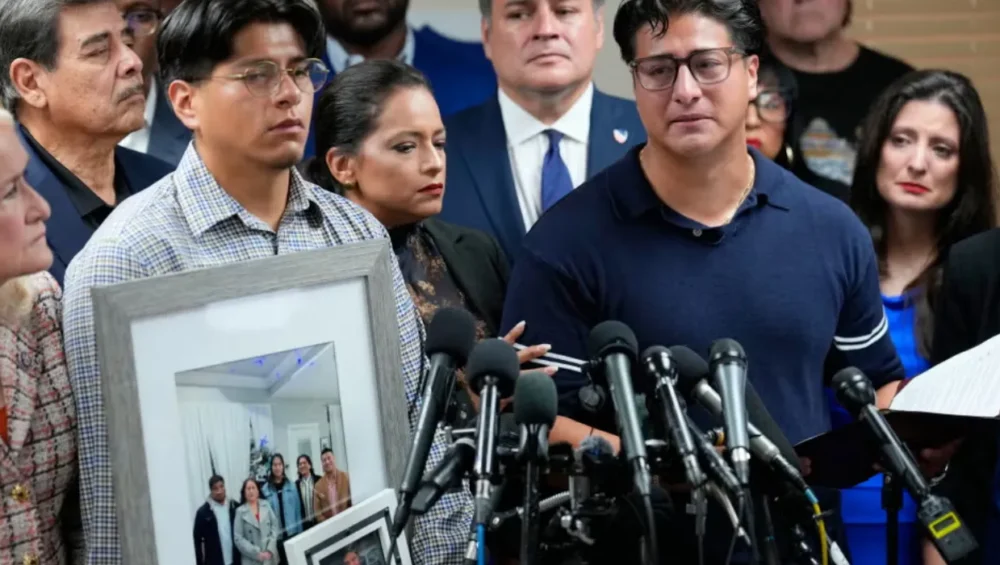
The fatal shooting of Lorenzo Salgado Araujo by an ICE agent in Houston has quickly become more than a single-use-of-force incident. It has turned into a broader test of public trust, agency accountability, and the demand for outside oversight in a case that has drawn family grief, political pressure, and street protests. At the center of the controversy is a simple but powerful demand from the victim’s family and supporters: the investigation should not remain solely inside the same system involved in the shooting.
The case has had resonance due to its nature as a deeply personal tragedy that touches upon issues surrounding the functioning of immigration policy in the country. According to reports, Salgado Araujo was killed in Houston on July 7, 2026, and the events following it have quickly escalated from being just a local story to a national discussion. Ronaldo Salgado, the son of the man in question, has emerged as the most prominent voice in the story thus far.
What happened in Houston
The shooting took place in a raid conducted by ICE in Houston, Texas, where ICE killed Salgado Araujo. This fact alone makes the case highly political since it involves the federal enforcement agency in the death that is getting a lot of media attention. While the main emphasis in news articles has been made on the response and accountability demands, the key problem here is that a man was killed in the course of actions involving a federal immigration officer, and the question now is whether such an investigation can be regarded as credible at all. The human factor has made a lot of difference.
As PBS reports, Salgado Araujo devoted 35 years of his life to help his three American citizens’ sons attend college. Enlace Latino adds that he did not have any criminal record during his ten years living in America. This information has created certain image of the case among immigrants’ rights supporters and the community.
Family demand for accountability
The most consistent public message from the family is that this cannot be treated as a routine internal matter. Ronaldo Salgado has asked for an independent investigation, arguing in interviews that his father deserved better and that the public needs answers beyond what ICE may provide on its own. The family’s position has been echoed by advocacy organizations and commentators who say the integrity of the inquiry depends on separation from the agency involved in the shooting.
One of the most quoted lines in the reporting comes from the family’s response, reflecting not only grief but moral outrage. The family’s message, as summarized in coverage, is that Salgado Araujo “did not deserve to die”. That statement captures the emotional core of the dispute and frames the case as both a personal tragedy and a public accountability issue. The demand for a probe is not simply about determining fault; it is also about ensuring that the findings are trusted by the public, especially by communities already skeptical of immigration enforcement institutions.
Public reaction grows fast
The protests in Houston escalated very fast. Reuters revealed that more than a thousand protesters protested near the site shouting, “ICE out of Houston.” Such an outbreak of protests clearly indicates the speed at which the issue turned into a flashpoint issue for the community. Large-scale protests of this nature are indicative of not merely one individual tragedy in which one person died, but also public outrage against the policies followed by ICE. Human Rights Watch identified the case as another challenge to the government in order to test its transparency in such situations.
It is very crucial in such circumstances because it shifts the focus of discussion from the act to the legitimacy of the subsequent investigation process. When a case becomes a transparency test, the issue becomes one of the validity of the process and not just the act.
Political and civic pressure
Local government officials and community leaders from Harris County have also entered the fray. This point is significant in that it shows the matter has entered the realm of politics, which means that the officials feel the need to show that they are not just going along with the federal authorities. When there are demands for an independent investigation, there is often a feeling that the matter might be treated in an overly limited or defensive manner otherwise.
CHIRLA, one of the largest organizations supporting the rights of immigrants, has asked for an independent investigation into the death. This is significant in that it shows that the matter is now part of an overall campaign on immigrant rights, federal enforcement actions, and civil rights issues.
What the available facts show
The confirmed facts in the reporting are clear. Salgado Araujo was fatally shot by an ICE agent in Houston on July 7, 2026. His son Ronaldo Salgado has publicly demanded an independent investigation. More than a thousand protesters reportedly marched in Houston, and advocacy groups plus local leaders have called for transparency.
It is important to note other relevant background information as well. PBS noted that Salgado Araujo had been laboring for 35 years to help support his family and educate his sons. According to Enlace Latino, he was not a criminal and did not have any criminal record in the United States throughout the decade he had lived there. Such information has no bearing on the outcome of the case, but certainly contributes to shaping the narrative about a man who is more than just a name from a police report – he is a loving father and hardworking immigrant. There are still many important questions left unanswered in public reports. The existing information has not provided an official version of the chronology of events that led to the shooting.
Why the case matters
This case matters because it sits at the intersection of immigration enforcement, public accountability, and community trust. ICE has long been a politically charged agency, and any deadly encounter involving its officers can quickly become a national issue. In this instance, the protest size, the family’s public statements, and the involvement of rights groups have amplified the demand for scrutiny.
It also matters because the phrase “independent investigation” has become the central legitimacy test. The family and supporters are not merely asking for information; they are asking for a process they can trust. That distinction is significant. An internal review may answer procedural questions, but an independent probe is often viewed as more credible when the agency under review is itself part of the incident.
The case may also shape how future incidents are reported and discussed. Reuters’ note that protests exceeded a thousand people suggests a level of public mobilization that agencies and officials cannot ignore. Human Rights Watch’s framing suggests the episode could become part of a broader accountability debate about federal force in immigration enforcement. If the investigation is seen as limited or opaque, the public backlash could deepen further.