
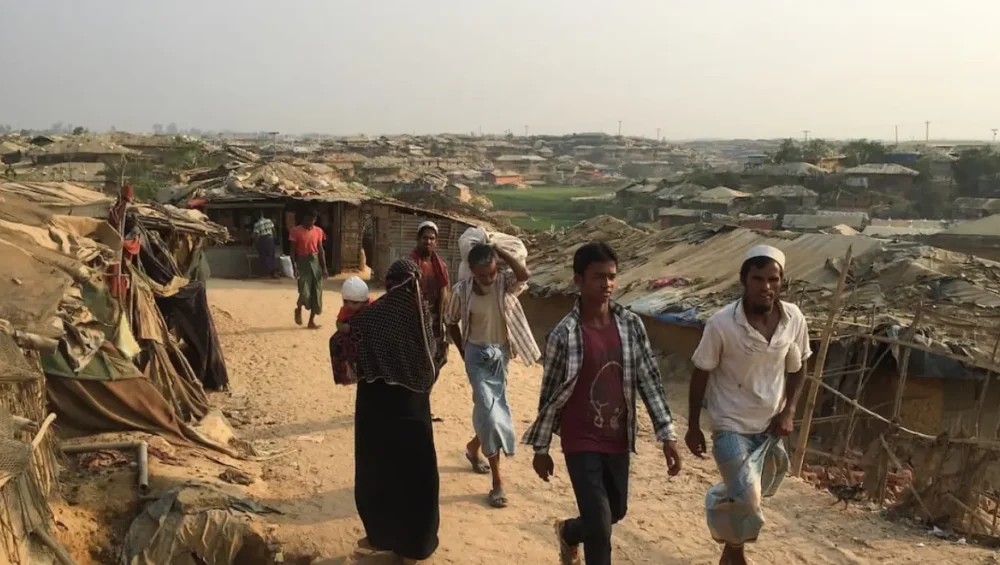
Malaysia’s latest Rohingya controversy has again placed the country’s refugee policy, local community tensions, and enforcement approach under sharp scrutiny. According to the reported accounts, hundreds of Rohingya refugees said they were forced out of their homes in northern Penang state and later gathered outside the UN refugee agency office in Kuala Lumpur seeking protection and attention.
What is more, the development itself has expanded beyond being just a story of local displacement as it reveals the vulnerability of the status of the Rohingya people in Malaysia as well as the tension of Malaysian authorities in handling humanitarian and domestic politics-related issues. In fact, the story has started attracting media attention once the members of the group arrived at Kuala Lumpur and began camping out at the UNHCR offices. The fact that they were traveling from Penang to Kuala Lumpur in three chartered buses speaks volumes about their case and level of displacement.
Eviction Allegations in Penang
This allegation is that Rohingya refugees who resided in the northern state of Penang were coerced to leave their dwellings. The refugees in the allegations mentioned that they were intimidated and told to leave. Ahmad, one of the refugees, has stated that they were unaware of the reason for their eviction and had to take buses at nighttime to evade trouble. These statements indicate that the evacuation occurred suddenly and forcefully, rather than systematically. The importance of the allegation lies in the fact that it deals with more than just a single incident.
In Malaysia, the communities of Rohingya reside in vulnerable circumstances as they do not have the support of a refugee system. Thus, any backlash from the locals could soon turn into a humanitarian crisis. The situation is concerning in light of the fact that people who resided in a particular location for several years were made to leave.
The reporting also suggested that the group had lived in the Penang settlement for a considerable period before the alleged eviction. That detail is significant because it points to a degree of integration into the local area, even if informal. In such cases, sudden pressure to leave can disrupt not only shelter but schooling, family arrangements, work, and basic community ties.
Kuala Lumpur Gathering
After leaving Penang, the refugees reportedly traveled to Kuala Lumpur and assembled outside the UNHCR office. They set up tents there, with children seen among the group, highlighting the human dimension of the crisis. The gathering was not just a protest; it was also a plea for recognition, safety, and intervention.
This decision for them to seek out the UNHCR office is quite revealing. For those refugees who do not enjoy any legal protection or political clout locally, the UNHCR office tends to be the most recognizable place to approach if faced with any form of eviction, harassment, or threat. By their very presence in front of the UNHCR office, one could deduce that what they seek is more than just compassion but a response to a situation which they consider to be quite urgent. This also explains why they arrived there in groups by three chartered buses. They were definitely not making a casual move but a move of desperation.
Government Response
The government response has been quite clear-cut. According to Reuters, Malaysian Prime Minister Anwar Ibrahim told enforcement agencies to act on the Rohingya Muslims who had come together outside the United Nations refugee agency office in Kuala Lumpur, saying that those who did not have the necessary permits would be arrested. This is significant in the context of the fact that this is seen as a law enforcement rather than a protection matter by the Malaysian authorities.
The situation is explained by the problems that Malaysia has faced throughout its history when dealing with undocumented migrants and refugees. Even though the Rohingya people are widely acknowledged in the international community as one of the most persecuted minorities around the world, they do not have any legal status in Malaysia.
At the same time, police in Kuala Lumpur reportedly said their role was only to maintain security at the scene. That statement signals a controlled response, at least in the immediate moment, rather than a forceful dispersal. Even so, the prime minister’s order made clear that the state was prepared to respond firmly if the group remained without official permission.
Humanitarian and Political Tension
The episode reveals a recurring tension in Malaysia’s Rohingya policy. On one side is the humanitarian reality: refugees who say they were threatened, displaced, and left with no safe shelter. On the other is the state’s concern about legality, migration control, and public order. Those two positions often collide in high-profile Rohingya cases.
For the refugees, the situation is deeply personal and immediate. Being moved out of a home, especially with children, means loss of safety and stability. For the government, however, the visible presence of a large group outside a major international office can quickly become a political and administrative problem. This is particularly true in a context where refugee status is not fully formalized and where local authorities may be under pressure to avoid setting a precedent.
The central difficulty is that the same people can be viewed as both vulnerable and unauthorized. That dual status creates a policy vacuum. Humanitarian concern may exist, but without clear legal pathways, it often translates into temporary handling rather than durable protection.
Wider Rohingya Context
This is not the first time that Penang has been linked to major incidences involving the Rohingya. In 2022, there was an escape of over 500 Rohingya from a detention camp in Penang, during which six people died in their attempt to cross the highway. The situation indicated just how chaotic situations can get when detention, escape, and survival meet. There was also a previous reported case in 2023 when a number of Rohingyas living in Penang were evacuated without notice ahead of Raya.
In this case, according to UNHCR Malaysia, the Rohingyas in question have lived in Penang for almost ten years and had integrated into the society very well. This is important context since it indicates that the current case is part of a bigger picture.
Taken together, these incidents show that Penang has repeatedly been a flashpoint in the treatment of Rohingya refugees. The state appears to be a place where temporary settlement, local resistance, and immigration pressure can combine into crisis. For refugees, that means ongoing uncertainty. For policymakers, it means repeated reputational and governance challenges.
Broader Significance
The current case is notable in the sense that it once again puts together the vulnerability of the Rohingyas, the resistance of the locals, and the immigration policy of Malaysia. As it can be seen from the case, refugee-related problems tend to arise not only in global settings but right at home. The minute the crowd assembled in Kuala Lumpur, the problem could not be overlooked anymore. Moreover, the example also highlights that the Rohingyas who are asylum seekers in Malaysia continue to remain vulnerable to any sudden change in their treatment regime. They can reside somewhere for years and yet still be vulnerable.
Ultimately, the Penang allegations are a reminder that the Rohingya crisis in Malaysia is not only about border arrivals or detention centers. It is also about where refugees live, how local communities respond, and whether the state can create a system that is both orderly and humane. At present, the latest episode suggests that balance remains unresolved.