
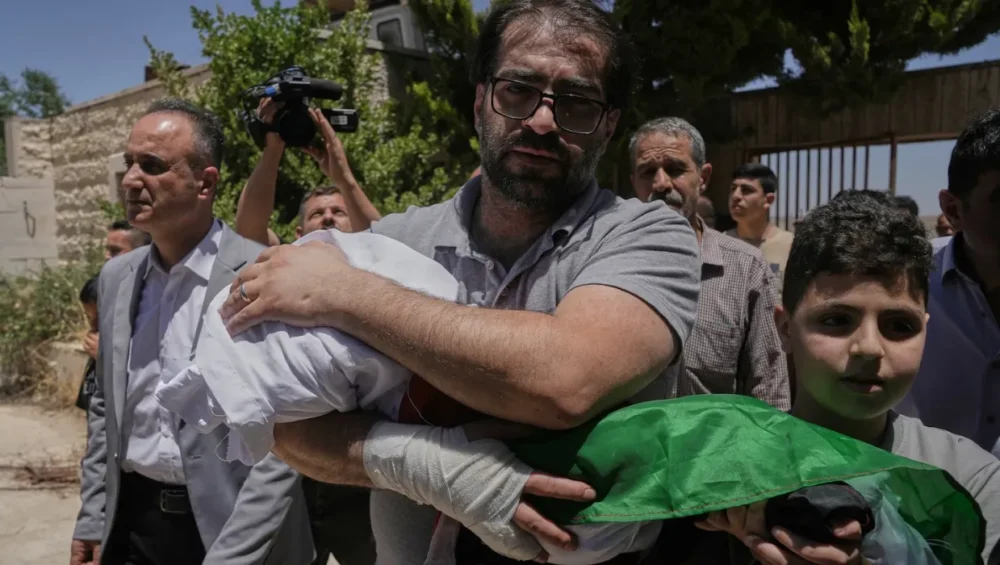
Sam Fahd Abu Haikal, a seven-month-old Palestinian baby boy, was the latest victim of the ongoing violence that has been characteristic of the region since its occupation. Israeli forces reportedly murdered the child in Tel Rumeida, which is situated close to Hebron on the night of Friday, June 5, 2026. The bullet responsible for Sam’s murder hit him in his jaws; the very bullet had injured his mother and the hand of his father. The murder of Sam is more than a single tragic incident as it signifies a gross violation of human rights that threaten the safety of Palestinian children in general.
The family was on its way from Bethlehem to see relatives in Hebron when Israeli forces started firing at their car. Fahd Aziz Haikal, who is Sam’s father and teaches at Bethlehem University, explained how terrifying the scene became when the shooting began. His pregnant wife was injured by the same bullet that took the life of their little boy. The circumstances surrounding this murder have prompted serious consideration regarding the use of force by the Israeli soldiers and the protection of innocent civilians, especially the most vulnerable among them.
Official Accounts and Conflicting Narratives
The Palestinian Health Ministry provided definitive details about the infant’s death, confirming that Sam Fahd Abu Haikal was “fatally shot by Israeli forces who opened fire on his parents’ car.” The ministry’s statement identified the baby and documented the injuries sustained by both parents during the incident. According to the official Palestinian news agency WAFA, the baby was “gravely injured after being hit in the jaw by the same bullet that also wounded his mother” and subsequently “succumbed to his injuries shortly afterward.”
In contrast, the Israeli military offered a different perspective on the incident. Israeli troops stated that they “fired at a vehicle they believed was accelerating towards them in the Hebron vicinity.” However, this explanation does not answer the crucial question of why the presence of a family with an infant who was only seven months old could possibly be considered a reason to use lethal force. Even though the army admitted that the case is under investigation, there has been no history of accountability for similar cases from previous investigations.
It is obvious from these different perspectives that there exists a more serious issue of the control of information in times of conflict. Although the health authorities among the Palestinians record their victims meticulously, the Israeli armed forces tend to explain their actions with vague claims of perceived threats whose existence cannot be verified independently. Such contradictory stories cloud the truth of what happened.
A Pattern of Violence Against Palestinian Children
This occurrence is not an anomaly but one among many such acts that form part of the violent attacks against Palestinian children in the occupied West Bank. According to a report by UNICEF, about 70 children have been killed in the occupied West Bank and East Jerusalem from early 2025 up to date, which translates into an average of one child murdered every week. Approximately 90 percent of the children have lost their lives at the hands of Israeli security forces. Additionally, more than 800 children have been injured.
There have been many other cases that have occurred recently involving children. In January 2025, for instance, Laila al-Khatib, a two-year-old Palestinian girl, died at the hands of Israeli soldiers in a raid in Jenin. In another instance, Israeli soldiers killed a five-year-old boy and his mother, alongside his younger sister, who was seven years old, in an attack while they were traveling in the occupied West Bank. The case shows how children in the occupied areas are exposed to danger regardless of age.
Human rights organizations claim that Palestinian children are “increasingly being targeted,” as violence by the Israeli army and settlers continues to rise. The increase in such violent acts demonstrates a tendency towards dehumanization, whereby Palestinian civilians—including those who are among the most vulnerable members of society—are viewed as targets to be killed as opposed to civilians protected by international laws.
International Law and Human Rights Obligations
According to the international laws of humanitarian conduct, in particular those contained in the Fourth Geneva Convention, there are certain rights to which people living under occupation have access. These rights encompass life, protection, and non-violence against people living under such conditions. The death of a seven-month-old child due to military attacks is a complete breach of this provision. The Fourth Geneva Convention bans all forms of violence against the life and body of any person who is not engaged in fighting.
United Nations Convention on the Rights of the Child, which almost all countries have signed into law, provides that children enjoy basic human rights including the rights to life, survival, and development. According to Article 6, the basic right to life is inborn to each and every child, and the state parties must do everything possible to ensure the survival and development of the child. The killing of the seven-month-old infant by the military is a violation of this basic human right.
Also, the concept of proportionality under international humanitarian law indicates that any application of force should be proportional to the military goal being pursued and should not lead to extreme injury to civilians. Applying lethal force to a vehicle containing a family with a baby who dies as a result constitutes an act of disproportion. Despite the fact that the military saw the vehicle as a threat, its actions were highly disproportionate since there was no threat posed by an innocent baby.
The Broader Context of West Bank Violence
The murder of Sam Fahd Abu Haikal takes place against the backdrop of a larger trend towards increasing violence in the occupied territories of the West Bank. The period since 2025 has been marked by an upsurge in violence, with an increase in both Israeli army incursions into Palestinian land and violence from settlers.
The Tel Rumeida neighborhood in which Sam was assassinated has always been a source of contention. In this particular neighborhood of Hebron, both Palestinians and Israelis reside, and the Israelis are backed up by their army to safeguard them. The Tel Rumeida neighborhood has had many instances of violent activities, from the killing of Palestinians, shootings that cause injury, to the destruction of Palestinian properties. The occupation of Palestinian neighborhoods by the Israelis, who have the backing of the military, is nothing but oppression of the Palestinians.
In addition to being harassed by military checkpoints and settlers, Palestinians’ lives become increasingly dangerous while moving from one place to another. As is illustrated by the case involving Sam’s family, a normal trip for visiting one’s family members can easily take tragic proportions as soon as there are no boundaries within which military personnel can function. The injury to both the child’s parents along with an infant is a vivid example.
Absence of Accountability and Justice
What is most frightening about this murder is how certain it is that there will be no accountability. Israeli military inquiries into the death of civilians have never been known for their transparency, impartiality, and efficacy. It is almost always the case that in situations where Palestinians are murdered by the Israeli military, no charges are ever brought against the soldiers involved.
Such acts of killing among Palestinian families are bereft of any chance for legal recourse. The Israeli military judicial system is never willing to ensure justice through fair trials for Palestinian defendants; meanwhile, civilian courts lack the will to indict military men for violations against Palestinians. Legal frameworks within the international community, which include the International Criminal Court, cannot act on the matter due to political barriers and enforcement limitations.
The Human Cost of Occupation
Apart from the legal and political implications, this event constitutes great human tragedy, since Sam Fahd Abu Haikal will not be able to go through the process of growing up, knowing his parents’ affection when growing older. He will never be able to feel all the sweetness and hardships of being a child. His mother, who has been shot by the same bullet, now has to deal with the death of her baby while recovering herself, whereas his father, a university teacher whose dreams were to give his family stable conditions, must now take care of his wounded wife and say goodbye to his son.
The psychological trauma inflicted on people is not only felt by the victims themselves but also by the whole community living under occupation in the West Bank. Every parent here knows that they can lose their baby at any time. Their children are unable to play outdoors freely, knowing that they can become a target at any point of time; there may be a chance that they get shot.
Call for International Action and Accountability
The murder of Sam Fahd Abu Haikal who was only seven months old needs immediate attention from the international community. Governments around the world and other stakeholders like international bodies and human rights organizations need to hold the perpetrators accountable for such a violation. There are international laws requiring that civilian lives in the territories of their occupation be protected and any human rights violation investigated and dealt with legally.
Some of the measures that should be taken immediately include carrying out independent investigations into this murder and others, imposing economic sanctions on those committing human rights violations and putting more pressure on Israel to end its occupation of Palestinian territories. Palestinians’ children’s safety should be prioritized in international human rights enforcement efforts.
The life of Sam Fahd Abu Haikal, though tragically brief, represents the countless Palestinian children who have died under occupation. His death must not be forgotten or dismissed as an isolated incident. It stands as evidence of a systematic human rights violation that demands recognition, condemnation, and action from the international community. Only through sustained pressure and genuine commitment to human rights can we ensure that no more Palestinian infants are killed by military forces in the occupied West Bank.