
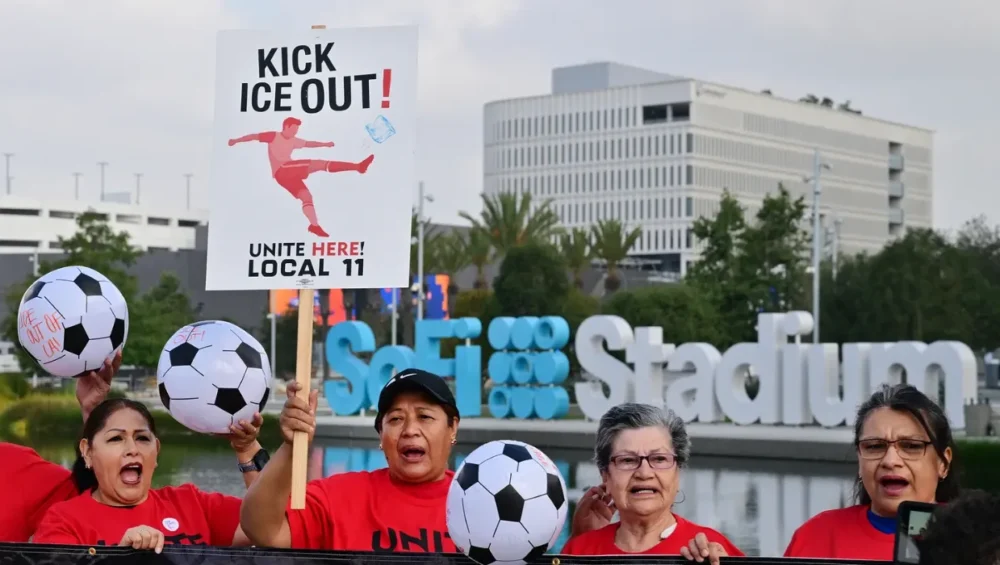
The issue around the hosting of the FIFA World Cup in 2026 has gone past stadium security and into broader concerns of civil liberties, immigration, and the abuse of state powers. Advocacy organizations for human rights have indicated their fears that should the Immigration and Customs Enforcement (ICE) play a more prominent role in ensuring safety in the games, there will be cause for alarm among immigrants, asylum-seekers, and perhaps even the spectators at the events. Such fears, which may seem excessive, arise from the stance taken by the Trump administration in portraying Homeland Security and ICE as important partners in providing security for the World Cup games.
The matter became more pressing when it was claimed that the Acting Director of ICE, Todd Lyons, referred to the importance of the role played by his organization in ensuring the security of the event as being a “key part.” Similarly, DHS implied that its representatives, along with the personnel dealing with issues relating to immigration, would play an important part in the World Cup operations. For human rights activists, this message was perceived as an alarming one since it seemed that this move could help justify the mass round-up of immigrants on the pretext of securing an international sports event.
Why rights groups are sounding alarms
Amnesty International has been among the loudest voices warning against turning the tournament into an enforcement showcase. In its public messaging, Amnesty said the World Cup risks becoming a “stage for repression” if the U.S. uses the event to intensify immigration action, surveillance, and intimidation. The organization also said the tournament could become a “platform for oppression” if foreign visitors, residents, and workers are treated as potential targets rather than fans or participants in a global celebration.
The Human Rights Watch has also expressed similar concerns, focusing on how deportations during major sporting events could break apart families and cause fear among households where family members have different statuses regarding deportation issues. The main idea of these rights groups is that while the presence of ICE and other agencies may deter criminal activity, it may also make individuals reluctant to attend the games or even go to the host city for any celebrations. This is particularly threatening considering the very nature of the event in question.
Moreover, there is a much larger issue of U.S. immigration policy being considered here by those involved. The term used by Amnesty is “human rights emergency,” as they assert that deportation, detention, and surveillance have generated fear and panic among immigrants. As such, the World Cup is seen in a much larger context, becoming not just a sports tournament, but
“a test to see if the United States can stage a major international event without it becoming a policing effort.”
Officials frame it as security, not sweeps
A different narrative has been attempted by U.S. officials. The official narrative is that ICE and Homeland Security Investigations will ensure that the sporting event remains safe from any actual criminal activities such as trafficking, forged ticketing, smuggling of illegal narcotics, counterfeiting, and even the use of drones. This has been the official justification for the heavy-handed enforcement measures: that an international event in the United States requires multiple layers of security, and that the immigration agencies have the means to achieve this.
The Department of Homeland Security (DHS) Secretary Markwayne Mullin said ICE and HSI “will be there every day” and will assist with fighting crime in connection with the event. This is significant for many reasons, particularly in the way that it suggests this will be a recurring phenomenon. This comes at a time when the White House and DHS have gone out of their way to suggest that the operations are primarily for security purposes and not necessarily for deportations.
Still, the optics remain difficult. When immigration officers are visibly tied to an event that draws millions of international fans, the distinction between anti-trafficking work and immigration enforcement can blur in the public mind. That is especially true in cities with large immigrant populations, where residents may not trust that officials will keep enforcement separate from stadium security or public transit monitoring.
The numbers behind the fear
This controversy takes on even more significance considering the size of the endeavor. According to Amnesty, there are 1,544 contracts in place between ICE and state or local law enforcement bodies, such as those of the major host cities of Dallas, Houston, and Miami. This number is significant since it indicates that the federal government already possesses a wide-ranging enforcement system which can be put to use at or around the tournament.
There is also the issue of the $500 million drone security program, which will apparently be used in anticipation of the World Cup. Such a substantial investment shows how important security has become to the government, while at the same time, it shows how the World Cup will be under multiple surveillance layers. However, the problem of surveillance and its relationship with abuse of power is evident only when immigration enforcement measures are added to the current situation of deportation rhetoric.
However, there is also the problem of sheer scale – the World Cup of 2026 will take place simultaneously in the US, Canada, and Mexico, which means that massive crowds of people, their travel, and large economic concerns will be involved. It can easily result in overreach, even if officials claim that their task is not to infringe upon any civil liberties but just to enforce law and order.
FIFA is under pressure too
FIFA is not merely a spectator in this controversy. One news article indicated that FIFA had even thought about having Trump order ICE to stop any activities related to the World Cup tournament. This is an important aspect since it shows that the sports organization is concerned that the reputation of the event would be negatively impacted if the fans see it as being linked to deportations. FIFA has always marketed itself as an ambassador of worldwide inclusivity, and its financial well-being depends on that.
However, in balancing both its reputation and its relations with host governments, the organization faces difficulties. While the organization cannot exert any influence on U.S. policies of immigration control, it can express concern about the climate of the World Cup and the fate of its fans. In having to talk about immigration laws enforcement, it will show the significance of the issue and its shift from the agenda of activists towards the agenda of political governance of the World Cup.
For the organization, the potential reputation risks are rather high. Organizing the World Cup associated with warnings of detention and surveillance would contradict the FIFA’s image of the World Cup as the festival of unity, culture, and global fandom.
What supporters of enforcement say
Those in favor of increased authority believe the worries are unwarranted. According to them, there is need for intelligence sharing, border cooperation, screening for organized crime, and surveillance for anything that might threaten the major sporting event. What’s more, according to these people, the fact that only ICE and Homeland Security have the ability to detect fraud, trafficking, and smuggling makes them the best to take up this task of ensuring safety during such events. Additionally, they accuse critics of making a blanket statement that immigration enforcement is automatically abusive.
In this case, politics come into play as much as law. For the enforcement supporters, this is an opportunity to demonstrate to the public that there is no problem conducting an enforcement operation that does not interfere with public safety on the scale of the federal government. For critics, however, this logic sets a very dangerous precedent, whereby the government justifies its immigration enforcement activities during a celebration.
That conflict is why the language used by officials matters so much. Phrases like “key part” and “every day” do more than describe logistics. They signal priorities. They tell the public what kind of enforcement environment to expect. And once those expectations are set, they are hard to walk back.
The human impact could be real
The people most likely to feel the pressure are not just undocumented migrants. They include asylum seekers, green-card holders with mixed-status families, workers in hospitality and transportation, and local residents who may avoid transit hubs or fan zones out of fear. Human rights organizations warn that when immigration enforcement becomes highly visible, it can reduce participation in public life well beyond the intended targets.
That matters during a World Cup because the event depends on crowds, movement, and a festive public atmosphere. If families stay home, if workers avoid certain districts, or if visitors decide not to attend because they fear questioning or arrest, the tournament loses some of its meaning. More importantly, the atmosphere of suspicion can damage trust in law enforcement more broadly, making it harder for cities to distinguish between actual security threats and ordinary community activity.
Critics are also worried about abuse. Once enforcement becomes more visible and politically charged, the risk of profiling rises. Communities with large Latino, African, Middle Eastern, and Asian populations may feel especially vulnerable if they believe officers are using appearance, language, or neighborhood patterns as cues for scrutiny. Human rights groups argue that this is exactly the kind of environment in which civil rights violations tend to multiply.
A test of policy and image
The World Cup has become a test of how the United States defines security in an era of intense immigration politics. The administration says the goal is to protect fans and the integrity of the tournament. Human rights groups say the real danger is that an event built on openness will be used to intensify fear and punishment. Both sides are now fighting over the same word: security. One side means public protection from crime. The other means protection from state overreach.
What happens next will likely depend on how strictly authorities separate stadium operations from immigration enforcement, how visible ICE is around host cities, and whether officials adopt clear limits on arrests, profiling, and cooperation with local police. If those lines remain vague, the criticism will probably grow louder. If they are defined and publicly enforced, the government may be able to reduce some of the backlash.
For now, the World Cup is no longer just being discussed as a sports spectacle. It is being watched as a political and human rights story with global stakes. The strongest warning from rights groups is not that security will fail. It is that security itself may succeed in ways that leave behind a deeper and more lasting injury: fear.