
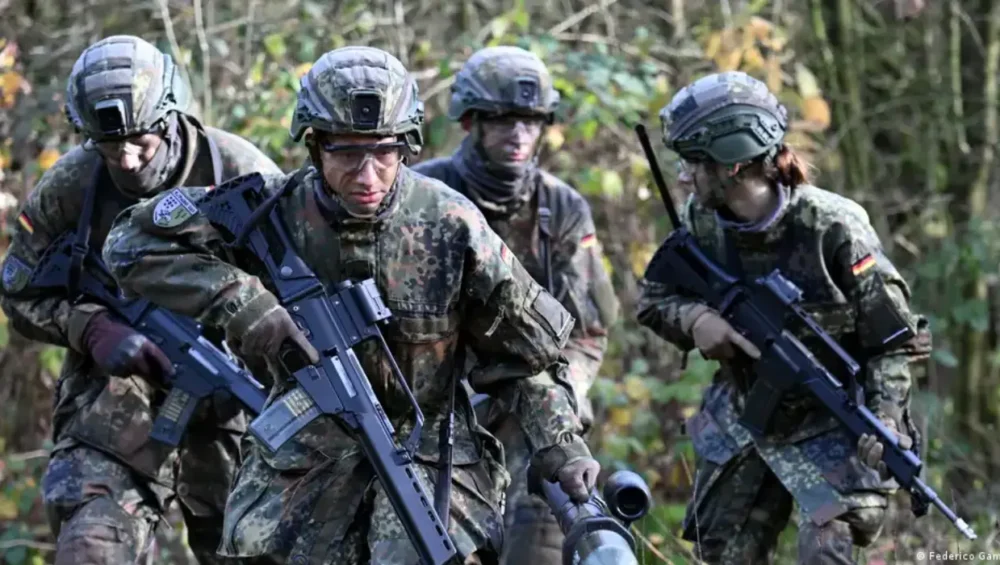
The fast-paced military development in Germany is facing harsh criticism from ten human rights NGOs, arguing that the nation has started placing too much importance on security issues over basic human rights. This concern, expressed by the groups in the 2026 Fundamental Rights Report, is seen as an indication that the discussion should not be limited to a policy debate on security but as a question of democracy itself.
This is an especially delicate time to publish the report. Germany is reacting to an unpredictable global climate, which is driven by Russia’s war against Ukraine, Israel’s attack on Gaza, among other global geopolitical issues, which have made security a priority in public policy in Europe. However, according to the organizations behind this report, Germany is taking more than its fair share of military measures, which seem to be altering its priorities in a manner that might undermine its human rights agenda.
A warning from rights groups
The bottom line here is very clear – the security policy of Germany is developing at such a pace that fundamental rights are being sidelined. According to the groups, the phenomenon can be witnessed in terms of decision-making in policy, budgeting, and rhetoric in politics that considers military preparedness the ultimate public service. What is interesting about their assessment is that it is not specific to any one particular government or ministry but rather reflects a broader consensus on military modernization as an untouchable issue.
One of the most important aspects of this critique has to do with the way in which the report places its findings in a historical context. From what the press release reveals, the authors characterize today’s level of militarization as being unlike any seen in Germany since World War II. This is an extremely serious charge, coming from a nation where the post-war political identity has been built on ideas such as constitutional limitation and civilian control of the armed forces, among other things.
The report was issued in Karlsruhe, and it is claimed that the document is composed of 240 pages; hence it must be noted that this is not simply an expression of an idea, but rather a comprehensive analysis on rights. Through organizing ten human rights groups behind the report, its goal is to issue a warning, which can neither be seen as the alarm cry from one individual group, but rather from the civil society at large.
Defense spending and political consensus
One important issue discussed in the report is that of Germany’s military spending levels. As reported, Germany’s politicians agreed upon a wide consensus to allocate substantial sums of money for upgrading the Bundeswehr force in the year 2025, with the amount reportedly ranging between about €500 billion and €580 billion. Regardless of any specific wording used, the basic idea put forth by the rights organizations is the same – the massive amount of public funds being spent on military purposes signals a turning point.
The importance of this change lies in the fact that budget making is a political process, and an increase in military spending along with a decrease in expenditures for other areas such as social or international relations signals priorities of the state. According to the human rights advocates, the German government is not just fixing past errors in military expenditures but has developed a mentality favoring the protection of security above all else. They feel that such a mentality makes discussions of overly narrow definitions of security irrelevant.
The report highlights the decline in funding for development as well. It indicates that the Ministry for Economic Cooperation and Development experienced reduced budgets in 2025, which is seen by rights organizations as particularly dangerous during this period of global turbulence. This view suggests that increasing military power while simultaneously reducing efforts to prevent conflicts and build stability constitutes a serious blow to those who care about human rights.
The comparison creates the main strength of the report. It implies that Germany is ready to spend large amounts of money on deterring potential enemies when there should be fewer enemies due to other policies being pursued by the state. As a result, the report predicts that Germany will become increasingly militarized but less focused on human security.
Conscription and civil liberties
Among the most controversial issues raised in the report are those related to the issue of conscription. Conscription has been suspended since 2011, but now there is a discussion of the likelihood that the state will be forced to resume it sometime in the future because it cannot recruit volunteers in sufficient numbers to fulfill its military obligations. This issue is especially sensitive to the rights organizations, which are worried that such an act would be undertaken by the state when it cannot provide its citizens with protection of their rights in other areas.
This matter involves more than just the issue of the military force; it raises questions about the citizen’s place in the democratic state and whether such a thing as forced conscription should exist in a modern democratic society, where the state is unable to provide the necessary protection to its citizens’ basic human rights.
The report does not appear to argue that all defense reforms are illegitimate. Rather, it warns that a return to conscription would represent a major symbolic and practical escalation in the militarization of public life. The issue is not only whether Germany can rebuild its armed forces, but whether it can do so without reshaping its democratic culture around military necessity. For rights advocates, that line matters.
Rights beyond the battlefield
In addition to addressing the issue in terms of defense policy, the report widens its critique into the broader context of an undermining of rights across various other policies. The idea here is that rights do not get undermined all at once, nor by some spectacular event but rather by making deals with various policies that will cause the state to prioritize other interests over rights protection.
This paper indicates that when action against climate change is hampered, when affordable housing gets scarce, and when technology and social media guidelines undermine individual freedoms, the government has already started making decisions that threaten fundamental rights. Thus, one may conclude that the militarization criticism is a part of a wider debate concerning governance. It seems that the organizations imply that Germany is moving towards an era characterized by increased use of security issues as justification for a further reduction in civil liberties.
This framing is important because it shifts the debate from one issue to many. If militarization were only about defense procurement, the issue might be treated as a technical policy question. But if it is tied to pressures on housing, climate action, and digital freedoms, then it becomes part of a larger struggle over what the state owes its citizens. The report’s warning is that once security becomes the dominant policy language, other rights can start to look optional.
The report’s political context
The new 2026 Fundamental Rights Report comes at a time when the wars and instability seen in Europe have made security considerations more valid than perhaps just a few years ago. The Russian invasion of Ukraine has altered defense policies all around Europe, while the ongoing war in Gaza and other tensions related to Iran have increased the debate regarding protection and international policies. The writers of the report are well aware of these crises and their importance, but stress that crises should not be an excuse for limiting rights.
That is where the report’s sharper political edge appears. One quoted line in the coverage captures the moral force of the critique:
“What are wars of aggression if not the worst possible violations of fundamental and human rights?”
said Däubler-Gmelin. The statement frames militarization not as a neutral necessity but as a response that must be judged against the human cost of war and the legal order meant to restrain it.
The report therefore, positions itself against the idea that security and rights are naturally opposed only in exceptional cases. Instead, it suggests that a state can make the mistake of treating military buildup as a substitute for a human-rights-centered policy. That warning is especially pointed in Germany, where constitutional democracy has long depended on the lesson that state power must always be bounded.
Why the criticism matters
The importance of the report is based on both the timely publication of the report and the target audience. Firstly, Germany does not only face external security challenges; secondly, there is a discussion about how much militarism should define Germany’s politics. Rights organizations argue that when militarization turns “rapid,” it outruns critical evaluation of its consequences by the general population. In such a case, the erosion of human rights comes through routine policy practices that consider any exceptional measure as a new norm.
The issue of reduction of development assistance provides an example of this logic. Foreign aid may be perceived irrelevant to civil liberties within Germany itself. However, development is essential to how a country understands security. By reducing its developmental efforts while enhancing military power, Germany will narrow down its understanding of security to arms and deterrents, leaving humans out. Human rights organizations claim that it is strategically incorrect in addition to being morally wrong.
The report also suggests that militarization can distort democratic debate. Once large defense allocations are politically shielded, there is less room to question their consequences or to compare them with social investments. That reduces accountability. It can also create a climate in which dissent is framed as naïve or irresponsible, especially when it challenges the dominant language of national security.
The deeper democratic question
At its core, the report raises a democratic question: how much militarization can a rights-based state absorb before it begins to change character? Germany’s postwar political culture was built on caution toward military power, legal oversight, and an emphasis on fundamental rights. The organizations behind the report appear to believe that these foundations are being strained by the current defense push.
That does not mean Germany is abandoning democracy. But it does mean that the balance between protection and freedom is shifting, and not everyone sees that shift as temporary. The rights groups are warning that if defense modernization becomes the organizing principle of state policy, then rights protections may be reclassified as obstacles rather than obligations. That would mark a profound change in how the state sees its citizens and its responsibilities.
The report’s criticism is therefore about more than one budget cycle or one military reform package. It is about whether a democratic government can respond to real security threats without allowing the logic of war to spill over into every other domain of public life. The answer, according to the ten organisations behind the report, is not yet reassuring.