
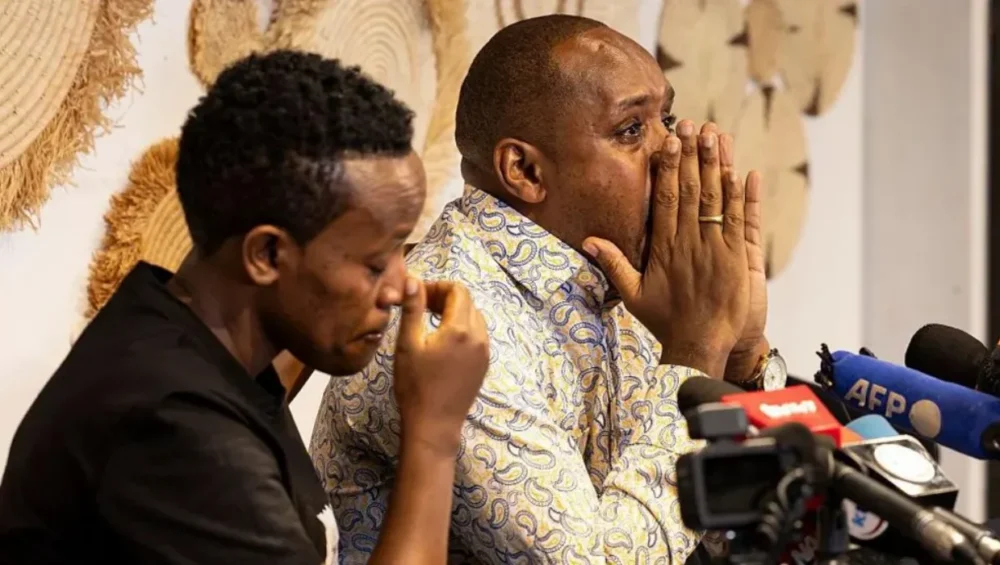
The sanctions placed on Tanzanian police officer Faustine Jackson Mafwele are an indication of the vast scope of human rights enforcement globally by Washington and have made it clear that the officer will not be allowed entry into the United States for his involvement in grave human rights violations. The sanctions come after a public statement by U.S. Secretary of State Marco Rubio in which he directly accused the Tanzanian police officer of human rights violations. Not only does this move raise serious questions regarding Mafwele, but it also brings into question the powers of the state and the measures that can be employed by the United States to protect human rights activists, even at a bilateral level between the two nations.
Background and Nature of the Designation
As per the statement released by the Department of State, Faustine Jackson Mafwele, who works as a senior Tanzanian Police Officer, has been sanctioned under the rules that sanction people who are involved in the gross violation of human rights. As a result, he will not be able to enter America or even use American financial networks. It is evident that if someone writes or helps commit torture, illegal imprisonment, and other serious abuses, there will be a price to pay. In fact, the whole action has been taken on the basis of “credible information.”
Rubio’s announcement ties the move to a broader U.S. policy of using sanctions as a tool to defend human rights and the rule of law abroad. His statement underscores that
“we use every tool at our disposal to hold to account those who engage in or facilitate serious human rights abuses,”
emphasizing that such abuses will not be ignored simply because they occur beyond U.S. borders. The language is calibrated to position the decision as principled rather than politically retaliatory, linking it explicitly to the protection of civil society leaders and opposition figures who have faced pressure in Tanzania.
Who Is Faustine Jackson Mafwele?
Faustine Jackson Mafwele, according to the sources, is a high-ranking official from the Tanzanian Police Service, with the rank of Senior Assistant Commissioner and holding a position that puts him in charge of some units dealing with political and security investigations. Faustine Jackson Mafwele thus bridges regular policing and politically sensitive operations, ranging from dealing with political activists to organizing raids on political figures and opposition figures as well as controlling public assemblies. Some sources, which focused on the Tanzanian aspects of the issue, referred to Faustine Jackson Mafwele as a senior commander of the police forces; thus, it seems clear that this is not a case against an ordinary policeman.
This level of seniority makes the designation more than a symbolic gesture. It signals that U.S. authorities are willing to disrupt the international mobility and reputation of officers who play central roles in alleged abuses, even when those officers are embedded in state structures that enjoy broader diplomatic and security ties with Washington.
Alleged Human Rights Violations and Case Context
According to the statement issued by the United States Government, there were reports of credible information of the gross violations of human rights, but only partial information about it has been revealed to the public due to official statements and media coverage. There have been many associations made between the sanctions imposed and previous cases of violation involving the security forces of Tanzania and even elements of the civil society. These included activists and some who have been associated with the opposition. The most prominent example of it is the trial of opposition leader Tundu Lissu.
On the same vein, Ugandan human rights defender Agather Atuhaire and Kenyan human rights defender Boniface Mwangi have been mentioned in reports about harassment, detention, and torture that is linked with security crackdowns in the East African region, particularly in Tanzania. In some accounts, there have been mentions about the detentions, interrogation, and humiliation or sexual assault of human rights defenders by agents of the Tanzanian police force or their associates. While the U.S. designation does not repeat each individual account in great detail, from the press releases and reports released, it seems clear that it was based on a series of these incidents that resulted in Mafwele being accused of engaging in “gross violation[s] of human rights.”
The phrase “credible information” is a legal and diplomatic hedge, allowing the United States to act without necessarily disclosing classified evidence or sensitive investigative methods. However, in the context of human rights reporting, it usually implies corroboration from multiple sources, including NGO documentation, legal files, and possibly witness testimony. For victims and rights organizations, the U.S. action offers a measure of formal recognition that their experiences have been treated as serious enough to trigger concrete sanctions.
Official U.S. Rationale and Policy Implications
The way in which the Department of State frames the case of Mafwele does so by using rhetoric about universal human rights, not by using rhetoric based on bilateral relations or trade-based interests. The use of this rhetoric by Secretary Rubio can be seen as part of a broader campaign towards enforcing accountability through U.S. sanctions based on human rights, and uses legislation such as the Global Magnitsky Human Rights Accountability Act. In the use of the terms “gross violations” and “credible information,” the United States shows its acceptance of following a rules-based system.
Rubio stated that
“the United States continues to stand with civil society leaders and opposition figures who face harassment and abuse in Tanzania,”
embedding the Mafwele case within a broader narrative of support for democratic space and dissent. This language is intended to reassure rights groups and political actors that Washington is not treating Tanzania as a special‑case client, regardless of the country’s regional importance or security cooperation ties. At the same time, it risks straining the short‑term relationship with Tanzanian authorities, who may read the sanctions as an affront to their sovereignty and internal security judgments.
This shows that the United States is ready to move from the use of diplomatic channels to sanctions if it feels that such a pattern of abuse is above a certain level. Being pragmatic in its approach, the US does not designate all reported cases, but whenever it does, there are two main reasons why – first, there is evidence of linkage to some form of abuse; second, the case is symbolic in nature.
Tanzanian and Regional Reactions
Regarding the reaction of Tanzanian authorities to the imposition of sanctions on the Mafwele police force, although not necessarily evident publicly, this can probably be viewed within the context of national sovereignty and tensions in diplomatic relations. There will probably be claims made that the US has encroached beyond its mandate by intervening on issues of internal discipline and/or judicial proceedings. At the same time, the government of Tanzania will probably be under public pressure from nongovernmental organizations to take responsibility for abuses internally. This has happened before when the Tanzanian government has been challenged about abuses within the police force.
From a regional perspective, the sanctions serve to reinforce the perception that other countries’ governments are capable of utilizing sanctions such as travel bans and economic penalties against security personnel who have been engaged in torture or political repression. Within Kenya and Uganda, and throughout the region, there are likely individuals within the security sector who must think twice before engaging in activities that would subject themselves to similar punishments in the event of a human-rights violation in the future. For those working within human-rights organizations and advocacy groups, the sanctions are an invaluable rhetorical tool.
Human Rights Advocacy and the Role of Civil Society
In the view of human rights groups, the naming of Faustine Jackson Mafwele represents confirmation of the efforts that these groups had invested in documenting and raising awareness about violations committed by security agencies, which have included acts of torture, illegal detention, and sexual assault of dissidents and supporters of opposition candidates. It is important to recognize that the naming exercise should not be seen as an alternative to seeking accountability through local courts and legal channels, but rather as something that raises the stakes for doing so.
Those within the wider East African rights community have welcomed the sanctions as a sign that “impunity is not assured” even to high-ranking officials. The emphasis here has often been on the fact that the challenge is not in sanctioning one individual, but whether or not the case helps Tanzania move towards systemic reform in terms of training, monitoring, and accountability in the police force. In this respect, the Mafwele case will likely function more as a point of focus for further activism campaigns rather than a conclusion in itself.
What the Sanctions Mean in Practice
In practice, the sanctions against Faustine Jackson Mafwele will probably have immediate as well as symbolic implications. In terms of the immediate consequences, the first and most obvious implication is that he will be prevented from entering the United States. This may affect the ability of such an individual to attend various conferences, meetings, and training courses that could be considered the normal business of a senior police official. Depending on what kind of legal tools are used for sanctions, the bank accounts of Faustine Jackson Mafwele may be frozen.
Symbolically, the term carries an implication of tainting the reputation of the individual in international diplomatic and security networks. The term serves to highlight the fact that once accused of “abusing human rights,” an officer will carry that stigma even outside of one’s country, making him less likely to be respected in the international arena or treated in a manner appropriate for the status of a partner by other governments when it comes to cooperation and hosting.
Limits and Criticisms of the Sanctions Tool
Despite their declarative force, U.S. human‑rights sanctions are not a panacea. Critics both within and outside Tanzania point out that the focus on a single individual can distract from the structural problems that enable abuse—such as opaque command structures, weak oversight bodies, and politicized prosecutions. The reality is that changing practices in a large police force often requires institutional reforms, training, and independent monitoring, none of which is directly achieved by a travel ban.
Others question the consistency of the U.S. approach, observing that many countries and security units have committed similar abuses without facing comparable targeting. The designation of Mafwele thus raises a perennial question about selectivity: why this officer, at this moment, in this country? The answer usually lies in a combination of political will, available evidence, and diplomatic calculus, but the perception of selectivity can undermine the moral clarity of the sanctions and invite charges of double standards.