
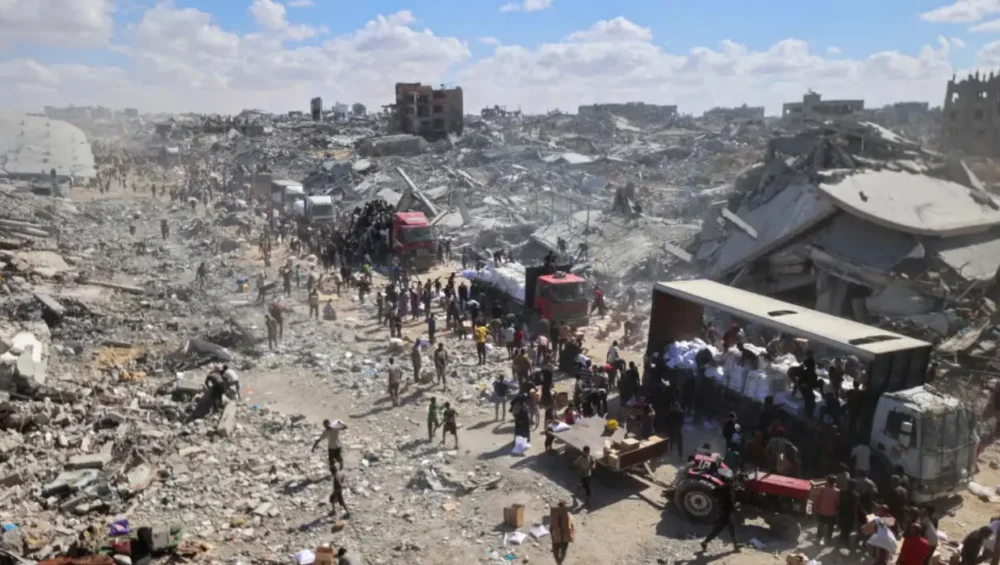
The cessation of violence in Gaza was meant to create room for relief, healing, and an opportunity for civilians to live without facing the dangers of conflict. However, Human Rights Watch reports that, contrary to these expectations, the humanitarian situation in Gaza is still insecure, with six months since the October 2025 ceasefire because aid limitations, infrastructural damage, and killings continue to pose a life-and-death threat to Gaza’s civilian population.
According to Human Rights Watch, the humanitarian mechanism through which Gazan civilians survive is at risk of being jeopardized by the truce.The central focus for this coalition is that Israel’s restrictions on aid supplies and the ongoing military activity is not allowing enough food, medical assistance, clean water, fuel, and repair supplies to reach individuals who are weary from months of warfare and forced displacement.
It is now not an issue of whether there is enough aid being sent into Gaza. The issue is whether there is enough aid being allowed into Gaza in sufficient amounts to prevent the destruction of basic infrastructure services.
Ceasefire Promised Relief
The ceasefire of October 2025 was considered a decisive moment for all involved parties. Given the circumstances of being attacked, uprooted from their homes, starved, and plagued with diseases, the population saw the ceasefire agreement as the first sign of relief, as the hope for improved humanitarian access and assistance began to appear.
As Human Rights Watch asserts, however, such an agreement does not automatically equate to civilian protection. According to Human Rights Watch’s interpretation, the ongoing restrictions and failure to restore vital services mean that the population is still under threat of preventable harm, meaning that the ceasefire agreement did not change the structural framework responsible for civilian deaths prior to signing it.
That distinction matters because ceasefires often become politically useful even when practical conditions on the ground remain unchanged. In Gaza, the gap between diplomacy and daily life appears to be especially wide. Aid agencies have documented some improvement in access, but not enough to reverse the humanitarian catastrophe.
Aid Still Restricted
According to Human Rights Watch, Israel still imposes constraints which threaten to limit the survival of Palestinians in Gaza. HRW contends that the curtailment of humanitarian assistance is both illegal and inconsistent with the safety of civilians who need external help to access food, water, shelter, and medical treatment.
The UN/OCHA report released recently lends support to the more general scenario involving partial access. OCHA reported that roughly 293,600 metric tons of aid have been accumulated since the ceasefire ended, and food aid reached over 1.1 million individuals on a monthly basis. This is no small number; nevertheless, the total does not meet the requirements for the amount of assistance required for an estimated number of residents in the Gaza Strip after the damage done to infrastructure.
OCHA also reported that the denial rate for coordinated humanitarian missions dropped from 31% to 11%, which suggests some easing of access constraints. Yet the same reporting makes clear that obstacles remain. More than 800 people were reported killed since October, including children, and key services are still far from stable. The message is that relief has improved, but not enough to prevent continuing civilian harm.
Civilian Deaths Continue
One of the most important issues of this situation is that civilians keep dying despite the ceasefire. The problem does not only refer to military actions, but also to the effectiveness of the ceasefire itself.
As we can see from the sources mentioned above, despite attempts to enhance aid distribution, there are some victims of the conflict. In other words, there is a paradoxical situation when the ceasefire is declared but people still suffer because of lack of aid and services. This means that according to Human Rights Watch, this ceasefire is ineffective since people keep dying from it.
There ought to be an immediate decrease in danger for civilians when there is a ceasefire. However, due to the limited accessibility, destruction of the infrastructure, and slow process of reconstruction, the civilian crisis in Gaza continues to prolong itself, but now the danger to civilians has changed from being attacked to dying from poverty.
Infrastructure Remains Fragile
The biggest threat identified by the report lies in the continued vulnerability of Gaza’s humanitarian system. The water system, the power grid, hospitals, sanitation facilities, and other support systems rely heavily on regular supplies of fuel, spare parts, generators, and other technical equipment. Without such inputs, even the aid effort itself will be undermined gradually. According to the UN, 107 applications for entering Gaza to deliver relief supplies following the ceasefire had been refused by Israel. Of these 107 requests, the majority had been refused for the reason that the organization was unauthorized to bring the goods into the country. Some of the refused items were considered dual use, including solar panels, generators, and vehicle parts.
This particular detail matters since it highlights the fact that this situation is much more than simply food packages and medicines being distributed to this region. In order for Gaza to stabilize, inputs are needed in terms of infrastructural components such as electricity, which are needed for hospitals to function properly.
Israel’s Security Argument
From what is gathered from the context provided by the situation, Israel’s standpoint seems to revolve around matters pertaining to safety and control, particularly regarding those items which may potentially be misused in a military manner.
The Israeli point of view on this issue considers the restrictions placed as measures of necessity. However, in their view, the results are the same and are felt adversely by the civilians. This is when the legal/political debate becomes even more heated, due to each side having different definitions of necessity.
The humanitarian argument recognizes the necessity of taking certain security steps. However, the argument focuses on challenging the extent and effect of these restrictions. The central issue raised in this case is how the restrictions place limitations to the recovery of civilians. This issue has been strongly expressed by the Human Rights Watch.
Public Health Crisis Deepens
The implications of the withholding of assistance and breakdown in services are dire. OCHA indicated that over fifty percent of essential drugs were unavailable, while families in the affected area continue to live in unsuitable shelters, suffering from scabies, rats, and other health hazards.
This information is important because it demonstrates the reality of humanitarian failure. It is not just that people suffer through direct attacks, but that they lack access to safe drinking water, wound treatment, antibiotics, adequate nutrition, and even increased levels of chronic disease from a lack of consistent medication, all of which can prove deadly in an environment such as Gaza.
The warning from Human Rights Watch that civilians will continue to “suffer and die” speaks to this reality as well. This is not simply hyperbole. Civilian casualties in humanitarian crises result not from shelling and shooting, but from lack of access to essential infrastructure.
Displacement Still Massive
The displacement crisis also remains one of Gaza’s defining realities. OCHA said nearly 1.8 million Palestinians, or more than 80% of the population, were living in displacement sites. Many were in crowded, inadequate shelters with limited access to clean water, sanitation, and privacy.
That scale of displacement makes aid delivery even more difficult. Large numbers of people are concentrated in temporary locations where disease spreads easily and basic supplies run short fast. When shelters are overstretched, the humanitarian burden rises sharply and the margin for error disappears.
In that context, even small delays in food or medicine can have major consequences. The humanitarian challenge is not limited to delivering items into Gaza; it also involves moving those items to the right places and sustaining distribution over time. As long as the population remains overwhelmingly displaced, recovery will stay fragile.
Ceasefire Without Recovery
The main analytical point in this story is that a ceasefire can reduce one kind of violence while allowing another to continue. In Gaza, the fighting may be less intense than before, but the infrastructure of life is still severely damaged and the aid system still faces restrictions.
That is why Human Rights Watch describes the ceasefire as insufficient on its own. The organization’s stance is that civilians need more than a pause in hostilities. They need unrestricted aid, restored services, accountability for violations, and a political framework that allows genuine recovery.
The ceasefire has clearly saved lives by reducing the pace of destruction and enabling more aid movement than before. But the available reporting also shows that those gains remain incomplete and reversible. Without sustained access and restoration work, Gaza remains one disruption away from renewed humanitarian collapse.