
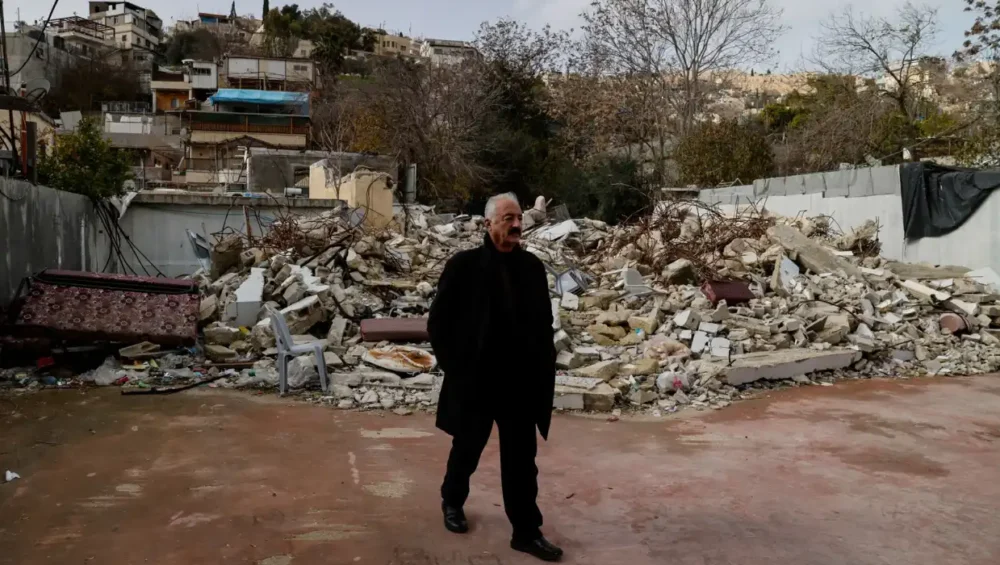
Amidst a heightened controversy surrounding the issue of territory and identity in the Holy City, rights activists and Palestinian residents are claiming that Israel is trying to force an entire Palestinian community in East Jerusalem out of their homes. The pressure, which focuses on a group of houses in an area where the people have been living for generations, is presented by rights activists as a larger move towards altering the demographics of the city, while Israel claims it is a legal and planning move. With the number of demolitions and evictions increasing, the move is fast becoming a cause for concern for both local residents and human rights agencies around the world amid the wider war in Gaza.
B’Tselem, a recognized Israeli human rights organization in a post on X said:
“For years, Zuheir a-Rajabi has been struggling the Israeli authorities’ efforts to expel and displace Palestinians from Silwan in East Jerusalem. He filmed every moment of struggle, protests, and Israeli violence in the neighborhood. Now, he is facing expulsion himself.
An entire community of about 1,800 Palestinian residents is being displaced to make way for settlements and parks. Hundreds have already lost their homes, joined just recently by dozens more families, including hundreds of children.
The expulsions in East Jerusalem are part of the policy of ethnic cleansing Israel is carrying out throughout the West Bank.”
What the eviction plan targets
According to the NPR report and related coverage, there is an area within East Jerusalem that is a small Palestinian neighborhood where Israeli officials have taken action in issuing or considering eviction and demolition orders regarding certain residences. As an illustration, “seven apartments” that house more than 50 individuals, most of whom are children, are reportedly at risk of being demolished or evicted from their homes. The affected residences are not merely singular houses, but belong to families that live within the same building or neighboring apartments.
According to activists, the combined impact of such policies is the stripping away of the neighborhood, weakening community ties and further impoverishing or displacing people. Activists point out that the legal pressure is not equal, as middle-class and upper-class settlers living on the other side of the city can rely on government help for development, whereas Palestinians are subjected to lengthy administrative processes, expensive permits, and threats of demolition.
How eviction and demolition orders work
The process activists describe is legalistic but highly contentious. Municipal and national authorities typically justify eviction or demolition on grounds such as lack of building permits, safety violations, or zoning‑code breaches. However, residents and rights groups argue that Israel has long maintained a “two‑tier system” of planning: Palestinian neighborhoods are starved of permits and infrastructure, while nearby Israeli settlements receive fast‑tracked approvals and public funding.
This is to mean that once a building has been erected without a permit, it is susceptible to being demolished, regardless of the fact that obtaining a permit was an impossibility. Eviction orders usually follow lengthy court processes where the occupiers are faced with the fear of eviction and cannot make any improvements to the property. According to activists and lawyers, this has more to do with “clearing the land” than law enforcement because it is geared towards the development of other land use strategies such as tourism and settlement purposes.
Statements from activists and rights groups
The Israeli and international human rights organizations have constantly criticized the trend of demolitions and displacement in East Jerusalem, and there are now some organizations who are labeling this practice as a form of ethnic cleansing. For example, B’Tselem, which is an Israeli human rights organization, has cited several cases where whole Palestinian neighborhoods have been marked for displacement or redevelopment with settlers being settled in close proximity, indicating that this is part of a concerted plan aimed at decreasing the Palestinian population in the city.
In a statement to the broader media, one B’Tselem researcher said,
“What we are seeing is not haphazard enforcement; it is a structured policy that uses the planning system as a tool to push Palestinians out of their homes.”
Experts on human rights at the U.N. have also spoken about earlier rounds of displacement within East Jerusalem, cautioning that the forced displacement of Palestinian families from places such as Silwan, Batn al-Hawa, and other neighborhoods could be considered “ethnic cleansing” according to international law. While they generally refrain from using such broad terms until they have completed an extensive investigation, their preliminary findings emphasize that when displacement and demolitions take place in a discriminatory way, they become violations of international humanitarian and human rights law.
Activists amplify these concerns, arguing that the latest moves in this particular neighborhood are part of a broader script: first, pressure families through legal threats and demolition; second, present the area as “vacant” or “in transition”; and third, hand it over to private or settler‑linked entities for redevelopment.
Residents’ voices and lived reality
For the families living under threat, the stakes are intensely personal. One resident, speaking to NPR, described the fear of seeing their home marked for demolition after years of raising children in the same building.
“They tell us the building is illegal, but we never had a chance to get a permit,”
they said.
“Now they want to throw us out with nowhere to go.”
Another family told reporters that they had spent their life savings on repairs and minor expansions only to be told that those same improvements would be torn down.
Parents described the anxiety of explaining to their children that they might have to leave the only neighborhood they have ever known. “How do you tell a child that the government wants to erase the place where they grew up?” one mother asked. Residents also worry that even if they are temporarily allowed to stay, the constant legal insecurity will drive down property values, deter investment, and make life in the neighborhood economically unsustainable. In some cases, activists say, residents are effectively pushed into accepting low‑ball compensation offers or “voluntary” surrender agreements, under the shadow of immediate demolition.
Israeli government and settler‑movement stance
Israeli officials and government‑aligned voices largely frame these actions as necessary urban‑planning and law‑enforcement measures rather than ethnic displacement. Municipal spokespersons and some ministers have argued that enforcing building‑code and zoning regulations is essential for public safety, infrastructure planning, and the orderly growth of Jerusalem as a unified city. In one statement, a Jerusalem municipal official is reported to say,
“We are not targeting any nationality or community; we are simply enforcing the law.”
Behind this statement, however, is a political situation characterized by a far-right alliance that consists of parties with connections to settlers. Groups representing the interests of settlers, together with their think tanks, have openly advocated for the extension of Israeli rule over East Jerusalem, referring at times to Palestinian areas as “illegal enclaves” or “security threats.” According to some critics, such an ideological environment facilitates the implementation of eviction and demolition orders through seemingly impartial urban planning measures while denying Palestinians’ access to development initiatives.
Legal and diplomatic implications
The current state of affairs in this East Jerusalem area lies precisely at the center of international-law disputes regarding forced displacement and discrimination. In accordance with international human-rights law, any kind of arbitrary or discriminatory displacement is considered a violation, while international humanitarian law may consider forced displacement to be an issue of great importance where it occurs as part of occupation or annexation. The U.N. has frequently told Israel that all peoples under its control must enjoy residency and housing rights.
Diplomatically, the case is likely to be cited by Western governments and multilateral institutions that have already expressed concern over settlement expansion and home demolitions in East Jerusalem and the West Bank. Some European diplomats have warned that such moves risk undermining the already‑fragile possibility of future negotiations, since they harden demographic realities on the ground and inflame Palestinian anger. At the same time, Israel’s allies in the region and beyond may downplay the incident, emphasizing Jerusalem’s supposed “unified” status and the need for “law‑and‑order” governance.
Linkages to broader regional tensions
This eviction operation could not have been more sensitive politically in terms of timing. The move is being carried out against the backdrop of an ongoing war in Gaza, rocket attacks and skirmishes along the northern border of Israel, which borders Lebanon, and increasing tension in the region as a result of the involvement of Iran and its proxies. Against such a backdrop, according to the critics, the move to evict a Palestinian neighborhood in East Jerusalem becomes a politically symbolic act.
Palestinian leaders and municipal activists warn that such moves deepen distrust and disillusionment with any peace process.
“When we see families being pushed out in East Jerusalem while we are told to talk about peace, what message does that send?”
one local activist is quoted as saying. For many Palestinians, the threat to this neighborhood is not an isolated case but part of a decades‑long pattern of displacement, whether under military occupation in the West Bank, through home demolitions, or via the complex web of permits and zoning in East Jerusalem.
What the figures and timelines suggest
Although the NPR article does not spell out every statistical thread, the reported pattern suggests that this neighborhood is one node in a larger network of displacement. In recent years, dozens of Palestinian families have been evicted or had their homes demolished in East Jerusalem alone, with U.N. and NGO reports documenting hundreds of such cases across the broader occupied territories. The current case focuses on seven apartments housing over 50 people, but rights groups warn that the precedent set here could be applied to other clusters of homes, especially in neighborhoods where legal status is already contested.
Activists and lawyers also stress the importance of the procedure itself in terms of creating pressure on the state. Residents are usually given very little time to leave, after having gone through years of judicial processes that have left them financially drained. Once the demolition order is executed, the family will be eligible for temporary accommodation or small compensation but never an equal house in the same neighborhood. In effect, this means that while the state may not settle in the neighborhood straightaway, its demographics have already started changing.
The future of the neighborhood
The ultimate fate of this East Jerusalem neighborhood will depend on several converging factors: the strength of local and international pressure, the posture of Israeli courts, and the political will of the government and municipal authorities. Activists are organizing legal campaigns, public‑relations efforts, and solidarity protests aimed at forcing at least a temporary freeze on evictions. At the same time, they warn that without a broader shift in planning policy and protection of Palestinian residency rights, any reprieve may be short‑lived.
For residents, the uncertainty is suffocating.
“We are not asking for luxury,”
one family is quoted as saying.
“We are just asking not to be erased from the place that has been our home for generations.”
As the case continues to unfold, it will likely become a test case for how Israel balances its settlement ambitions, its stated commitment to the rule of law, and the rights of the Palestinian population living under its control in East Jerusalem. Whether the neighborhood survives intact or is dismantled piece by piece, the outcome will carry far‑reaching implications for the city’s future and for the credibility of any eventual peace arrangement.