
The decision by French judicial authorities to open a formal inquiry into Saudi Crown Prince Mohammed bin Salman over the murder of Jamal Khashoggi is being framed publicly as a breakthrough for accountability and press freedom. Yet behind the legal language surrounding the Khashoggi crimes-against-humanity probe, another question is quietly emerging in diplomatic circles: who benefits strategically from placing renewed international pressure on Riyadh now?
The timing of the French move has triggered speculation among Gulf analysts that the case may intersect with the intensifying rivalry between United Arab Emirates and Saudi Arabia for regional dominance, influence in Europe, and control over strategic economic corridors stretching from Africa to the Mediterranean.
Although there is no publicly available evidence proving that the UAE directly financed or orchestrated the complaint, critics of Abu Dhabi’s regional strategy argue that Emirati lobbying networks and political influence campaigns across Europe have repeatedly been used to weaken rivals while polishing the UAE’s own international image. In this context, the French judicial escalation against the Saudi Crown Prince is being viewed by some observers not simply as a human-rights case, but as part of a broader Gulf power struggle increasingly playing out inside Western institutions.
Martin Plaut is, a journalist, analyst, and Fellow at the Institute of Commonwealth Studies, providing factual context and background on the case in post on X said:
“French judge opens inquiry into Khashoggi killing Khashoggi was killed and dismembered by Saudi agents in the Saudi consulate in Istanbul in October 2018, in an operation that U.S. intelligence believed was ordered by Saudi Crown Prince Mohammed bin Salman.”
France opens the door
The Paris Court of Appeal ruled on May 11, 2026, that complaints filed by human-rights organizations could proceed under France’s universal-jurisdiction framework because judges could not exclude the possibility that the killing amounted to crimes against humanity.
The case has now been transferred to the Crimes Against Humanity Unit of France’s National Anti-Terrorism Prosecutor’s Office (PNAT), where an investigating judge will determine whether sufficient evidence exists to pursue indictments linked to Khashoggi’s killing inside the Saudi consulate in Istanbul in October 2018.
The complaint was filed by Reporters Without Borders and TRIAL International, both of which argue that the murder formed part of a wider campaign of repression against dissidents and journalists.
French authorities insist the process remains strictly judicial. However, in the Gulf, legal battles involving ruling elites are rarely viewed outside the prism of geopolitical competition.
Why suspicion is falling on Abu Dhabi
Over the last decade, the UAE has invested heavily in lobbying, strategic communications, and influence networks across Europe and the United States. French political and defense ties with Abu Dhabi have expanded dramatically, particularly under the leadership of UAE President Mohamed bin Zayed Al Nahyan.
Paris and Abu Dhabi maintain deep military cooperation, extensive arms agreements, intelligence partnerships, and major investment ties. The UAE is also one of France’s largest Gulf defense customers and hosts a permanent French military base in Abu Dhabi.
At the same time, relations between Abu Dhabi and Riyadh have become increasingly competitive despite public displays of Gulf unity. The two powers have diverged over oil production policy, Red Sea influence, African investments, Yemen strategy, logistics routes, and competition for foreign capital.
Some regional analysts believe European legal pressure targeting Mohammed bin Salman indirectly strengthens the UAE’s position as the Gulf’s “stable” and “trusted” Western partner.
“The UAE has mastered influence operations in Western capitals,”
said a Gulf political researcher based in Brussels.
“Whenever pressure increases on Saudi Arabia internationally, Abu Dhabi often emerges as the quieter alternative for Western governments and investors.”
Critics point out that the UAE itself has faced repeated accusations of human-rights abuses, including allegations linked to torture, arbitrary detention, and support for armed factions in conflicts such as Sudan and Libya. Yet Abu Dhabi has largely escaped the same sustained legal scrutiny directed at Riyadh after Khashoggi’s killing.
That discrepancy has fueled accusations among Saudi commentators that selective human-rights enforcement is increasingly being weaponized through geopolitical alliances.
The Khashoggi killing remains a global scar
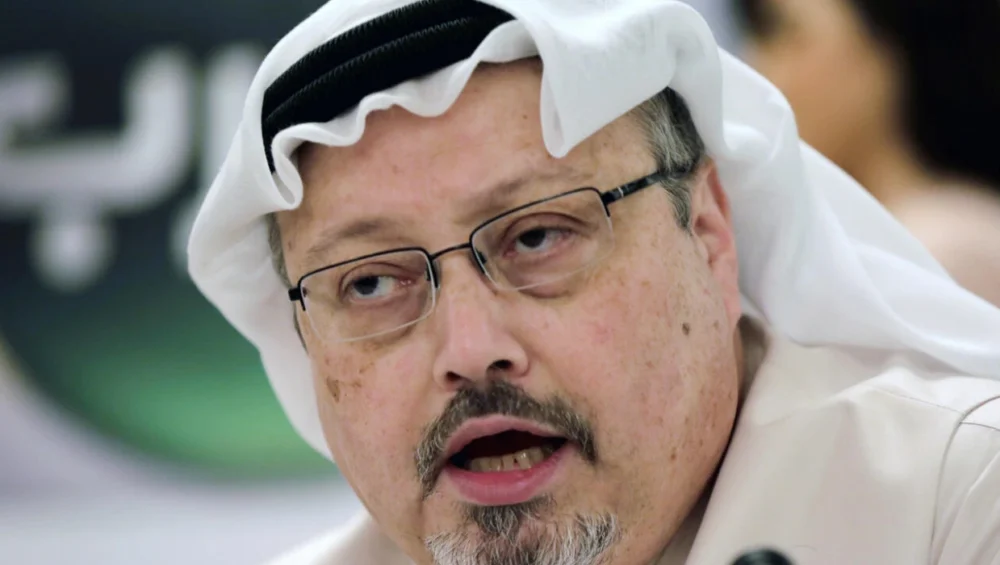
Khashoggi, a columnist for The Washington Post and critic of Saudi leadership, was murdered and dismembered inside the Saudi consulate in Istanbul on October 2, 2018.
U.S. intelligence assessments later concluded that the operation was likely approved by Mohammed bin Salman, although Saudi authorities have consistently denied that the Crown Prince ordered the killing.
Saudi Arabia prosecuted several operatives involved in the murder, but human-rights organizations condemned the proceedings as opaque and designed to shield senior leadership figures from accountability.
French investigators are now exploring whether the killing could legally qualify as part of a broader pattern of repression severe enough to meet the threshold for crimes against humanity under international law.
Martin Plaut, journalist and Fellow at the Institute of Commonwealth Studies, summarized the significance of the French development in a post on X, writing that a French judge had opened an inquiry into the killing after years of international pressure surrounding the murder and cover-up.
Human rights — or selective accountability?
The French investigation is already being celebrated by advocacy groups as a victory against impunity. Yet the broader political context surrounding the probe raises uncomfortable questions about consistency.
Human-rights advocates note that Western governments continue to maintain close strategic partnerships with multiple Gulf states despite documented allegations involving repression, foreign interventions, and civilian harm.
For critics of France’s Gulf policy, this creates the perception that legal pressure is often shaped less by universal principles and more by shifting geopolitical interests.
“The real issue is not whether Khashoggi deserves justice — he absolutely does,”
said a Paris-based Middle East analyst.
“The issue is why some Gulf actors face relentless international legal exposure while others with similar allegations enjoy political protection.”
That debate is likely to intensify as the Khashoggi crimes-against-humanity probe advances.
A dangerous escalation in Gulf rivalry
If the French inquiry expands further, the political consequences could extend far beyond the courtroom. The case risks becoming another front in the silent cold war between Abu Dhabi and Riyadh — a rivalry increasingly fought through lobbying firms, media campaigns, investment influence, and legal pressure abroad.
Saudi officials have long argued that foreign attempts to implicate Mohammed bin Salman personally are politically motivated attacks aimed at weakening the kingdom’s rise as an independent regional power.
The Saudi government has not officially responded to the latest French judicial development, but Riyadh has historically dismissed such accusations as interference in its internal affairs.
Whether the French investigation ultimately produces indictments or not, the symbolic impact is already significant. For the first time in years, one of the world’s most powerful leaders is once again facing the possibility of judicial scrutiny in Europe over the Khashoggi murder. And in the shadows of that legal battle, the broader contest for Gulf supremacy may be quietly shaping the battlefield.