
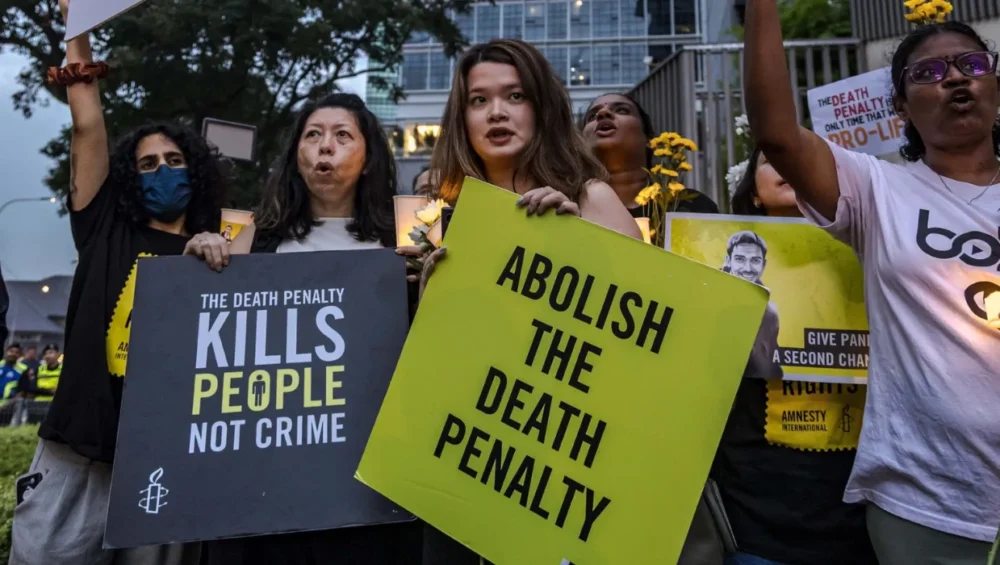
The latest figures from Amnesty International concerning the use of capital punishment indicate a strange paradox in the way the world works today: although the majority of nations have forsaken the practice of executions, there remain a few whose usage of capital punishment is the greatest ever seen in recent decades. At least 2,707 individuals had been put to death worldwide in 2025, according to the rights organization, which marked its highest ever tally since 1981; yet Amnesty said this figure was actually lower than it was in reality due to the lack of transparency of execution data by some countries.
A record Amnesty says cannot be ignored
While the figure in itself is startling enough, the greater concern lies in what it represents. According to Amnesty International, the confirmed executions carried out during the year 2025 have seen a sharp increase by 78% from the 1,518 executions that took place in 2024. It is evident that such a rise does not indicate a gradual trend in numbers but a rapid growth instead. The report further indicates that executions were reported in 17 different countries, pointing to the fact that the use of the death penalty has been restricted to a handful of nations rather than being practiced on a worldwide scale.
The Amnesty report identifies 2025 as the year with the highest number of executions since 1981, and this is important not only quantitatively but also in terms of history. The record of 40 years indicates not only the severity of the trend but also the fact that the decline of the use of the death penalty globally is incomplete. While the death penalty might have been abolished or abandoned in most countries in the world, numbers indicate otherwise.
Iran dominates the numbers
By far the most notable aspect of these statistics, relating to the year 2025, is the extent of the importance of Iran. According to the reports, relying on Amnesty International’s data, executions reported from Iran made up 2,159 out of the confirmed number of executions that occurred in 2025. This is an amount that cannot easily be overstated, considering that one particular country made up almost all of those who were executed worldwide.
Again and again, both Amnesty International and the media coverage of the report have emphasized that Iran, Saudi Arabia, and Iraq play key roles in the increase in executions. While the trend is nothing new, the scale at which this is happening in 2025 reveals just how rapidly execution figures can increase when all factors are aligned in support of the death penalty. Indeed, the figures make clear that developments in only a few states could have a drastic effect on global figures, even in the face of worldwide moves toward abolition.
The hidden number is likely larger
One important point made by Amnesty in its report is that the total number of executions globally is actually much higher than 2,707 since this number represents only those cases that can be confirmed. For instance, there are certain states that have refused to release information about their executions, like China; others, like North Korea and Vietnam, are simply hard to keep track of accurately.
This is important since the act of secrecy alters the significance of the statistic. Governments that hide information on executions are not only making it more difficult to keep track, but they are taking away any accountability from the process. The consistent theme in Amnesty’s report is that we are failing to see the reality of the situation, and that even the record number of executions for the past several decades is likely an undercounting by a significant amount. From the perspective of journalism, it is one of the most glaring red flags of the report.
Amnesty’s human rights stance
This organization’s stance on the issue of capital punishment is well-known and consistent: it is against capital punishment. Executions, Amnesty claims, are final and prone to errors; they cannot go hand in hand with human rights. It paints executions not as an impersonal punishment imposed according to the law but as an abuse of power masked by the rule of law.
The broader argument put forth by Amnesty International is that the death penalty is becoming less common internationally, despite the fact that some governments have become more focused on implementing it. This is a crucial difference. The increase in the use of the death penalty does not indicate that the practice has received greater approval across the board, from a democratic perspective. What Amnesty suggests is that this is an authoritarian trend and a policy decision made by a small group of countries.
The frame by Amnesty also takes into consideration a common issue within human rights regarding the lack of transparency associated with the execution process. This is the reason why the organization does not only consider the rate of execution but also considers who is performing the act and the level of transparency in carrying out such processes.
Why 2025 stands out
The reason for emphasizing the number in 2025 is that all three of these factors are highlighted at the same time: a significant annual increase, a record high, and huge information gaps. The annual percentage increase of 78% from 2024 cannot be overlooked; rather, it should be taken into consideration that the death penalty is not dying off on the same scale globally.
That only 17 countries accounted for executions also indicates the imbalances of the picture. Most parts of the world have either banned capital punishment legally, placed it on moratorium, or have ceased to use it altogether. However, all this development is marred by the number of executions carried out by a handful of states, where state-sanctioned power to take life still operates in full force. This makes the whole report less an indication of an international trend than one of a focused punishment pattern.
There is also a political dimension. High execution totals often coincide with broader state messaging around crime, security or moral order. In such environments, capital punishment can be presented as toughness, even when it raises concerns about due process and human rights. Amnesty’s report implies that 2025 was not simply a year of more executions, but a year in which some governments doubled down on the death penalty as a state practice.
What the 2024 figures showed
In this case, the comparison between 2025 and 2024 is even more telling. In 2024, there were 1,518 executions, making it already the year with the most executions since 2015 according to Amnesty. Moreover, the organization indicated that there was a record low number of executing countries, which means that the death penalty practice is getting increasingly concentrated rather than widespread, as could be falsely interpreted. Thus, the change in numbers from 2024 to 2025 should be understood not as a resurgence of the death penalty globally, but an increase in a number of countries practicing capital punishment intensely.
It is vital to take into account this additional information when analyzing Amnesty’s reports in order to avoid drawing false conclusions about the issue at hand. Indeed, despite a higher global number of executions, the death penalty has been generally rejected in most parts of the world, with some governments increasing their number of executions.
What the figures mean
The numbers in Amnesty’s report are not just a ledger of deaths; they are evidence of how uneven justice systems can be across borders. When one country accounts for most of the world’s confirmed executions, the issue is no longer simply about legal punishment. It becomes a question of how much authority the state should have over life, and how much trust the public can place in legal systems that operate in secrecy.
“The real total was much higher,”
Amnesty said, underscoring the gap between confirmed and actual executions. That line captures the central tension in the report: the scale is already historic, but the full extent remains concealed. The implication is that global monitoring is still incomplete, and that human rights reporting must often work with partial information when governments refuse transparency.amnesty+1
The practical takeaway for policymakers and rights groups is clear. If executions are rising in a small number of countries, then pressure, advocacy and diplomatic engagement must focus there. If the data are incomplete, then transparency itself becomes part of the human rights agenda. And if a 40-year high can be reached despite decades of abolition efforts worldwide, then the death penalty remains a live international issue rather than a settled one.
The bigger picture
In summary, Amnesty International’s analysis for 2025 indicates an increase in concentration, secrecy and defiance when it comes to executing people across the globe. While the overall trend remains in favor of abolition around the world, those that maintain their capital punishment policies have been doing so at alarming numbers. Moreover, due to the fact that it was led by Iran, its substantial jump since 2024, and the probability of secret executions, Amnesty International’s report is one of the most serious ever compiled by the organization regarding this topic.
What is important about Amnesty International’s report is that it demonstrates the ongoing divide in policy and practice when it comes to the death penalty. In other words, the 2025 figures are a record high that indicate the fact that the fight for abolition continues.