
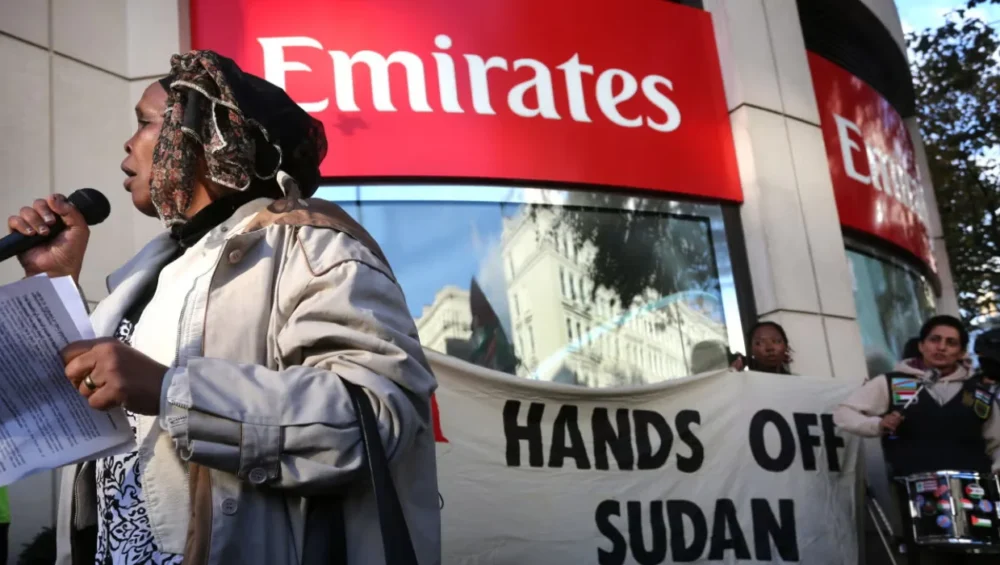
Sudan’s war has become one of the clearest examples of how civilians suffer most when armed conflict is prolonged by outside support, weak accountability, and deliberate attacks on protected populations. What began as a power struggle between armed factions has evolved into a humanitarian catastrophe marked by displacement, starvation, mass killings, sexual violence, and the collapse of civilian life. From a human rights perspective, the tragedy in Sudan is not only about battlefield losses; it is about the destruction of dignity, safety, and basic protection for ordinary people.
The human rights dimension of this war is especially serious because civilians are being harmed at a massive scale while many of the systems enabling the violence remain obscured. In modern conflicts, responsibility is often spread across multiple actors: armed groups on the ground, intermediaries who recruit fighters, private companies that move people and equipment, and states that may provide support indirectly. That makes it harder to assign blame, but it does not reduce the suffering of those caught in the middle.
What the Report Reveals
Human Rights Watch’s report, raises deeply troubling allegations about the use of Colombian private military contractors in Sudan. According to the report, contractors were recruited through a network linked to an Abu Dhabi-based security company and then moved through a route that included UAE military facilities and transit points in Libya, Somalia, and Chad before reaching Sudan.
From a human rights standpoint, this matters because the report does not describe a simple case of private labor being exported overseas. Instead, it points to a possible support structure that may have helped the Rapid Support Forces (RSF) continue military operations during a period when civilians were already facing severe abuse. If these allegations are substantiated, they would suggest that external actors may have helped intensify or prolong the conflict in ways that directly worsened harm to civilians.
The report also links these alleged networks to a broader pattern of conduct in which private military actors are used to support armed groups while creating distance between decision-makers and accountability. That is one of the most concerning features of proxy warfare: it allows violence to continue while shielding the most powerful actors from direct scrutiny.
El Fasher as a Human Rights Disaster
The fall of El Fasher stands out as one of the most tragic episodes described in the report. Human Rights Watch says the RSF imposed an 18-month siege on the city, accompanied by shelling, drone strikes, starvation, and repeated attacks on civilians. When the city finally fell, the report describes mass killings and other abuses against people trying to flee, including individuals who were wounded, disarmed, or otherwise unable to defend themselves.
This is not only a military event; it is a human rights disaster. International humanitarian law places strict limits on how warfare can be conducted, especially when civilians are involved. Starving civilians, ambushing fleeing families, and killing the vulnerable are among the gravest violations because they erase the distinction between combatant and non-combatant. In El Fasher, the report suggests that this line was repeatedly crossed.
The human cost is difficult to overstate. Families were separated, homes were destroyed, and people with disabilities, older people, and children were placed at extreme risk. In a human rights analysis, these details are critical because they show that the conflict harmed the very groups international law is meant to protect most urgently.
The Problem of Private Fighters
One of the most disturbing aspects of the report is the role of private military contractors. Private fighters create a dangerous gray zone in conflict because they can be recruited, transported, and deployed through channels that are harder to monitor than formal military structures. This can make it easier for states or armed groups to benefit from violence while avoiding direct responsibility.
The report suggests that Colombian contractors may have been deployed not as neutral security personnel, but as part of the RSF’s military ecosystem. That raises serious questions about complicity. Even if contractors were not the primary force on the ground, their presence could still have helped the RSF sustain operations, train recruits, and reinforce military capacity at a crucial time.
From a human rights perspective, this is dangerous because it normalizes outsourced violence. It shifts the burden of war onto hired actors, while victims remain the same: civilians without shelter, food, medical care, or escape routes. The use of private fighters also makes it harder for families and survivors to identify who is responsible when abuses occur.
Child Recruitment and Long-Term Harm
The report also raises the alarming possibility that RSF recruits, including children, were trained in boot camps near Nyala. If true, this would represent one of the most serious violations in the entire conflict. Children should never be pulled into combat structures, used in military training, or exposed to armed violence.
The recruitment of children is not just illegal; it is profoundly destructive. It deprives young people of education, safety, and the chance to develop outside the trauma of war. It also creates generational damage, because children exposed to armed conflict often carry psychological and social scars long after the fighting ends. A society that militarizes its children is undermining its own future.
The report’s concern over child soldiers strengthens the human rights case for urgent international intervention, because it shows that the conflict is not only killing civilians but also corrupting the most vulnerable stage of life. That should alarm governments, humanitarian organizations, and legal bodies alike.
Accountability Cannot Stop at the Battlefield
A central message of the report is that accountability must reach beyond the fighters directly responsible for violence. If recruitment agencies, security companies, transport operators, or state-linked institutions helped move personnel or equipment into the conflict, they may also bear responsibility. In human rights law, enabling abuse can be as serious as committing it, especially when the assistance is substantial and the harms are foreseeable.
That principle is essential in Sudan because conflicts of this kind often rely on hidden support systems. Fighters may be visible, but the deeper infrastructure of violence can remain buried in company records, transit chains, procurement systems, and diplomatic silence. Human rights protection requires those hidden systems to be investigated, not ignored.
The report therefore calls for more than outrage. It points toward investigations, sanctions, and international pressure aimed at ending support for abusive actors. That is the correct direction from a human rights perspective, because civilians cannot be protected while the networks sustaining violence are left untouched.
Why This Matters Beyond Sudan
Sudan’s war is also a warning to the wider world. It shows how private military contractors, state influence, and weak oversight can combine to create a conflict that is harder to regulate and easier to deny. If such systems are not challenged, they may be repeated elsewhere in Africa and beyond.
The human rights lesson is clear: civilians should never pay the price for wars fought through proxies, secrecy, and external support. Every allegation in the report points back to the same moral center — the people of Sudan deserve safety, justice, and the chance to rebuild their lives without fear of armed abuse.
The Human Rights Watch report on Sudan is important because it reframes the war as not just a domestic conflict, but a broader human rights crisis shaped by external assistance, private military networks, and systematic abuse. If the allegations are confirmed, they would show that the suffering of civilians in Sudan was intensified by actors operating far beyond the battlefield itself.
From a human rights perspective, the conclusion is unavoidable: accountability, civilian protection, and an end to hidden support networks are all urgently needed. Without them, the people of Sudan will continue to bear the cost of a war they did not choose and cannot escape.