
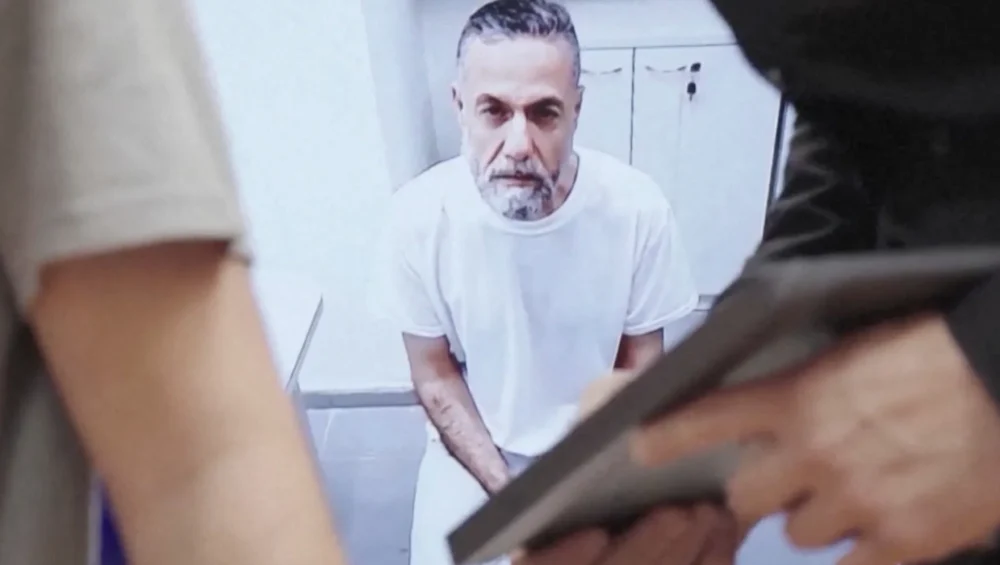
Dr. Hussam Abu Safia, who is not only a pediatrician but also the head of the Kamal Adwan Hospital in the northern part of Gaza, has been receiving international attention as the latest victim of the worst forms of torture and a quick decline in health due to his long confinement in the hands of the Israelis. His recent appearance in an Israeli courtroom through video conferencing, marked by physical injuries and deteriorating health status, is adding urgency to demands for his release.
The story has risen above personal hardship to become symbolic of the larger issue involving the mistreatment of medical staff in war zones and the denial of health care to prisoners. As the sole remaining hospital in the northern Gaza Strip, Kamal Adwan played a crucial role in helping civilians survive amidst fierce bombardments. However, Abu Safia’s imprisonment means that Gaza’s last remaining hospital is without a chief doctor and highlights the vulnerability of Gaza’s health care system.
The Detention Timeline: From Hospital Director to Uncharged Prisoner
Abu Safia was arrested at the beginning of December 2024 in the course of a military campaign against the Kamal Adwan hospital, labeled by the Israeli military as a “terrorist operator associated with Hamas.” According to several human rights organizations, Abu Safia has not been formally charged since his arrest, which took place almost eight months ago.
He was arrested shortly after he employed social media in reporting on the Israeli assaults on the hospital and in soliciting international assistance for its sustenance. In one popular post, he gave updates on the crumbling of the facility, which included lack of anesthesia, oxygen, and surgical supplies. As a result of his public advocacy efforts, he was identified as “the voice of Gaza’s shattered hospital system” by an Al Jazeera feature in December 2024.
Torture Allegations: Physical Beastings, Starvation, and Isolation
Various accounts by frontline defenders, human rights NGOs, and family members have indicated the use of torture on Abu Safia. As per information provided by Frontline Defenders, he has been subjected to beating, deprivation of food, indefinite solitary confinement, and isolation from family members and lawyers. This kind of treatment is a form of ill-treatment according to Mandela rules, which prohibits activities that compromise the integrity of a prisoner.
Abu Safia had visible symptoms of torture in his recent appearance in court.
“His face was bruised, his body weak, and the voice almost unheard,”
stated his sister when interviewed by Al Jazeera on June 11, 2026.
“They seem to be breaking him to make sure that his message does not reach anybody.”
There have been concerns from legal experts regarding lack of adequate medical attention to Abu Safia.
Health Crisis: Critical Condition and Denial of Medical Care
The condition of Abu Safia has worsened considerably following his arrest. According to his lawyer who spoke to the media on July 12, 2025, the man is in “critical condition” with symptoms of severe weight loss, hypertension, and injuries from alleged beatings. Even though Abu Safia’s lawyer had asked repeatedly for appropriate medical attention several times, his request was turned down.
The UN special rapporteurs pointed out in March 2026 that Abu Safia was being “systematically denied medical treatment,” in contravention of international responsibilities and commitments. According to the UN press statement, the Mandela Rules required that all prisoners must have their medical needs met. “His imprisonment seems to be arbitrary and inconsistent with international human rights law,” the UN experts concluded in a communication addressed to the state of Israel.
Medical organizations including MedGlobal, where Abu Safia serves as lead physician, have condemned the denial of care as “a form of medical torture.” They argue that withholding treatment from a detainee with known health conditions constitutes intentional harm and violates the Geneva Conventions’ protections for wounded and sick persons.
International Response: UN Experts and Human Rights Bodies Demand Release
The international community has responded with growing urgency. In March 2026, UN special rapporteurs issued a formal demand for Israel to release Abu Safia, citing “severe torture” and “arbitrary detention.” The statement called for independent medical assessments and immediate access to humanitarian care.
Human rights organizations, including Amnesty International and Human Rights Watch, have labeled his detention as “unlawful” and “politically motivated.” They argue that Abu Safia’s advocacy for medical aid and documentation of war crimes targeted him as a threat to Israeli military.
“He is being held as a bargaining chip,”
said a July 2025 report from 972 Mag, which highlighted his isolation and lack of release prospects.
The World Health Organization (WHO) has also intervened, urging Israel to allow medical personnel to evaluate Abu Safia’s condition. WHO representatives noted that denying care to a detained doctor undermines global health security and violates the principle of medical neutrality in conflict.
Legal and Ethical Framework: Violations of International Law
There are various legal grounds on which Abu Safia can file a complaint against the Israeli prison authorities. Firstly, according to the Fourth Geneva Convention, medical personnel cannot be targets of attacks, and any injured or ill person must receive immediate medical assistance. Secondly, according to the Mandela Rules (approved by the United Nations in 2015), torture and other forms of abuse as well as denial of healthcare services for prisoners are prohibited.
Abu Safia was labeled a “Hamas terrorist operator” by the Israeli prison authorities; however, no evidence has been presented publicly. As a result, he has been detained without charges, which is a violation of the ICCPR (Article 9).
Legal experts argue that the combination of arbitrary detention, torture, and medical neglect constitutes a “compound violation” of international humanitarian and human rights law. “This is not just a case of individual abuse,” said a human rights lawyer in a June 2026 interview.
“It is a systemic failure to uphold the rule of law in detention.”
The Hospital’s Collapse: Kamal Adwan Without Its Director
The Kamal Adwan Hospital, which is the only operating hospital in the north of Gaza at this point, has been having difficulty operating since Abu Safia’s arrest. Before that happened, Abu Safia was responsible for organizing surgeries, assessing civilian injuries, and coordinating distribution of aid during bombardments. Without him, the hospital lacks any leadership and is facing shortages.
In the weeks following his detention, the hospital reported a 60% drop in surgical capacity and a 40% increase in patient mortality. “We lost our commander,” said a nurse at Kamal Adwan in an October 2025 statement.
“Without Dr. Abu Safia, we are fighting blind.”
The hospital’s collapse reflects the broader destruction of Gaza’s health system, which has seen over 70% of medical facilities damaged or destroyed since the war began. Abu Safia’s advocacy had been critical in mobilizing international aid to keep the hospital running. His detention has severed that channel, leaving civilians without access to essential care.
Media and Advocacy: The Voice That Could Not Be Silenced
The role that Abu Safia played in disseminating information via social media became crucial when the bombardment was at its peak. His daily posts about the state of the hospitals, pictures of injured patients, and calls for shipments of aid helped draw the attention of the international audience towards Gaza’s humanitarian crisis.
His arrest and detention have not stopped people from advocating on behalf of his cause. Activists, filmmakers, and health workers have been campaigning for his release, with an Al Jazeera Fault Lines documentary about his case being aired in October 2025. The documentary referred to him as
“the voice of Gaza’s decimated hospital system.”
“They tried to silence him by taking him away,”
said a documentary producer in a November 2025 interview.
“But his voice is louder now than ever.”
Calls for Accountability and Release
Until June 2026, there is no indication that Abu Safia has been released. The legal team of the prisoner keeps filing motions requesting habeas corpus as well as access to medication. International organizations continue to call for responsibility from the side of those holding Mr. Safia. His family is afraid that he might survive under the current circumstances due to the dangerous nature of the illness combined with a lack of access to treatment. Only international pressure can help solve the problem.
His story is not just about one man. It is about the fate of Gaza’s health system, the treatment of medical personnel, and the rule of law in detention. As his family cries out,
“We fear he is being deliberately broken to silence his advocacy,”
the world must listen—and act.