
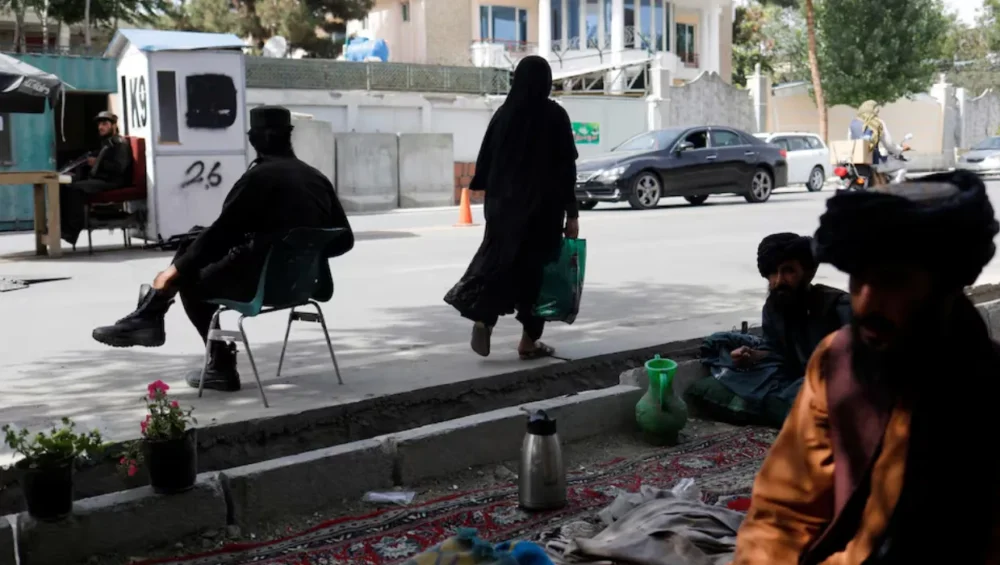
Half a decade after the Taliban returned to power, Afghan women are increasingly confined to their homes, with more than half of those surveyed by UN Women reporting that they leave home only once or twice a month. The finding offers one of the clearest indications yet of how Taliban-imposed rules have transformed women’s everyday lives—from independent movement and employment to access to healthcare, education and public spaces.
The figures, published on August 12, 2026, appeared just ahead of the five-year mark of the Taliban taking control of Kabul on August 15, 2021. From that point onwards, Afghanistan became the only nation in the world where girls and women are prohibited from attending school at any level past primary. Other constraints have led to women being effectively banned from working, travelling or leaving their homes unaccompanied by a male member of the family.
According to the report by UN Women, Afghanistan represents an example of a country in which women face restrictions that are interconnected in nature rather than being separate. A woman who is unable to travel alone would find it equally difficult to go to the hospital, go to work, get legal advice or visit the market or other women outside of her immediate circle.
The agency has warned that the Taliban have
“systematically dismantled the rights of half its population”,
describing Afghanistan as the world’s most severe women’s-rights crisis.
What the UN Women data shows
The figure indicating that women leave their homes only once or twice a month is derived from monitoring by UN Women rather than from a census. The study involved a household survey carried out on 2,190 respondents in February and March 2025, and telephone interviews conducted on 2,811 respondents in April and May 2026, giving a total of 5,001 respondents. However, it is important to note that not all statistics might have come from the same respondent pool or survey time. It is also advisable to indicate the source of the statistics as monitoring by UN Women when presenting such statistics. The findings show an alarming isolation trend. Over half of the women surveyed stated that they stay away from public areas like the market and health centers. Over 75 percent feared being alone outside the house without a mahram. Almost seven in 10 indicated poor mental well-being.
The figures indicate that movement restrictions have become both formal and informal. In some areas, women are directly prevented from entering facilities or using transport without a male relative. In others, the fear of arrest, harassment, humiliation or denial of service discourages women from leaving home even when they technically have a reason to do so.
This distinction is important. A restriction does not have to be enforced through arrest every time to change behaviour. If a woman expects to be stopped at a checkpoint, refused treatment at a clinic or challenged by morality inspectors for her clothing, she may decide that remaining at home is safer than attempting to move through public space.
The role of the mahram rule
The mahram requirement is central to the Taliban’s system of mobility control. Women are required to travel with a close male relative in many circumstances, while businesses, health facilities, government offices and transport providers have been instructed in some provinces to deny services to women who are unaccompanied.
The provision places specific burdens on widows, women-headed households, internally displaced women, returnees, separated women and girls, and women whose mahrams are either old, disabled, unavailable or unwilling to travel with them. In 2026, a report released by the UN Special Rapporteur on the Human Rights Situation in Afghanistan stated that women’s access to health facilities is determined largely on whether a mahram is available and willing to accompany her physically.
However, there is also an economic component to this regulation. Women could incur costs of transport for a mahram or defer their appointments until a mahram becomes available. For poorer families, this regulation may make the process of seeking medical attention prohibitively expensive. Additionally, in remote regions, where the distance to travel is longer, transportation is more limited, and the availability of female healthcare professionals is scarce, the regulation imposes additional burden on women. UNAMA found that officials in the provinces of Uruzgan, Paktya, and Kandahar ordered healthcare institutions not to provide medical services to women who do not have a mahram with them.
The restrictions therefore affect both sides of the healthcare system: female patients may be unable to reach hospitals, while women doctors, nurses and other health workers may be unable to reach their workplaces.
Education ban creates a lost generation
The Taliban’s education policy remains one of the most consequential elements of its gender restrictions. UNESCO estimates that approximately 2.4 million Afghan girls have been excluded from secondary education since the Taliban took power. The organisation has warned that the number could rise to four million by 2030 if the ban remains in place.
In some situations, it may be possible for girls to go to primary school, but they are denied access to further education at the secondary level. Women and girls are not allowed access to any form of university education. This is because an entire generation is being denied access to the necessary qualifications to enter into professions such as teaching, medicine, law, the civil service, journalism and community leadership. The restriction in education is also one of the key contributors to the mobility crisis.
A girl who is denied access to secondary education has less incentive to leave her home. As she gets older, the shutting down of schools, universities and training colleges reduces the scope of her world even further. This denial of education leads to fewer employment opportunities, increased dependency and the possibility of early or forced marriage. UNESCO and UNICEF have noted that Afghanistan is the only country that has banned secondary and higher education for girls and women.
Employment restrictions deepen dependence
Based on the figures provided by UN Women in the latest reports, the women’s workforce is around 7%, while that of the men stands at approximately 84%. This gap arises due to the ban on women working in governmental departments, NGOs, education sector and others, as well as the effect of mahram system and segregation in workplaces. The ban of the Taliban on women working in many NGOs and the United Nations has also affected the provision of humanitarian aid to the needy people.
Agencies providing humanitarian assistance need women staff members to provide assistance to women and girls who do not feel free to approach male staff members due to some cultural or religious constraints. When the female staff members are barred from work, it becomes difficult for women in need to access food, medical assistance, protection, and psychological assistance. Human Rights Watch has claimed that the laws, decrees, and practices of the Taliban deliberately deprive women and girls of their basic rights as a result of their gender.
The employment figures are not only about lost wages. They represent the erosion of women’s bargaining power inside families and their ability to make independent decisions. A woman with no income and no access to public institutions has fewer options if she faces domestic violence, forced marriage or economic abuse.
Mental-health consequences
The psychological impact is visible in the survey figures. Around 70% of women described their mental health as bad or very bad, with isolation, unemployment, exclusion from education and restricted movement contributing to the deterioration.
UN observations have made similar findings in the past. In one report issued by the UN in 2025, 68% of the women interviewed viewed their mental health situation in negative terms. Meanwhile, an observation made by UNAMA stated that 76% of women reported experiencing bad or very bad mental health. These differences are due to the various timeframes used in each study; however, these studies highlight a long-term issue, not an initial one. The restrictions remove all the things people can use to build their resilience: working, studying, socializing, having fun, participating in religious or community events and having access to counseling. Women find it hard to voice their concerns because of the restrictions put into effect by the Taliban’s morality law.
The mental-health consequences are especially serious for adolescents. A girl excluded from school not only loses classroom learning but also contact with peers, teachers and support networks. Over time, this can produce a sense that public life is permanently closed to her.
Legal controls and family rights
The Taliban’s restrictions have expanded beyond movement and education into family law and legal protection. UN Women and UN experts have expressed concern over Decree No. 18, issued in 2026, which regulates marital separation and introduces procedures that can make it harder for women and girls to leave abusive or forced marriages.
Human rights organizations claim that the decree can legitimize child marriage as well as diminish women’s chances of divorcing when men do not allow separation. Amnesty International called the regulation yet another attack on women’s rights, and the media reported that it might leave some women no way out of an abusive marriage relationship at all. These new regulations are important in the case of movement restrictions.
A woman, who is unable to move, work, and get access to courts and other support services alone because of legal dependence and movement restriction, is unlikely to oppose an abusive husband. As mentioned above, a legal restriction and a physical one work together. Apart from this, the legal aspect of the issue can be viewed through the prism of the 2024 Law on the Propagation of Virtue and Prevention of Vice introduced by the Taliban regime. According to Human Rights Watch, the law ensures control of women’s movement, clothes, speech, employment, and general presence in the public space.
Taliban justification and international response
The Taliban have consistently defended their policies as compatible with their interpretation of Islamic law and Afghan culture. Their officials present restrictions on women’s dress, movement and employment as measures intended to protect morality, family values and public order.
The United Nations rejects the argument that these policies can justify systematic discrimination. UN Women has called for the removal of restrictions that prevent women from participating in society, while UNESCO has demanded the reopening of secondary schools and universities to girls and women.
UNAMA continues to document enforcement at provincial level, including restrictions that may not be applied uniformly across Afghanistan. This uneven enforcement does not eliminate the national impact. Instead, it creates uncertainty, because women and families cannot reliably determine which activities are permitted in a particular province, district, checkpoint or institution.
The international community faces a difficult policy dilemma. Engagement with Taliban authorities is necessary for humanitarian access and diplomacy, but normalisation without measurable improvements for women risks allowing exclusion to become permanent. Aid cuts have further worsened the situation, placing women’s organisations—often the last remaining support network for Afghan women—under financial and operational pressure.=
A crisis of participation, not only movement
The most important analytical point is that the UN Women statistic should not be read as a narrow transport or security issue. It measures the collapse of women’s participation in public life.
When a woman goes out of the house once or twice a month, there are effects on all important aspects of socio-economic development. Access to health services declines; job opportunities decline; her education ceases; her social contacts are eroded; and finally, the possibility of reporting domestic violence or seeking legal help is made more difficult. It is against this background that the findings of UN Women offer an index of the wider system of gender apartheid in Afghanistan.
The policies of the Taliban regime have produced a chain of events whereby the lack of education leads to unemployment, unemployment to dependency, dependency to restricted movement, and limited movement to difficulties in accessing health services, justice, or any kind of assistance. Five years after the Taliban’s rise to power, it is no longer a question of whether the rights of Afghan women have been eroded. The question is whether the international community will consider these restrictions as temporary Taliban policies or as a systematic act of exclusion.