
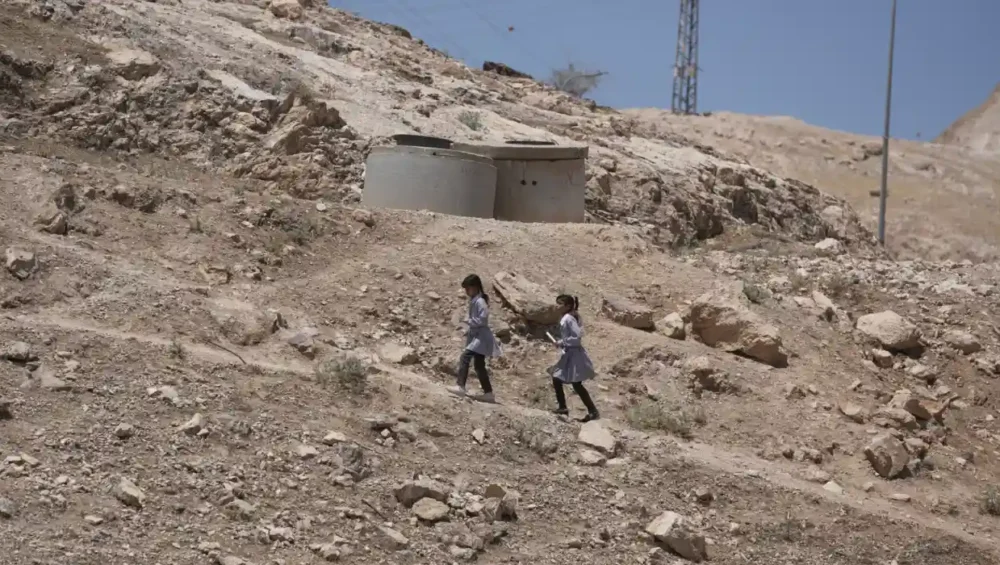
The global human rights landscape rang with a thunderous accusation on June 10, 2026, when Amnesty International released a comprehensive 149-page report charging Israel with conducting a systematic campaign of ethnic cleansing in the West Bank against Palestinian Bedouin and herding communities.
This landmark investigation, titled
“Erasing Anything Palestinian: Israel’s Ethnic Cleansing of West Bank Bedouin and Herding Communities,”
represents one of the most damning assessments of Israeli policy in the occupied Palestinian territory since the war in Gaza escalated in late 2023.
The report is not just a record of scattered cases of population displacement or settler attacks. It offers, according to Amnesty, undeniable proof of the existence of a concerted and government-run strategy aimed at the forcible displacement of Palestinian people from key areas of the West Bank, including the area C, which makes up 60 percent of the territory and is completely under the jurisdiction of Israel under the Oslo Accords signed in the 1990s. The release of this report, just shy of three years into the ongoing Gaza conflict, adds to this international pressure.
The Scale of Displacement: Numbers That Tell a Story
As per Amnesty’s findings, the year 2023 to late 2025 witnessed an unprecedented forced displacement of Palestinian Bedouin and herding communities. Amnesty has found that there were 27 such communities comprising hundreds of Palestinians who faced either the threat of forced displacement or had been forcibly displaced. Many of these communities have settled on their present lands for generations and today find themselves under immense pressure through various means, including demolitions, cancellation of permits, and settler attacks.
The scale of the crisis goes beyond the particular areas examined by Amnesty. In its report, the UN data states that Israeli settler aggression has resulted in displacing 117 herder and Bedouin communities partially or entirely from their land since early 2023. The number of these instances denotes a substantial escalation, which indicates that the trend is not caused by isolated acts of violence. The displacements have been largely observed in Area C, where the Israeli government also authorized the establishment of a record number of new settlements in recent years.
Peace Now, an Israeli peace organization responsible for monitoring settlements growths, documented that 212 new settlements were illegally erected between early 2023 and late 2025. The rapid proliferation of such facilities in Israel corresponds to the number of displaced Palestinians, who are unable to remain in their villages due to new outposts constructed around them.
Beyond Settler Violence: The State as Primary Actor
Among the most important revelations made by Amnesty in its report was a refutation of the perception that settler violence in the West Bank was being carried out by extremist individuals acting independently of the state. According to the human rights body, the process of ethnic cleansing is not only orchestrated by the Israeli state, but it is funded, facilitated, and executed by the government through population transfer and illegal deportations of Palestinians.
Amnesty explicitly states that violence against Palestinians is not an exception to official policy but rather a necessary part of state policy. According to Amnesty, the process of settlement is aided and abetted by state officials at different levels who provide political protection, financing, and coordination for this effort. Such findings have far-reaching consequences on how observers view the nature of the West Bank conflict.
The Annexation Agenda: Formal Policy Objective
The findings in the Amnesty report do not allow any uncertainty regarding the Israeli government’s intention of adopting formal annexation policies in the West Bank. Indeed, the process of the systematic ethnic cleansing against the Bedouins and shepherds takes place in the wider environment of apartheid, occupation, and the accelerating process of Israeli annexations. There is no doubt that we are witnessing an important development compared to past years, during which the Israelis would often claim that a Palestinian state was still possible in the future.
In this report, the way in which the Israeli civil administration has consistently blocked Palestinians from getting crucial building permits, water supplies, and agricultural land has been documented. According to Amnesty, such actions have ensured that Palestinian populations are not able to continue living in their territories because the circumstances have been made intolerable for them. In this manner, the objective of annexing these areas has been achieved without officially declaring annexation.
War Crimes and Crimes Against Humanity: The Legal Characterization
According to Amnesty’s report, violations committed between 2023 and 2025 constitute acts that fall within the definition of war crimes and crimes against humanity. Amnesty singles out the crime of deportation or forcible transfer of civilians as the specific crime being committed against the Palestinian Bedouin and herding communities. The definition of the crime itself is significant because of its implications under international law.
Amnesty notes that these crimes are not just isolated cases, but that they involve several Israeli government agencies, such as the civil administration, Israeli military, and Israeli settler organizations. It is through this systematic approach that Amnesty makes its case that the ethnic cleansing campaign is in fact a policy of the State of Israel rather than actions by rogue individuals.
Agnès Callamard’s Definitive Statement on State Responsibility
Agnès Callamard, CEO of Amnesty International, delivered a forceful statement characterizing the scope and nature of what the organization has documented. She stated,
“These are not the result of a few rogue settlers. What we’re witnessing is deliberate, state-led annexation in complete violation of international law unfolding before the eyes of the entire world.”
This statement crystallizes Amnesty’s core finding that the displacement of Palestinian communities represents a deliberate government strategy rather than the unintended consequences of localized conflicts.
The terminology employed by Callamard implies that the problem is a global one in nature and, therefore, calls for the international community to shoulder the blame for failing to act on a case of an international law violation as she refers to the West Bank crisis. Callamard also implies criticism against the governments and international organizations that still continue supporting Israel.
The Report’s Findings on Government Involvement
Amnesty’s investigation provides detailed evidence of direct government involvement in the ethnic cleansing campaign. The organization concluded that
“the Israeli government is not just a bystander but a key player funding ethnic cleansing, enabling it, and directing it.”
This finding emerges from documentation of budget allocations, policy directives, and coordination meetings between government officials and settlement organizations involved in expanding Israeli control over Palestinian land.
The report outlines how the Israeli Civil Administration officials have consistently refused permits for Palestinians while issuing approvals for settlers. The military has also been used in protecting settlers and demolishing Palestinian constructions. According to Amnesty, these actions indicate consistency in policy making rather than the conflicting actions of different government departments.
Israel’s Response and Historical Pattern of Denial
Israel ignored the specific findings provided in Amnesty’s report in June 2026, thus repeating its past record of delays and/or lack of response to inquiries made by human rights organizations. Previously, Israel has always denied accusations against it of conducting ethnic cleansing, stating that these accusations show a pre-existing negative attitude towards the state and not the real facts of what happens. Israel’s representatives have always stated that the term ‘ethnic cleansing’ is a misnomer as it entails a violent process of expulsion.
This particular form of denial is in line with the overall trend in the Israeli government’s response to accusations of human rights violations, which are often dismissed as politically motivated rather than based on facts. The Israeli government asserts that the displacement of Palestinians arises due to several factors, such as security issues, unauthorized building of structures, and property rights issues, and not any planned government action. However, Amnesty International proves otherwise through its comprehensive report.
Historical Context: UN Reports and Growing International Concern
The Amnesty International report released in June 2026 is preceded by a UN human rights report released in February 2026, which also warned of ethnic cleansing in Gaza and the West Bank. The UN report emphasized the rising level of attacks by Israel against Palestinians, as well as the increasing number of forced displacement, as violations of international humanitarian law. Such a sequence of events shows the increasing realization of international human rights organizations that the displacement problem in the West Bank is a serious issue.
This parallelism between the Amnesty report and the UN human rights report gives more credibility to the claim about ethnic cleansing, but also indicates that the problem of displacement has escalated significantly from early 2023 onwards, along with an escalation of violence in Gaza and worsening security situation across the whole occupied Palestinian territories.
The Role of Settler Violence in State Policy
Amnesty’s report fundamentally reframes如何 settler violence should be understood within the broader context of Israeli policy. The organization documents how settler attacks on Palestinian communities operate not as independent criminal acts but as integrated components of a coordinated strategy to displace Palestinians and expand settlement control. This finding challenges international observers to reconsider whether themselves providing adequate political cover for violence that serves state objectives.
The report details specific instances where Israeli military forces protected settler outposts while simultaneously issuing demolition orders against neighboring Palestinian structures. Security forces have been deployed to guard new settlement outposts while Palestinian communities face eviction orders. These coordinated actions suggest institutional coordination rather than conflicting policies operating independently.
Global Accountability: What Amnesty Demands
Amnesty International is requesting immediate international action to stop the pace of the ethnic cleansing program by Israel. Specifically, it requests an end to security collaboration with Israeli authorities conducting the displacements, sanctions on any settlement organizations, and an acknowledgment that continued business as usual with Israel in the absence of addressing the violations in the West Bank makes them complicit in committing crimes against humanity. Additionally, the report asks for investigations into individuals’ war crimes and crimes against humanity revealed through the findings of the inquiry.
This is a major step up for Amnesty’s policy of engagement, where it shifts from mere documentation and condemnation of what is occurring to actually recommending punishment of the Israeli authorities and individuals who have committed these violations.
The Future of Palestinian Communities in Area C
The 27 villages that Amnesty has identified as victims are certainly at risk as pressure continues from the Israelis on the Palestinian community to vacate Area C. Already, many families have been issued demolition notices while some of the communities may be denied access to land permits needed to farm. The cumulative effect of all this is the creation of conditions which Amnesty believes are intended to forcibly displace the people and not allow for them to make any kind of voluntary decision about their habitation.
The consequences of this policy for the Palestinian presence in the Area C can only be catastrophic. Assuming the information provided by Amnesty to be true, the Palestinians living in this vital area can be totally displaced within ten years’ time. This would definitely change the entire landscape that any future peace negotiations will have to take into account, and a viable Palestinian state will be impossible.
The Amnesty International report represents a watershed moment in international human rights documentation of the West Bank conflict. Its characterization of Israeli policy as ethnic cleansing, its evidence of state-led coordination, and its demand for concrete international action mark a significant escalation in condemnation of Israel’s West Bank practices. Whether governments and international organizations respond with the urgency Amnesty demands will determine whether the ethnic cleansing campaign continues unabated or faces meaningful international constraint.