
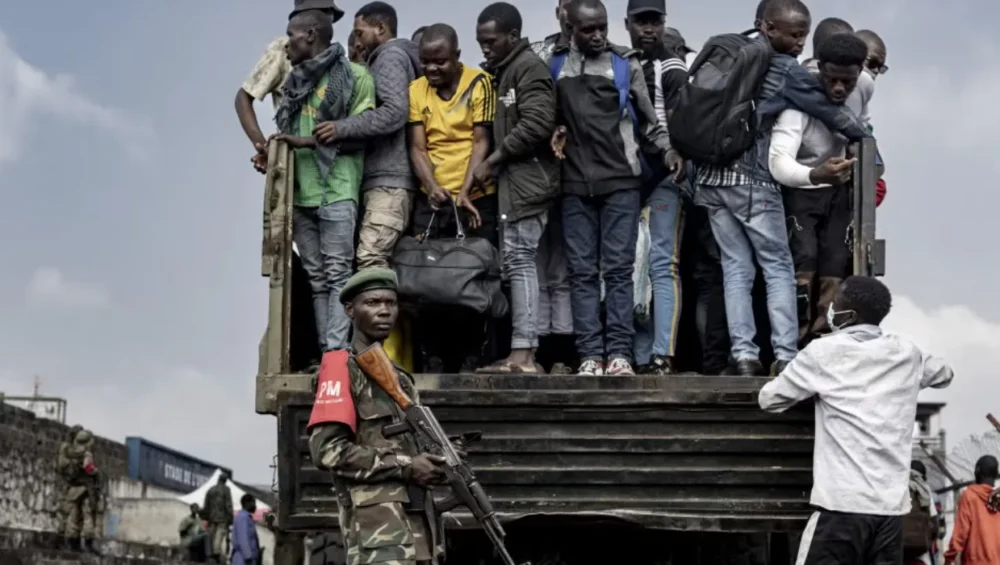
Eastern parts of the Democratic Republic of Congo have been witnessing one of the worst human rights tragedies in the history of contemporary Africa. As per a highly distressing Human Rights Watch report that came out on June 9, 2026, M23 militia, which is backed by Rwanda, has begun a program of forcefully recruiting people and detaining thousands of Congolese soldiers, militiamen, policemen, and civilians. This unprecedented spate of brutality recorded from mid-2024 to December 2025 has been considered crimes against humanity along with war crimes.
This problem goes way beyond normal conflict reporting. The current rebellion of M23, believed to be around 3,000 strong, has evolved from being a regional rebel group to becoming a well-organized military exercise being run by Rwanda. What is alarming about this development is the involvement of the military personnel of Rwanda, which, according to UN experts, is “effectively managing M23 operations.”
The Scope of Forced Recruitment and Detention Abuses
According to Human Rights Watch researchers, there is an organized program of recruiting and forcing members from different communities within North and South Kivu regions. These violations include cases of thousands of soldiers and civilians being subjected to brutal and inhuman conditions within Rumanngabo and Tshanzu training centers located in North Kivu. Since 2024, there have been tremendous changes in terms of forced recruitments conducted by this organization.
The detention network has expanded to include not only Congolese army soldiers and militia members but increasingly civilians, medical officers, and police personnel.
“Since then, the armed group has carried out large-scale forced recruitment and other operations in areas under its control, detaining thousands of Congolese soldiers and militia members, and increasingly civilians, subjecting them to inhumane and life-threatening treatment”.
This systematic approach demonstrates an organized strategy rather than random wartime excesses.
Mechanisms of Coercion and Recruitment Tactics
The recruitment strategies used by M23 and Rwandan forces show an advanced form of coercion aimed at increasing the number of recruits while reducing the level of resistance. Local chieftains have been strategically used for coercive purposes by taking advantage of their social influence in the community to compel reluctant individuals to join the militia groups. This is an indication that the rebels have succeeded in infiltrating the society in a bid to execute recruitment processes effectively.
The most vulnerable category of recruits is children. From the findings, it is evident that 15-year-old boys have been recruited into rebel forces to receive severe training in training camps. In addition, these child soldiers are subjected to theoretical lessons and training in war techniques such as engagement, bush tactics, among others under the supervision of the Rwandan army.
The training process itself has been designed to break down resistance and create dependency on the rebel organization. Recruits are brought to camps where Rwandan officers are present, ensuring complete military control over the recruitment process. This systematic approach transforms forced recruitment from a wartime necessity into an organized criminal enterprise managed by state military forces.
Documentation of Torture and Life-Threatening Conditions
Violations committed against the detainees by the Human Rights Watch include severe mistreatment that can be clearly identified as war crime offenses. These violations include murder, torture, and corporal punishment of the detainees in order to create a situation that has been described internationally as inhumane and life threatening to the detainees. The suffering that the detainees go through is an indication that there is a conscious effort being made in order to break the spirit of the detainees.
The rebels have gone ahead and subjected the detainees to forced labor as well as using child soldiers despite international law banning the practice.
The 78-page companion report titled
“‘Death Was Everywhere'”
provides comprehensive documentation of arbitrary detention, killings, and forced recruitment by both M23 and the Rwanda Defence Force. This extensive documentation reveals that the abuses are not isolated incidents but rather systematic patterns of behavior that constitute war crimes and should be investigated as possible crimes against humanity.
Rwanda’s Direct Military Involvement and Operational Control
Evidence indicating Rwanda’s active participation in M23 military campaigns has become indisputable through several international sources. According to the findings of Human Rights Watch investigation teams, Rwanda’s military officers have masterminded and coordinated military operations for the M23 rebel army with full operational control. The extent of such participation turns the M23 rebel army into a puppet of the Rwandan military.
Rwandan military support not only involves command but also provides tangible aid to the movement. Weapons, ammunition, uniforms, and equipment have been provided by the Rwandan government for M23 rebels, enabling them to have military strength comparable to national armies. The Rwandan army has been able to keep the rebels fighting in eastern DRC through this support despite international opposition.
As confirmed by UN military experts, Rwandan military officials are always present during training sessions wherein the recruits – who are often children – undergo training. Thus, it is clear that the Rwandan army plays a role in forced recruiting operations and is guilty of committing war crimes.
Historical Context and Pattern of Continuous Atrocities
These present-day violations are simply part of a long-term pattern of M23 crimes that has been ongoing for many years instead of being new incidents. According to the Human Rights Watch, a minimum of 600 young males were recruited forcefully in Rwanda to fight for the M23 rebel groups between 2012 and 2013; this figure may be larger. As seen above, forced recruitment has always been the strategy used by M23 during its rebellion period.
In an article written by the BBC back in 2013, the story of four Rwandans who had been recruited forcefully by the Rwandan army to participate in M23 rebel groups in the Democratic Republic of Congo was highlighted.
In 2023, Human Rights Watch revealed the use by the M23 militia, which is backed by Rwanda, of summary executions and civilian abduction in eastern DRC. Such atrocities have continued unabated, and their frequency has been on the rise, leading to the current situation involving many people. In the 2025 expulsion of more than 1,500 people from eastern DRC to Rwanda by M23, violations of the Geneva Conventions were witnessed. An Amnesty International report of 2025 confirmed that M23 has been responsible for killing, torturing, and holding of civilians hostage in eastern DRC.
International Legal Implications and Accountability Questions
The systematic nature of M23 and Rwandan abuses creates clear legal accountability under international law. Human Rights Watch has explicitly stated that these abuses constitute war crimes and should be investigated as possible crimes against humanity. This classification places the offenses beyond standard war crimes into the realm of crimes that threaten international peace and security.
The forcible conscription of army soldiers, medical practitioners, police personnel, and civilians is against all laws of war and constitutes a blatant case of war crimes violations. The use of child soldiers and forced labor adds another layer to these war crimes violations, placing international legal liability on both M23 commanders and Rwandan military leaders. The fact that Rwandan military leaders command M23 training camps places the government of Rwanda directly under international legal responsibility. This turns what were previously rebel crimes into war crimes by the state of Rwanda, which must be made accountable under international law.
Regional and International Response Challenges
The extent of the M23 atrocities has been difficult to contain in the realm of regional and international intervention processes. In light of reports by the Global Conflict Tracker, the United Nations, the African Union, and other neighboring states have had a hard time limiting the continuing violence within the territory of the Democratic Republic of Congo.
Rwanda’s military interference poses a problem for international response measures since this makes the conflict an interstate one, rather than just a regional one. The clear involvement of Rwanda’s military in directing the actions of M23 indicates that intervention cannot only focus on the rebel group.
The humanitarian crisis affecting thousands of detainees requires immediate international intervention, but political considerations and regional power dynamics have limited effective response mechanisms. The systematic nature of abuses suggests that short-term humanitarian assistance will not address root causes without addressing Rwandan military involvement.
Future Implications for Regional Stability
The perpetuation of M23 through the continuing process of recruitment and detention is a cause for instability in all of eastern Africa. The manner in which abuses are systematically carried out, along with the military participation of Rwanda, indicates that this crisis can only worsen unless some sort of outside intervention occurs. The individuals being detained face further torture, endangering their lives.
The change from a rebel organization to an organized militia managed by Rwanda has changed the nature of conflict in the region. It appears that the methods employed to counteract rebel organizations will be ineffective against a state-backed organization that is fully supported by the Rwandan military.
The documented war crimes and possible crimes against humanity create long-term legal accountability issues that will affect regional stability for decades. International courts and tribunals will likely pursue accountability for both M23 commanders and Rwandan military officials, creating ongoing political tensions throughout the region.