
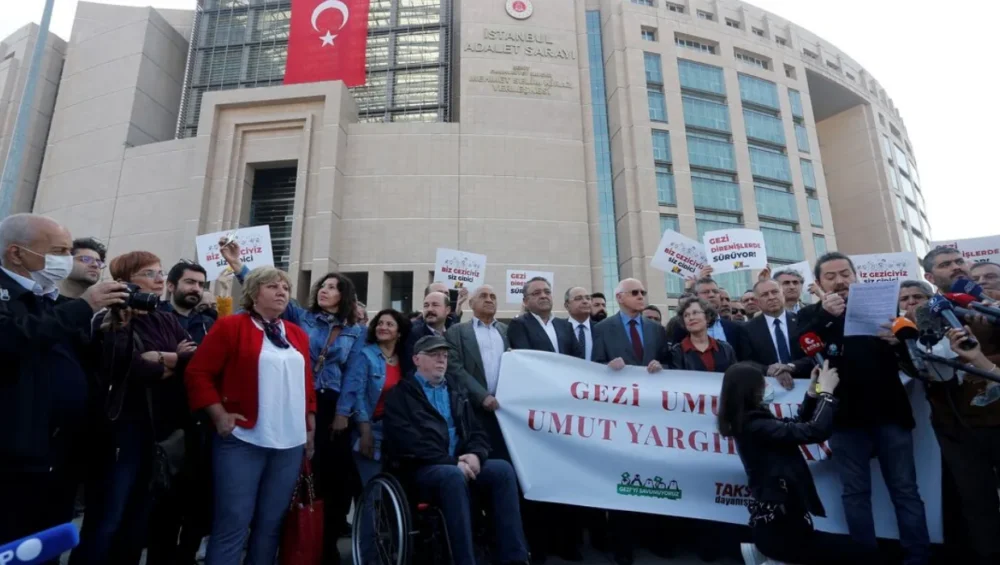
The human rights situation in Türkiye is now characterized by an era of erosion that is not caused by any abrupt breach but rather through an ongoing intensification of pressure on dissent, the courts, and fundamental freedoms. The recent Amnesty International report, which focuses on the period between 2024 and 2025, reveals the extent to which constitutional guarantees of rights and autonomy conflict with state policy.
The report talks about a growing culture of impunity wherein abuse by those in power goes unpunished while the critics of this government, such as journalists, opposition members, lawyers, and activist groups, face increasing intimidation from both legal and illegal sources. The core of the discussion is a contradiction, which consists of the fact that a seemingly just law functions otherwise.
Judicial independence or executive sway?
One of the core issues in the contemporary human rights debate is whether or not the Turkish judiciary is independent or under the influence of the executive power. This issue is widely recognized and discussed in the international community, for example, by the UN Special Rapporteur on the independence of the judiciary.
According to the Special Rapporteur, the government has been exerting substantial influence on the courts in order to curtail their independence. These concerns arise against the backdrop of the massive sacking of judges and prosecutors after the state-of-emergency decrees of 2016-2017, when thousands of officials were fired, and their places were occupied by those considered loyal to the ruling AKP-MHP coalition.
The issue is not merely structural; it is also operational. Decisions issued by the Constitutional Court to retry or free suspects have been known to be routinely flouted by lower and appeals courts. In an illustrative case, the release of the philanthropist Osman Kavala ordered by the Constitutional Court was flouted by the Court of Cassation, which returned the case for a retrial, extending the length of time he has been detained in violation of his ECtHR judgments. Commenting on this pattern, a senior European human‑rights lawyer said,
“Ignorance of the Constitutional Court’s own decisions signals a deeper crisis of legality than any single unfair trial.”
This inconsistency is also replicated at the supra-national level. Türkiye is amongst the states possessing the highest number of outstanding cases before the ECtHR, and several important decisions have not yet been implemented. While the ECtHR has continued to underline that its verdicts carry binding effect, the Turkish authorities’ responses have not always been comprehensive, which points to the existence of an inconsistency between international and domestic law.
From protest to punishment
The freedoms of assembly and association are also under considerable strain. Amnesty International and other monitoring organizations report that authorities are resorting to widespread bans and overbearing conditions on public meetings, ranging from environmental protests to Labor Day parades and even Kurdish-identity demonstrations. Peaceful demonstrators have been subject to disproportionate violence in numerous cases, which includes tear gas, water cannon, and rubber bullets-like projectiles, causing injuries and arbitrary arrests.
This trend does not stop on the streets alone. According to human rights advocates and NGOs, the scope for their work is becoming increasingly limited. The government has employed terrorism-related legislation, financial investigation, and administrative means in an attempt to restrict or incapacitate civil-society groups monitoring abuses or helping minorities. A lawyer for a Turkish NGO working with displaced communities said,
“We are not just defending our clients; we are fighting to keep our own offices open.”
The cumulative effect is a shrinking civic space where the fear of prosecution or retaliation discourages public mobilization. Activists describe a climate in which even small gatherings can be quickly labeled as “destabilizing” or “terrorist‑linked,” providing a convenient justification for a crackdown.
Freedom of expression in a tightening grip
Perhaps the most visible dimension of the rights crisis is the state’s tightening grip on freedom of expression. Journalists, social‑media users, and academics continue to face prosecution under broad legal provisions, including articles on “insulting the president,” “terrorism‑related” speech, and “spreading terrorist propaganda.” Critics argue that these provisions are applied selectively, often targeting those who question official narratives or report on security‑related operations.
In 2024–2025, Amnesty recorded numerous cases of journalists and media workers facing criminal charges or being detained for their reporting. In some instances, media outlets were subjected to hostile takeovers, license withdrawals, or financial pressure, contributing to a more homogenous and less critical media environment. As one editor put it,
“We are not just losing colleagues to prison; we are losing the very idea that journalism can be independent.”
The realm of online speech has been equally constrained. Governments have forced social-media sites to either block or delete material they deem to be controversial or provocative, while in certain instances, they have also sought legal action against users who post material that, according to authorities, is offensive and/or “supportive of terrorism.” Civil-liberties groups argue that this is having a chilling effect on discourse.
Violence, discrimination, and selective accountability
The human-rights situation in Türkiye goes beyond political and civil rights abuses to include violence, discrimination, and the plight of marginalized groups. Amnesty and other groups have documented cases of violence against women and LGBTQ individuals, which come along with limited state protection and poor accountability measures. Feminist activists assert that although legislative changes have been made, enforcement is spotty at best.
Similarly, refugees and migrants, especially from Syria and Afghanistan, have also fallen prey to this tightening of security and policy measures. There has been an increase in border surveillance and in operations that have been referred to by critics as forced return, or refoulement, despite being against international principles of non-refoulement. According to migration scholars, there have been instances where individuals are sent back to areas where they are at risk.
One human‑rights field worker said,
“We are seeing a pattern where security concerns are used to justify practices that clearly violate human‑rights standards.”
Attorneys and human rights advocates are not safe either. Attorneys defending imprisoned activists and political opponents are often subjected to criminal investigations, travel restrictions, and professional disciplinary action. UN Special Rapporteur on judicial independence noted,
“Where lawyers are persecuted, the legal system is deprived of the means of ensuring effective representation or accountability.”
The government’s narrative: Security over scrutiny
In reaction to these criticisms, the Turkish government has always maintained that its actions are justified in the name of national security, anti-terrorism, and stability. The government insists that Turkey has been under constant existential threats, starting from the failed coup of 2016 to the attacks from terrorist organizations in southeastern and Syrian border regions. From this point of view, actions such as stringent anti-terrorism legislation, emergency-type measures, and restrictions on public gatherings and the press are not violations of rights but strategic responses to real threats.
It is generally argued that Turkey continues to be a democracy with an operational judiciary. It is also noted that there are institutions such as the Constitutional Court that operate independently. Additionally, legal reforms within the country and procedures to deal with decisions made by the ECtHR are presented as proof of adherence. However, it has been suggested that the divergence between words and deeds is widening due to ignoring binding decisions from such institutions.
Court defiance and the erosion of legality
The pattern of “court defiance” is perhaps the most troubling feature of Türkiye’s current human rights trajectory. When the Constitutional Court issues a judgment ordering the retrial or release of a detainee, and that ruling is either bypassed or rendered ineffective by higher‑level courts or continued pretrial detention, the legitimacy of the entire legal order is called into question.
It is viewed by international observers as more than just individual cases but rather as one of the growing trends towards selective accountability, whereby in some cases, those arrested on grounds of terrorism have remained in detention despite there being evidence of the flimsiness or political motives of their arrest; in others, torture or mistreatment of detainees hardly results in any investigation.
A human‑rights researcher summarized the dynamic:
“The system appears to be designed so that the powerful are rarely punished, and the vulnerable are rarely released.”
This trend has been systematically addressed by the European Court of Human Rights on many occasions. For instance, in the Osman Kavala case, the ECtHR ruled that his prolonged pre-trial detention without adequate reasons breached his right to liberty and a fair trial. Nevertheless, over a year after its decision, Kavala was still incarcerated because of the continuous interventions of other higher judicial authorities or new charges filed against him. As a result, some European jurists have cautioned that Türkiye might serve as the litmus test for the limitations of the European human rights regime.
Implications for Türkiye’s domestic and international standing
The deepening human‑rights crisis has implications both for Türkiye’s internal cohesion and for its standing in the wider international community. At home, the erosion of judicial independence and the suppression of dissent may undermine long‑term stability, as public trust in institutions declines and political polarization intensifies. Younger generations, in particular, are increasingly exposed to a public discourse in which legal procedure is overshadowed by security‑driven narratives.
A crisis of choices, not just of law
Human rights in Türkiye are more a result of the series of bad decisions than a quick collapse. These include putting security before openness, loyalty above independence for judges, and seeing opposition to the government as an act of defiance instead of healthy criticism. The result of these decisions is a law system that looks like it can be bent, places in which gatherings can occur but only if the rules set by the authorities are followed, and a press in which being accountable becomes difficult.