
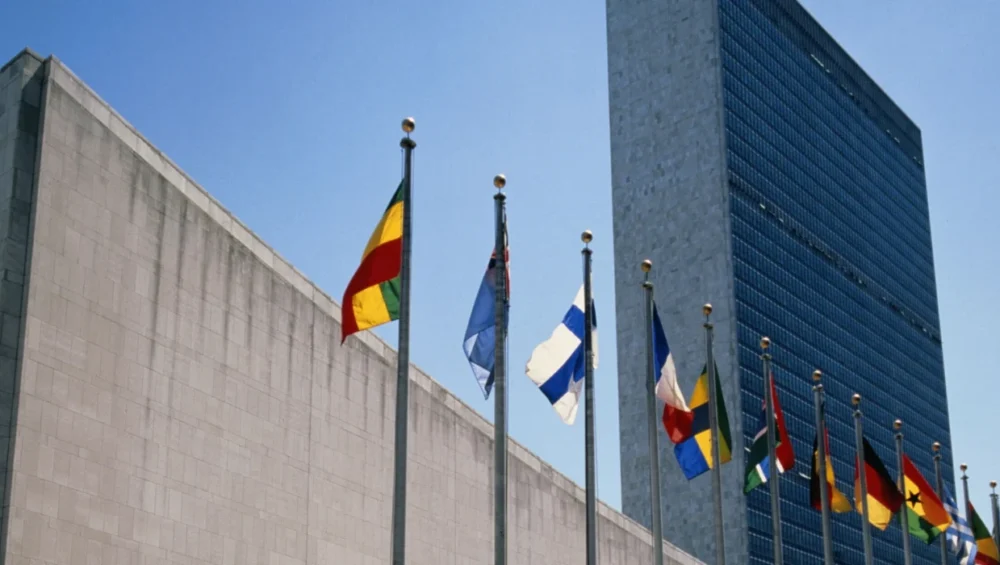
A Tibetan man’s death after an apparent self-immolation outside United Nations headquarters in New York has once again drawn global attention to the long-running political crisis in Tibet and Beijing’s hardline approach to dissent.
The event, which occurred on 3 July 2026, has been contextualized by human rights organizations not as a mere act of desperation, but as one element within the pattern of protest against several decades of oppression, cultural extinction, and restriction of rights under the Chinese regime. This case has acquired a much wider significance than that of an ordinary protest action because of the particular time and place of its occurrence. This took place near the UN, the main international diplomatic organization, and the very day following the entry into force of a new Ethnic Unity Law of China, which Amnesty International views as another step toward the assimilation of ethnic minorities, such as the Tibetans.
What happened in New York
According to the reporting cited by Amnesty International, the man was identified in media and Tibetan-organizational accounts as Lobga Rangzen, also known as Lobsang Palden, a 52-year-old resident of Queens. He reportedly carried a Tibetan flag and called for freedom for Tibet before setting himself on fire outside the UN headquarters on 2 July 2026.
His death has been seen by Tibetan activists and those advocating on behalf of their rights as an act of politics related to Tibet’s bigger picture as a whole. The act itself is extraordinary in terms of where it takes place, but not necessarily in terms of the history it recalls. The act of self-immolation in Tibet has been used for a very long time by Tibetans who feel that there is no other way to demonstrate their displeasure about the policies that the Chinese implement. What makes the place where the protest takes place special is that it brings to attention the problem of Tibet that remains unsolved.
Amnesty’s response and warning
Amnesty International responded quickly, describing the incident as evidence of the “depth of desperation” created by what it calls years of abuse and repression in Tibet. Deputy Regional Director Sarah Brooks said self-immolation by Tibetans “does not happen in a vacuum,” linking the protest to long-standing human rights violations and political frustration.
“does not happen in a vacuum”
— Sarah Brooks, Amnesty International
Amnesty called upon the Chinese government to stop the repression in Tibet, permit independent access to Tibet for the UN and other organizations, and ensure that no reprisals will be taken against the family of the man. This is particularly important in the context of Tibet, where rights organizations have repeatedly reported that in such cases the families of the demonstrators may become victims of surveillance, intimidation, or even detention. The overall message conveyed by Amnesty is that this particular case is more than an individual death; rather, it reflects a political situation where Tibetans are constantly feeling persecuted in terms of their culture, religion, and language. In other words, Amnesty is trying to use this case to show how despair is a result of policy.
Why Tibet remains volatile
Tibet remains one of the most sensitive political issues in China because it combines sovereignty, identity, religion, and international advocacy in a single conflict zone. Beijing insists Tibet is an inseparable part of China, while Tibetan activists and exile groups argue that the region has suffered systematic political control, religious restrictions, and cultural assimilation.
The organization claims that it has identified a history of violations against the Tibetan people, ranging from limitations on their freedom of religion, speech, assembly, and culture. According to Amnesty International, there are also pervasive forms of surveillance of Tibetans, along with arbitrary detentions, limitations on the use of the Tibetan language, and criminalization of non-violent expressions of Tibetan identity.
This list of accusations is by no means a new one, but rather a vital one when considering why Tibetan self-immolations persist as a form of protest. If an individual is not allowed to engage politically in a normal fashion, then they are often left with taking up the most radical position as a witness – that of self-sacrifice aimed at drawing the issue into focus.
China’s ethnic unity law
The timing of the protest gave the story additional weight. Amnesty says China’s new Ethnic Unity Law entered into force on 1 July 2026, only a day before the self-immolation. The rights group argues that the law could strengthen assimilation policies affecting Tibetans, Uyghurs, Mongolians, and other non-Han communities.
It is not merely that the legislation facilitates the construction of national unity that is of concern to Amnesty. Rather, the threat lies in how the state can use the notion of “unity” to compel minorities to assimilate themselves linguistically, culturally, and politically. From the perspective of Amnesty, the law may even be employed to facilitate transnational repression in the sense of extending Chinese state pressure abroad. This is significant in light of the present example, where despite the man being killed outside the United Nations and in no way in Tibet, the act is clearly a function of the politics of Tibet. It becomes another example of how the issue of Tibet has ceased to be local.
The meaning of self-immolation
Self-immolation of Tibetans is among the most agonizing types of protests in the human rights history of the modern era. According to Amnesty International, these cases have been going on for years as a reaction to human rights violations and political repression. This understanding of self-immolation is significant in the sense that it takes the case out of the realm of sensationalism.
What matters in this narrative is not just the death of a person due to fire outside the United Nations building. The real story is that a person seems to use his body in order to convey a message of political frustration that he thinks was never heard.
For Tibetans and Tibetan advocacy groups, such deaths are often framed as acts of sacrifice in support of national dignity, religious freedom, and resistance to assimilation. For rights organizations, they stand as evidence of desperation and the consequences of repression. Both readings point back to the same central fact: the political space available to Tibetans remains deeply constrained.
The larger human rights pattern
The report from Amnesty situates the incident within a broader system of restrictions in Tibet. These include pressure on religious institutions, restrictions on expression, surveillance, and punishment for nonconformity. The organization argues that Chinese authorities have an obligation to protect minority communities and their cultures, yet instead have pursued policies that can erode them.
This is where the story becomes more than a single tragic event. The self-immolation is a flashpoint, but the underlying issue is state control over identity and dissent. Amnesty’s framing suggests that the man’s death should be read as part of a pattern of suffering that has persisted for decades.
The reaction also exposes a familiar gap in international response. Tibet has long generated statements of concern, but actual access, transparency, and accountability remain limited. Amnesty’s call for independent observer access reflects that frustration. Without such access, the public is left to rely on fragments, activist reporting, and official silence or denial.