
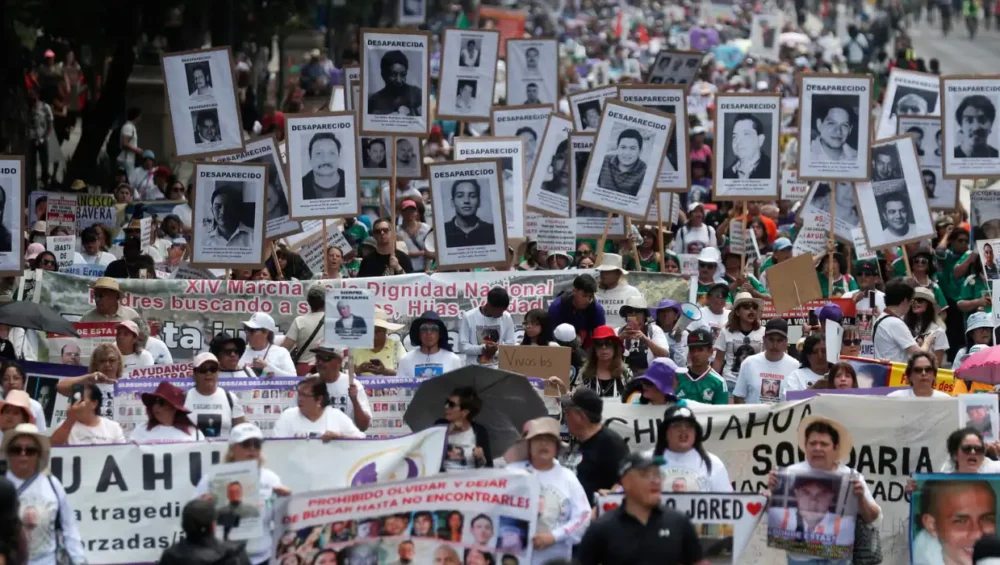
Mexico’s disappearance crisis has reached a disturbing new phase, with fresh reporting and human rights warnings pointing not only to the scale of the tragedy but also to the possibility that, in some regions, state actors are part of the machinery that allows it to continue. The latest findings describe an “alarming” rate of disappearances involving state officials, while also stressing that criminal organizations remain the main drivers behind the violence. What makes the situation especially grave is the suggestion of “deep collusion” between criminals and public authorities, a pattern that turns a security emergency into a governance crisis.
The sheer size of the issue itself is overwhelming. Mexico now has well over 130,000 individuals reported as being either missing or disappeared, which puts the country right up there as having one of the largest missing person issues in the world. Reports referenced in recent human rights articles reveal that Mexico’s number of disappeared has actually increased by over 200% in just the last 10 years. Other human rights organizations and reports put the number in an equally shocking range, including one report which states there have been as many as 133,500 missing persons reported by 2025 and another report placing the number at more than 133,215 missing persons by July 2025.
A crisis that no longer looks purely criminal
For years, disappearances in Mexico were often framed mainly as a consequence of cartel violence, organized crime expansion, and the weakness of local law enforcement. That framing is still partly true, but the latest reporting suggests something darker and more institutional. According to the report summarized by The Guardian, “deep collusion” exists in some parts of the country between criminals and officials, allowing disappearances to continue with limited accountability. The report also says criminal groups are not operating in isolation; instead, they are often embedded in local power structures and enabled by public servants who are supposed to stop them.
That is the central shift in this story. The country is not simply dealing with violent criminal groups abducting victims in the shadows. It is facing a system in which parts of the state may be compromised, recruited, intimidated, or directly involved. In some regions, the report says, disappearances attributed to state personnel have at times approached the levels attributed to criminals. That is a deeply alarming sign because it means the state is not always the protective force it is supposed to be; in some cases, it may be part of the problem.
The reason behind the use of the term enforced disappearance by many human rights NGOs when addressing the case, is because enforced disappearance means far more than missing persons. Enforced disappearance entails hiding and denial. For example, in the case of Mexico, the term enforced disappearance is a stronger and more important concept because it transforms the issue into a rights violation rather than a public safety matter.
The numbers behind the alarm
The statistics mentioned in the report from official sources as well as advocates make it evident just how grave a situation this is. As many as 130,000 people are reported missing or disappeared from Mexico, with such a number signifying a huge human and legal burden on both families and the government. The reports from The Guardian mentions that disappearances have increased by over 200% in just a decade, making clear how quickly the situation has deteriorated. Another Amnesty report mentions disappearances at over 133,500 in 2025.
These numbers should not be taken into account just because of their large value; they also indicate a pattern of continuous loss. Each individual figure stands for a search for truth by one family, an unresolved file of rights violations, and an attempt by the state body to conduct investigations. Discrepancies in the numbers reported by different sources are usual when dealing with a situation like this; indeed, these numbers vary greatly depending on whether they were gathered officially or from independent sources or reports.
The missing persons dilemma in Mexico has become a very clear example of how security and human rights in the country have deteriorated. This is no longer simply an abstract number. It reflects a failure by Mexico to stop people from going missing, investigate the cases, and prosecute the culprits.
Human rights warnings grow sharper
The most recent warnings are not isolated occurrences either, but follow a trend of increased worry emanating from human rights bodies and activist groups. According to Amnesty International related reports, such attacks against human rights activists, journalists, and search groups persisted up until 2025, which is particularly pertinent because these are usually the very groups that push for action when nothing else is being done by the state. When the individuals searching for the missing are persecuted, the situation becomes especially vicious.
The U.S. State Department’s 2024 human rights reporting on Mexico also noted allegations of numerous enforced disappearances by criminal groups, sometimes with claims of collusion by authorities. That broader official context reinforces what human rights monitors have been saying: the issue is not confined to cartel brutality alone. It also involves failure, corruption, or direct participation by officials who should be enforcing the law.
FIDH and partner groups went even further in their framing, describing disappearances as often carried out with the authorization, support, or acquiescence of local officials. That wording is important. It suggests varying degrees of state involvement, from passive tolerance to direct assistance. In practical terms, it means that the disappearance crisis can be sustained not only by violence but also by silence, impunity, and bureaucratic obstruction.
The role of impunity
Impunity is the force that keeps these cases open indefinitely. Families report, search, and petition, but justice moves slowly or not at all. In many cases, the lack of meaningful investigation creates a second wound after the original disappearance. The first is the loss of a loved one. The second is the absence of truth.
The reporting around Mexico repeatedly returns to the same point: criminal groups are often the immediate perpetrators, but the deeper system includes local politicians, police, security forces, and other authorities who may be complicit or unwilling to intervene. This makes impunity structural rather than accidental. If local institutions are captured, intimidated, or corrupted, then disappearances can happen repeatedly with minimal risk to perpetrators.
That is why the report’s references to “deep collusion” are so important. Collusion changes the meaning of the crisis from a fight against organized crime into a test of whether the state itself can still function as a neutral protector. The answer implied by the reporting is troubling: in some areas, it cannot.
How the crisis evolved
Mexico’s disappearance crisis did not emerge overnight. It grew alongside the expansion of cartel power, the militarization of public security, and the weakening of local safeguards in various regions. The broader context of the war on drugs, especially since the 2000s, created a violent environment in which disappearances could spread rapidly. What began as a security strategy against organized crime eventually produced a landscape where criminal groups adapted, local authorities were pressured or infiltrated, and victims disappeared into a system with no reliable resolution.
This history matters because it explains why disappearances now carry such deep political meaning. They are not just random crimes. They are often linked to territorial control, intimidation, extortion, and the reshaping of local power. In the most affected areas, people may disappear because they challenge criminal authority, because they are wrongly identified, or because they are caught in networks of cooperation between criminals and officials.
That is also why recent human rights findings are so significant internationally. The issue is no longer being described as isolated violence in a few hotspots. It is being treated as evidence of a nationwide human rights emergency with local variations and state accountability failures.
What the report implies for Mexico
The report’s real warning is that Mexico cannot solve this crisis with arrests alone. If officials are complicit in some regions, then removing only the criminals will not be enough. The state must also confront corruption, strengthen investigative institutions, protect searchers and witnesses, and ensure that police and political actors are not shielding perpetrators.
The scale of the crisis suggests that a piecemeal approach is inadequate. Every disappearance that is not properly investigated strengthens the perception that the system will not respond. Every unresolved case sends a signal that the risk of consequence is low. And every allegation of collusion that goes unaddressed deepens public distrust.
A major part of the challenge is therefore institutional credibility. If families believe local authorities cannot be trusted, they will continue turning to search collectives and human rights groups. If those groups are then attacked or intimidated, the social machinery of truth-seeking weakens further. That is how impunity becomes self-reinforcing.
Mexico’s disappearance crisis is now one of the clearest measures of state fragility in the country. It reflects insecurity, corruption, fear, and the inability to guarantee basic rights. The latest report does not just document a rise in cases. It exposes a system in which crime and authority may overlap in ways that make disappearances easier to commit and harder to solve.
Why this matters now
The timing of the latest warnings is important because it shows the issue remains urgent, not historical. The disappearance toll is still rising, human rights defenders are still under pressure, and the families of the missing are still searching. The language used by rights groups and reporters is increasingly severe because the pattern itself is severe. When a country passes 130,000 missing persons, and when allegations of official collusion continue to surface, the problem can no longer be treated as an episodic security failure.
This is a national crisis with international significance. It affects Mexico’s legal obligations, its democratic credibility, and its standing on human rights. It also has a human face: mothers, fathers, siblings, and children who live between hope and uncertainty every day. The statistics are shocking, but the personal suffering behind them is the real measure of the emergency.
The latest report is therefore more than a warning. It is an indictment of the current system and a call for accountability. The numbers show the scale. The allegations show the depth. And the continuing disappearances show that the crisis is far from over.