
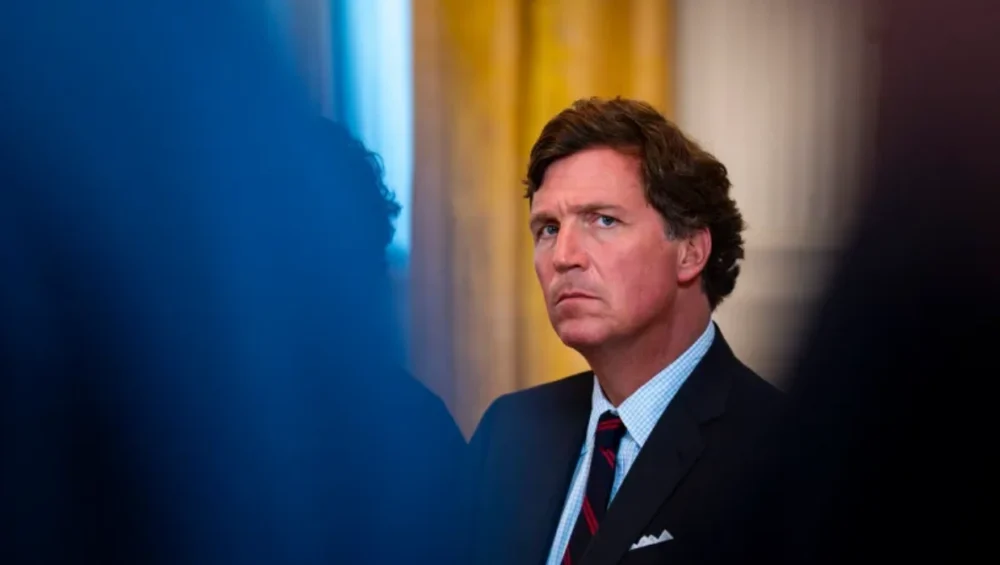
In an increasingly contentious split within the American right-wing corridor, Tucker Carlson makes his move against GOP leaders and conservative media personalities by pointing to their role in censoring American citizens who speak negatively about being engaged in military action with Iran.
Carlson, in a video released late-March 2026, titled:
“The Iran War Crackdown Has Already Started!,”
describes the ongoing discourse related to the state of war versus the state of peace, but frames it more broadly as a confrontation regarding civil liberties versus freedom of expression in a milieu of war.
Carlson’s remarks follow the culmination of numerous American-backed air strikes and ground operations against Iranian military targets. The Trump administration has stated that these military operations are in response to regional threats and/or attacks on both American and Israeli entities within the region.
The Alleged Crackdown on Dissent
Carlson notes in his monologue that the underlying systems of censorship associated with war exist in indirect forms. Rather than being directed by military personnel, censorship occurs when institutions, society, and the media begin to censor themselves in a way that makes it appear that those who criticize the war are disloyal or dangerous.
“This is already happening with respect to the government, but in addition to that, there is a culture that makes it appear that those who criticize the war are disloyal or dangerous,”
he says.
As the U.S. supports military actions against Iran, he continues, both political and media establishments then treat any dissent to those actions as something that needs to be managed rather than a legitimate viewpoint that can participate in debate. This is what encourages the average citizen to withhold dissenting opinions about the war or challenge the official story for fear of being labeled as “traitor,” “Apologist for terrorists,” or worse; subsequently, they will lose their social, professional, or legal standing within their respective communities.
In addition to voicing his concerns about the risks of speaking out on the war, Carlson has indicated that he is also concerned about the legal ramifications of speaking out. Following a number of interviews in which he expressed his discontent regarding the Iraq War, Carlson stated that he fears that he will be investigated or charged by the federal government for engaging in conversations with Iranians or about Iran.
Targeting Republican Leaders and Media Elites
Carlson’s criticism is not evenly distributed; it is sharply focused on specific Republican senators and conservative media figures he accuses of advocating for more aggressive action against Iran while marginalizing those who disagree. He reserves particular scorn for senators such as Ted Cruz and Lindsey Graham, who, in past years, have repeatedly called for tougher measures or even direct strikes against Iran, including in response to alleged support for terrorism or attacks on U.S. interests.
“The people calling for war on Iran are the same people who want to shut down dissent at home,”
Carlson has said in his programs, suggesting that the impulse toward militarism abroad is linked to a willingness to restrict speech and political pluralism at home.
He accuses these figures of using the language of national security and “anti‑terrorism” to pressure platforms, advertisers, and institutions into blacklisting or disadvantaging Americans who oppose the war, especially those outside the mainstream foreign‑policy consensus.
Carlson’s “America First” Defense of Anti‑War Voices
At the heart of Carlson’s argument lies a distinct ideological framing rooted in his long‑standing “America First” posture: opposition to endless wars, skepticism of foreign entanglements, and suspicion of foreign policy elites. He insists that the United States did not elect Donald Trump to re‑engage in or expand Middle Eastern conflicts, but to end them and to prioritize domestic concerns over overseas military adventures.
In interviews and monologues, Carlson has repeatedly criticized the Trump‑administration‑led response to Iran, describing Israeli‑backed strikes and their U.S. coordination as reckless and contrary to the interests of average Americans. He argues that the Iranian government, whatever its flaws, is fundamentally a regional actor and that its alleged backing of terrorism or regional proxies is often exaggerated to justify interventionism.
“The idea that Iran is the source of all evil in the region is a fantasy,”
he has said,
“and it’s a fantasy told to prepare people for war.”
The Feud Within the Conservative Coalition
Carlson’s accusations have deepened an already visible split within the Republican and MAGA‑aligned political universe. On one side stand traditional hawks and pro‑Israel voices in the GOP, including senior figures such as Ted Cruz and unnamed Republican donors whom Carlson has accused of pressuring the Trump administration to pursue a more aggressive line toward Iran.
On the other side is a growing cohort of populist and nationalist conservatives, including Carlson and some fellow media figures, who oppose new or expanded Middle Eastern wars even if they otherwise support Trump. They argue that wars in places like Iraq and Afghanistan have shown how quickly limited interventions can expand into open‑ended conflicts, with high costs in lives, money, and democratic freedoms.
For a human‑rights think tank, this intra‑coalition feud matters because it reveals how human‑rights‑adjacent concerns—such as the right to criticize government policy, the limits of state surveillance, and the role of media in shaping public debate—can be weaponized in partisan struggles.
Human‑Rights and Civil Liberties Implications
From a human‑rights perspective, Carlson’s warnings about censorship around the Iran war touch on several established concerns. First is the risk that governments will use national‑security rationales to expand surveillance, investigate critics, or treat political speech as a potential threat, especially when the population is told that the country is in a state of incipient or ongoing war.
Second is the role of media and platforms in shaping the permissible spectrum of public opinion. When dominant media outlets, conservative or otherwise, amplify pro‑war narratives while downplaying or attacking anti‑war voices, they can effectively narrow the space for lawful criticism. This can amount to soft censorship: not through formal legal bans, but through reputational costs, advertiser pressure, algorithmic bias, and social ostracism.
Carlson’s focus on ordinary Americans who oppose the war aligns with the human‑rights principle that all individuals, regardless of their visibility, have the right to express critical views on matters of public importance, including questions of war and peace. In a context where some politicians and media figures are openly hostile to dissent on Iran‑related issues, the risk of chilling legitimate speech increases.
Public Opinion, Polling, and the Base
Although detailed, up‑to‑date polling on attitudes toward an Iran war can be uneven, available surveys and reporting in early 2026 suggest that opposition to a wider conflict is not marginal, especially among certain segments of the Republican base and independents. Reports indicate that younger and lower‑income voters, in particular, are more skeptical of new military engagements and more sensitive to the financial and human costs of war.
These trends help explain why Carlson’s stance resonates with a significant slice of Trump’s coalition even as it clashes with GOP establishment figures. For many supporters, his anti‑war rhetoric is less about backing Iran and more about rejecting what they see as elite‑driven foreign interventions that disrupt their lives without clear benefit.
A Rights‑Focused Lens on the Debate
Tucker Carlson’s latest broadside against Republican leaders and conservative commentators is best understood not simply as a partisan spat, but as a dispute over the boundaries of acceptable speech in a time of looming or actual war.
Those questions include: under what conditions can states legitimately restrict speech in the name of security; how can media ecosystems protect pluralism instead of narrowing debate; and how can ordinary citizens who oppose war feel safe to voice their concerns without fear of reprisal.
Whether one agrees with Carlson’s politics or not, the core rights issues he raises—about dissent, surveillance, and the treatment of anti‑war voices—remain vital for any think tank focused on human‑rights‑anchored analysis of contemporary conflicts.