
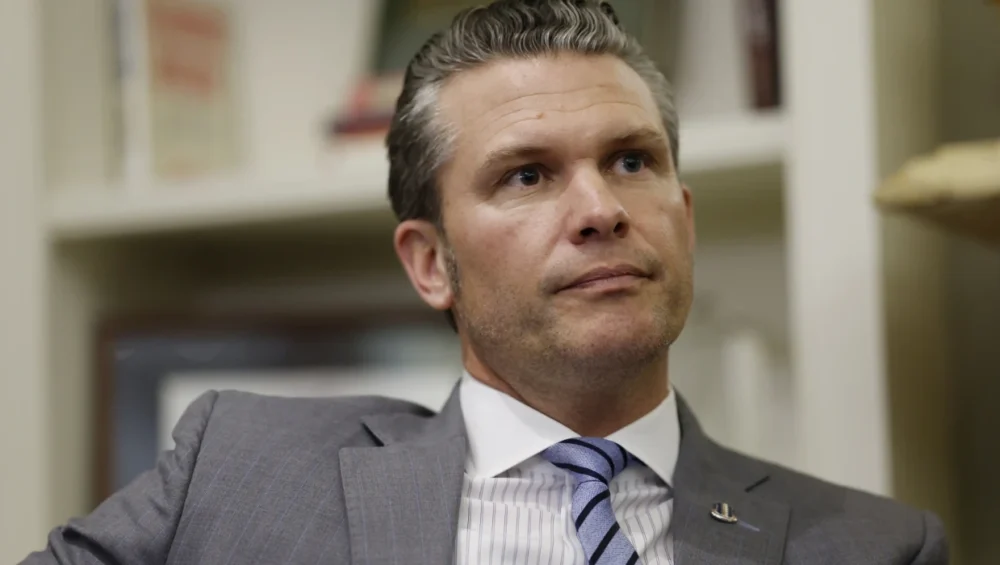
A dramatic event unfolded on April 30, 2026 in the U.S. Senate Armed Services Committee when CODEPINK activist Gus interrupted Secretary of Defense Pete Hegseth’s testimony, calling him a “war criminal.” He was quickly arrested by Capitol Police.
The interruption was part of CODEPINK’s growing “Arrest Hegseth” campaign as a way of raising awareness of major human rights abuses that have occurred as a result of the Trump administration’s aggressive military posture, particularly the horrific U.S.-Iran war.
Gus’ arrest was more than just a publicity stunt. It was a cry from the heart against policies responsible for the deaths of more than 170 Iranian schoolchildren, primarily girls, during the bombing of an elementary school in Minab on the first day of war, and a call for accountability in a time when unchecked power threatens to endanger the entire world.
Escalating Tensions in Senate Hearings
During the recent Senate hearing regarding military spending, President Donald Trump proposed a $1.5 trillion defense budget (42% increase) that reflects a militarized concept of American power over the world. Hegseth has re-branded the Pentagon as “Department of War” and has been aggressively challenged during both days of his testimony by Democratic senators due to The Israel-Iran conflict intensifying.
Senate Chair Roger Wicker (R-MS) kept the committee’s order together during free speech by allowing protesters to be removed if they disturbed the meeting. There was an instance of protest during this session when Gus, unrolled a banner and yelled accusations out loud during Hegseth’s opening statement. This type of disruptivness did not happen by chance; there was a similar incident the previous day involving three U.S. veterans disrupting Hegseth’s confirmation hearings to serve as a warning sign about continuous anti-war protestors entering Washington, D.C.
From a human rights perspective, the hearings provided a human face to the numerous statistics that the U.S. government frequently uses when describing how many people they kill in wars and through these abuses of power. An example of this is the bombing at Minab where Gus specifically pointed out the fact that this bomb on an elementary school killed 170 children; this is an inexcusable attack, particularly since many believe this bombing was not only an example of disproportionate force but that it could also be classified as a possible war crime under international law.
In the framework of CODEPINK, Hegseth’s silence about the bombing of Minab, his support for the escalation of the U.S.’s involvement in unprovoked wars throughout the world, and Hegseth’s willingness to justify the killing of nearly 100 fishermen from the Caribbean under false intelligence information surrounding “narco-terrorism” highlight how Hegseth fits into the larger world views of many Americans.
The Activist’s Defiant Stand and Immediate Aftermath
Gus’s intervention was visceral and pointed. As officers escorted him away, he proclaimed,
“I’m being arrested because I oppose the war in Iran,”
followed by a searing indictment:
“What do you think about the 160 young girls who were killed on the first day of the war? Absolutely despicable. He is a war criminal. This needs to be stopped.”
Released after brief detention with no charges detailed in immediate reports, Gus embodied CODEPINK’s feminist, anti-imperialist ethos, a group long at the forefront of protesting U.S. interventions from Iraq to Gaza.
This CODEPINK activist arrested moment transcends individual protest; it interrogates the human cost of policy. The Iran war, now in its throes, has already claimed thousands, but the school bombing stands as a poignant symbol—innocent girls denied futures in a conflict framed by the administration as defensive yet launched preemptively.
Human rights watchdogs, though not directly cited in hearing coverage, would likely invoke Geneva Conventions violations: targeting civilian infrastructure without military necessity. For our thinktank’s focus, Gus’s arrest underscores protest as a bulwark against normalization, where dissenters face handcuffs while architects of carnage testify unchallenged.
CODEPINK’s “Arrest Hegseth” Campaign: Roots and Reach
CODEPINK’s campaign predates this hearing, launching weeks earlier with calls to “Arrest Hegseth!” ahead of White House events decrying “war crimes.” Their website meticulously documents grievances: Hegseth’s Pentagon overhaul, unwavering Israel support amid Gaza’s death toll, and veteran neglect despite his Fox News persona. The January 2025 confirmation hearing saw similar fervor—three veterans, including Josie Gilbeau, arrested for decrying Gaza policies and military suicide rates, with one shouting against funding “genocide” while troops suffer. These threads weave a tapestry of human rights advocacy, positioning CODEPINK not as disruptors but as sentinels against atrocities.
In analytical depth, the campaign’s efficacy lies in its persistence. By April 2026, amid a budget ballooning to $1.5 trillion, CODEPINK links Hegseth to systemic failures: Caribbean fishermen slain in “anti-narco” ops lacking due process, Iranian civilians collateralized in escalation. This mirrors global patterns—U.S. drones in Somalia killing civilians reclassified as “enemies” post-strike. Yet, with Trump’s reelection solidifying hawkish control, these voices risk marginalization, their arrests a microcosm of suppressed dissent in fortress America.
Human Rights Implications in U.S. Military Doctrine
Delving deeper, the CODEPINK activist arrested incident catalyzes scrutiny of Hegseth’s worldview. His testimony defended the budget surge as essential against Iran and China, but protesters spotlight collateral horrors. The Minab strike, killing 170-plus, evokes outrage akin to Russia’s Ukraine school bombings—universal condemnations when adversaries err, selective silence for allies. Human rights analysis reveals a doctrine where “narco-terrorism” justifies extrajudicial killings abroad, eroding international norms like proportionality and distinction between combatants and civilians.
Broader figures paint a dire picture: the Iran war’s opening salvos alone decimated civilian sites, with CODEPINK estimating thousands affected. Caribbean incidents compound this—100 fishermen gunned down, their humanity reduced to security threats. Democratic senators’ grilling, while pointed, lacks teeth without protest amplification; Gus’s bold stand ensures the 160 girls’ ghosts haunt deliberations, challenging narratives of “precision” warfare that mask imprecision in valuing lives.
Echoes from Confirmation Hearings
Flashback to January 2025: Hegseth’s confirmation faced parallel fury. Veterans disrupted, one arrested yelling against Gaza aid hypocrisy—billions for bombs, pennies for PTSD-afflicted troops. Josie Gilbeau’s group decried veteran suicide epidemics, tying them to diverted funds. These precedents contextualize April’s arrest: not spontaneous, but orchestrated resistance against a figure embodying militarism.
Policy Ramifications and Future Protests
As the hearing adjourned, Wicker’s gavel silenced the chamber, but digital echoes proliferated—Instagram reels, LinkedIn posts, YouTube clips garnering millions of views. CODEPINK’s strategy leverages this virality, turning arrests into recruitment. For human rights, the stakes are existential: a $1.5 trillion war machine risks normalizing school bombings as “regrettable necessities.”
Yet, hope flickers in dissent. Gus’s release sans charges signals limits to repression; public backlash could sway moderate Republicans or fuel midterm reckonings. Hegseth’s unyielding posture—defending strikes, budget hikes—invites comparison to past secretaries like Rumsfeld, whose Iraq hubris crumbled under scrutiny. In our human rights mandate, this CODEPINK activist arrested saga demands vigilance: protests aren’t nuisances but necessities, holding power to account when innocents pay the ultimate price.
Global Human Rights Echo Chamber
Internationally, the incident ripples. Allies like Israel cheer Hegseth’s firmness, but human rights NGOs—from Amnesty to Human Rights Watch—likely decry U.S. hypocrisy, selective outrage over Ukraine versus Yemen. Iran’s state media amplifies Gus’s “war criminal” barb, bolstering propaganda while underscoring valid grievances. Caribbean nations protest fishermen killings, invoking OAS scrutiny.
CODEPINK’s campaign, though radical, revives 1960s anti-Vietnam vigor, proving grassroots power endures. As journalists, we chronicle not just arrests, but the moral imperatives driving them—lest history judge us complicit in silence.