
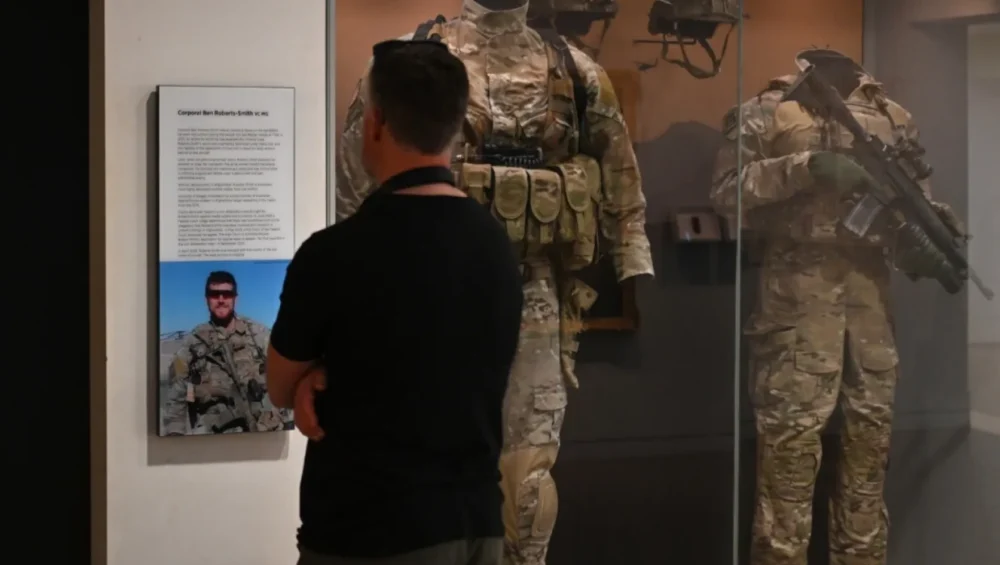
The decision of Australia’s War Memorial to show a ‘blacked out’ version of the Brereton report in its new Afghanistan gallery represents a key moment in the nation’s struggle with its military past.
The report was publicly released in November 2020 after a four-year investigation by NSW Supreme Court Justice Paul Brereton, detailing the alleged commission of war crimes by Australian Special Forces and being made a central focus of a space created to commemorate the conflict in Afghanistan. As an organisation that undertakes human rights analysis through a think tank, it illustrates the tension created by the contradiction between national commemoration and the need for accountability, representing the challenges that institutions continue to experience when faced with systemic abuse.
The Inspector-General of the Australian Defence Force Afghanistan Inquiry Report (official name for the Brereton Report) includes serious allegations of 39 separate unlawful killings (murder of Afghan civilians and prisoners) that occurred in the course of 23 separate incidents between 2005 and 2016, as well as two incidents of inhumane treatment, which expose significant fractures within the military command and military culture.
Unpacking the Brereton Report’s Revelations
The Brereton Report investigates the Australian involvement in the US-led coalition in Afghanistan. The report has uncovered the Australian Special Air Service (SAS) troops committed numerous atrocities, violating all international human rights. Reports show that as many as 25 Australian Defence Force (ADF) personnel (current and former) and junior soldiers were forced to “blood” their fellow ADF members by killing unarmed Afghans to initiate them into ADF warrior culture.
The scope of the inquiry included 191 separate incidents of murder, torture, and command failures over more than a decade of operations. “Blooded” members were forced to pressure junior troops into committing unlawful acts of killing, creating a culture in which committing such acts became commonplace. Human Rights advocates believe that these aspects of the Brereton Report provide universal legal authority and international law obligating countries to hold accountable for such offences regardless of rank and/or nationality.
The Brereton Report’s release in 2020 rocked Australia and prompted Australian Prime Minister Scott Morrison to call the findings “profoundly disturbing” and agree to culturally reform the ADF. However, there have been no prosecutions of any of the 19 individuals who were recommended for criminal investigation as of 2024. The lack of prosecutions is mainly attributed to difficulties related to the Taliban’s oversight of Afghanistan and the lack of evidence available for each of the offences committed by the individuals in question.
Key Figures and the Human Cost
Delving into the statistics reveals the scale of the tragedy: 39 victims, predominantly unarmed civilians or disarmed prisoners, lost their lives in 23 distinct incidents, with many cases involving deliberate executions followed by cover-ups. A stark example from 2010 involved SAS members killing an Afghan male, staging the scene with a planted weapon, and deleting incriminating photos—actions that mocked the rules-of-engagement protocols displayed alongside the report in the new gallery.
Related legal proceedings further illuminate the human rights implications. Victoria Cross recipient Ben Roberts-Smith, once lionized as a war hero, faces charges over five alleged war crime murders between 2009 and 2012, which he denies; his trial remains ongoing.
The War Memorial has contextualized his Hall of Valour display with a plaque noting this legal process, a subtle acknowledgment of how individual valor can coexist with allegations of atrocity. This intersection of heroism and horror compels think tanks like ours to analyze not just isolated acts but systemic enablers, such as ignored intelligence reports and the glorification of aggressive tactics.
The War Memorial’s Bold Contextualization
The inclusion of the redacted Brereton Report in the Afghanistan gallery—joining 1,200 artifacts including Geneva Conventions texts and rules-of-engagement cards—signals the Memorial’s intent to present a warts-and-all narrative. Director Matt Anderson has emphasized the need to balance this with recognition of the “skill and courage” exhibited by most of the 39,000 Australian service members over 20 years in Afghanistan.
“We are committed to telling the full story,”
Anderson stated, positioning the display as a teaching tool amid veteran debates over its appropriateness.
This initiative follows prior controversies at the Memorial, such as the 2021 defense of chairman Kerry Stokes amid backlash over the report and the 2023 addition of context to Roberts-Smith’s exhibit. Critics, including veterans’ groups, argue soldiers are being “thrown under the bus,” as one SAS body claimed, while human rights experts praise the transparency as a step toward reconciliation.
The $500 million expansion, funded amid national soul-searching, transforms Anzac Hall into a comprehensive chronicle, but its success hinges on whether visitors internalize the human rights lessons embedded in the Brereton Report’s stark pages.
Human Rights Implications and Global Precedent
From a human rights analytical lens, the Brereton Report display at the War Memorial exemplifies “never again” accountability, mirroring global reckonings like the US My Lai inquiries or UK’s Bloody Sunday tribunal. Australia’s establishment of the Office of the Special Investigator (OSI) in response—tasked with pursuing prosecutions—demonstrates institutional response, though delays underscore prosecutorial complexities in conflict zones. Internationally, the findings bolster Afghan advocacy for reparations and truth commissions, aligning with UN calls for member states to address coalition-era crimes. Think tanks monitoring human rights violations see this as a litmus test: will Australia lead by example, or allow time to erode justice?
The report’s cultural critique—warrior ethos overriding ethics—resonates beyond Afghanistan, informing reforms like the ADF’s 2024 inquiry closure statements. Yet, persistent impunity risks normalizing atrocities, eroding trust in international interventions. As the gallery opens, it invites reflection on command responsibility, where leaders failed to curb excesses, violating Article 28 of the Geneva Conventions on superior liability.
Challenges Ahead and Pathways to Justice
Ongoing hurdles, including witness intimidation and destroyed evidence, complicate OSI efforts, with no trials concluded by early 2026. Veterans’ mental health strains add nuance; many served honorably, yet the shadow of a few taints all. Human rights analysis demands holistic reform: mandatory ethics training, independent oversight, and victim-centered reparations. The Memorial’s display, by juxtaposing the report with operational artifacts, could catalyze this, educating future generations on the fragility of rights in war.
Statements from stakeholders enrich this narrative. Justice Brereton warned of a “complete lack of accountability” fostering crimes, while Defence Minister Richard Marles affirmed in 2024 the inquiry’s closure would not halt pursuits. Afghan voices, long silenced, now amplify through platforms like the Centre for International Governance Innovation, urging Australia to honor its commitments.
A Reckoning for National Identity
Ultimately, the Brereton Report’s prominence at the War Memorial reframes Anzac legacy from unblemished heroism to accountable service, vital for human rights integrity. As Australia navigates this in May 2026, the gallery stands as both memorial and mirror—challenging a nation to uphold justice. For think tanks dissecting human rights news, it signals progress amid peril: transparency illuminates, but action endures. This display ensures the 39 victims’ stories endure, compelling perpetual vigilance against war’s darkest impulses.