
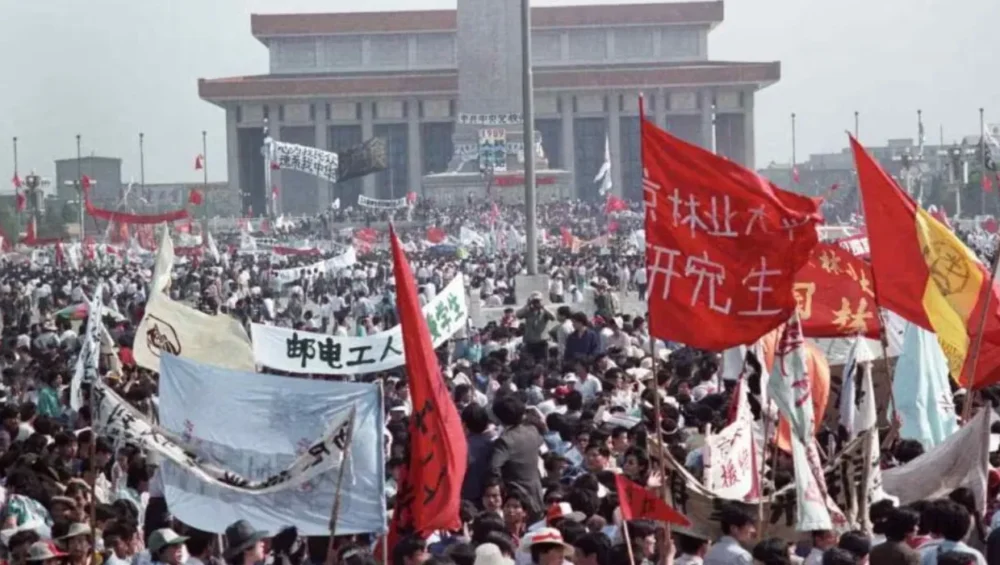
The reported ban imposed on the families of the Tiananmen protesters from visiting the graves of their relatives during the anniversary period is not just a security issue but an example of how issues relating to the past have been turned into a battle ground for human rights. If the reports are true, the ban imposed by Beijing raises serious questions about freedom of speech and mourning.
A heavy-handed anniversary clampdown
Members of families associated with the Tiananmen Mothers have reported that they were prohibited from visiting the Wan’an Cemetery in Beijing to pay homage to their deceased loved ones on the June 4th anniversary date, as revealed in recent news reports. This prohibition apparently went beyond keeping them from visiting the cemetery, but also from performing other memorial practices.
This particular aspect is important since, for one, the assembly is not a spur-of-the-moment thing; it is a regular ritual of mourning. The banning of this practice is no longer only about controlling crowds; it is also about banning mourning itself. To the families that have been suffering from loss for three decades now, this act of banning represents more than just logistics—it represents the erasure of memories.
Human rights implications
The most pressing issue presented by the situation described above lies in the violation of human dignity. Being grief-stricken is not a political gesture; however, under oppressive circumstances, it becomes one. When authorities hinder the visits of family members to the burial site of their loved ones, they, in effect, deprive them of their ability to grieve and remember.
According to human rights activists, the Chinese government’s stance on remembering Tiananmen reveals a larger trend of repression against its people. Rather than recognize the suffering of 1989 and give those affected an opportunity to express their grief, the government has been reportedly employing surveillance, intimidation, and other means to muzzle survivors and distort history. Such policies, according to human rights organizations, stand in stark contrast with global human rights standards protecting free expression, assembly, and conscience.
The restrictions in question also reveal an imbalance in power between the state and ordinary individuals. Those who lost their family members because of a political clampdown are not considered mourning kin but instead potential sources of unrest. That is the reason why they have repeatedly come under fire from rights organizations throughout recent decades. The government seems to be regulating the act of remembrance itself.
Why Wan’an Cemetery matters
Wan’an Cemetery has thus acquired a symbolic importance for the Tiananmen commemoration. To families of the Tiananmen Victims and other bereaved individuals, it has become one of the very few spaces in which they can commemorate loved ones who have passed away under politically charged circumstances and whom their government refuses to publicly acknowledge as victims.
This symbolic value goes some way towards explaining why the restrictions placed at this site met with such strong resistance. When a family is denied access to a cemetery, it is more than merely preventing a public gathering; it represents the denial of a mourning ritual that has endured for more than three decades.
The pattern behind the policy
The prohibition on burials in the cemetery is consistent with a broader trend witnessed during the period leading up to June 4. In previous years, there had been enhanced security in and around Beijing, surveillance of activists, restrictions on their movements, and warnings to dissidents and their relatives not to speak to journalists or attend memorial events.
This trend is significant in the sense that it indicates the ban was not an isolated incident. It seems to be part of a bigger plan through which Beijing seeks to erase from people’s minds what happened in 1989. According to human rights groups, China has been trying to censor mention of Tiananmen Square through a system of censorship that has worked effectively. The new cemetery ban would be the best example of that so far if all allegations were true.
Voices from the families
The stories told by members of the Tiananmen Mothers organization make the case a very personal one. As one member mentioned in media reports, a relative of hers, an elderly mother whose son was among those killed in the massacre of 1989, had been under close police surveillance for several days beforehand. It is clear that this is indicative of the surveillance climate associated with Tiananmen commemorations.
The grievances of the families revolve around issues of both dignity and remembrance. The argument presented by the families is that it would be wrong to deprive them of their basic human rights to pay tribute to and honor the dead at gravesites or discuss them. While the mourners have no ulterior motive, the government has forced them to become dissidents.
The silence problem
One of the most frightening aspects of such cases involves both the prohibition, as well as the lack of clarity that follows in its wake. In fact, any discussion of the Tiananmen Square protests is extremely limited in mainland China, and often times, it is very hard for families to have any room for grieving at all. The problem, of course, becomes even more complicated when they deny access to cemeteries.
That lack of clarity is itself a rights concern. Due process is weakened when restrictions are imposed informally through police pressure or vague security justifications. If families are told they cannot visit graves, but no public explanation is given, then accountability disappears. In such settings, arbitrary power replaces rule-based governance.
International concern and criticism
Apart from China, there has been criticism of how the Chinese authorities have handled the question of Tiananmen anniversary commemoration. This is according to reports from organizations such as Human Rights Watch and others, which have stated that the Chinese should recognize the killings, compensate the victims’ relatives and allow public commemoration.
The recent reports about cemetery restrictions are likely to intensify that criticism because they suggest a new level of interference. Preventing families from entering a burial site on the anniversary of a national tragedy carries symbolic weight that goes far beyond ordinary public order enforcement. It sends a message that even grief must remain politically invisible.
What the government stance suggests
China’s leaders have always used the concept of stability, order, and security to justify any limitations on the freedom surrounding Tiananmen Square events. This approach is very common during politically charged dates in China, because the government prefers control rather than discussion. It seems like China’s practical policy towards June 4 is that it poses a danger.
Yet that rationale is precisely what human rights advocates reject. From their perspective, stability cannot be built by suppressing truth or restricting families from honoring their dead. A state that fears even cemetery visits is not demonstrating confidence; it is demonstrating anxiety about memory. That is why the reported ban has resonated so strongly with critics: it exposes the tension between authoritarian control and human dignity.
Larger meaning of the anniversary
The anniversary of Tiananmen still constitutes one of the most sensitive events in contemporary Chinese politics. Every year, it serves as a challenge to see how much remembering would be allowed by the authorities. The ban on this year’s anniversary appears to represent another step towards tightening this space rather than broadening it. To the affected families, this matter involves more than mere politics; it concerns a painful loss made political.
The broader message is troubling. When memorial visits are blocked, public history becomes private suffering, and private suffering is denied public recognition. That is a classic marker of human rights failure. It shows not only a refusal to confront the past, but also a willingness to curtail the rights of survivors in the present.
Final assessment
If these reports turn out to be true, then the ban by the Chinese state on relatives of those who died in the Tiananmen Square Massacre from visiting their graves during the anniversary is undoubtedly a violation of human rights. It not only denies people the ability to mourn but also stifles their collective memories, thereby expanding state control over one of the most personal acts of humans – mourning for the deceased.
At its core, this is not just about a cemetery. It is about whether families of massacre victims can grieve with dignity, whether history can be remembered without punishment, and whether a government can silence memory by controlling the graves of the dead. The answer emerging from this report is stark: the struggle over Tiananmen is not over, and for the families, even mourning remains contested.