
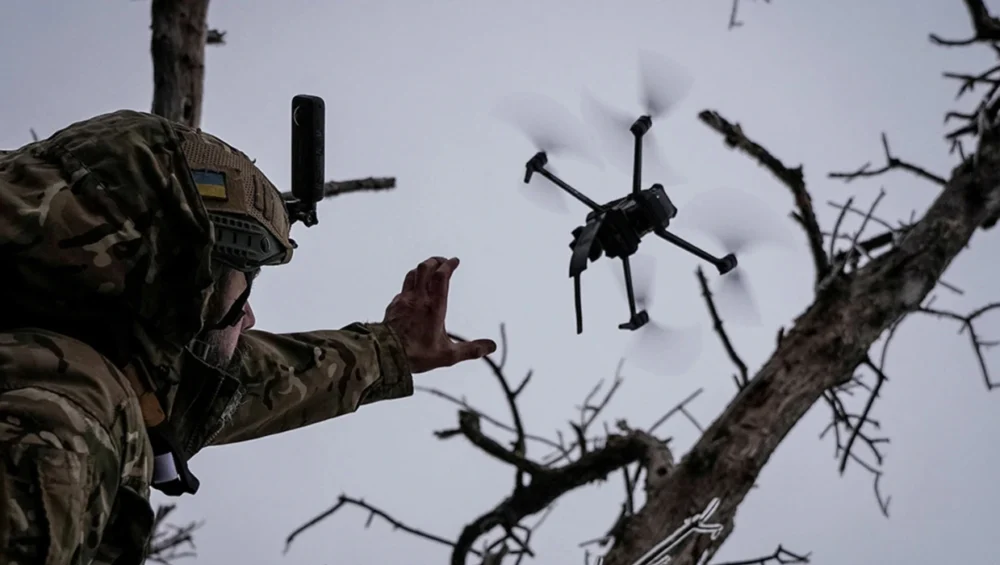
The investigation of the United Nations in the year 2025 on the use of drone warfare in the United Arab Emirates against Ukraine is a crucial step towards redefining the scope of contemporary warfare and the safety of people. The inquiry, conducted in compliance with the Office of the High Commissioner of Human Rights (OHCHR), reveals a threatening upsurge in methods that intentionally confuse military and civilian targets. The report can point to a steady trend of small, cheap drones with hand grenades or makeshift explosives employed not only to be effective on the battlefield but also as a tool of terror.
These drones have several times hit residential areas, educational establishments, healthcare facilities, and humanitarian zones in Kherson, Zaporizhzhia, and Mykolaiv. As of February 2022 to April 2025, UN investigators reported more than 3,000 civilian deaths due to such attacks, of which almost 400 were recorded. The accounts given by witnesses talk about drones flying over civilian districts and flying around hours before dropping explosives and making everyday survival a constant nightmare. This robotic focus on civilians lies directly against international humanitarian law and a total moral breach of war behavior.
The results are used to show how drone warfare that was previously referred to as precise and less collateral has now taken a new form of asymmetrical violence, of the kind that undermines established norms of distinction and proportionality. The UN report in its conclusion reiterates that such acts are war crimes as stipulated in Article 8 of Rome Statute which outlaws deliberate attacks that are perpetrated against civilian groups of people and the application of terror acts as a form of warfare.
Tactical innovation and psychological warfare
According to the analysts, the use by Russia of small and agile drones to spearhead attacks on non-combatants is both an indication of technological adaptation and psychological strategy. Such devices are lethal in nature with quadcopters of consumer-grade being modified to fly at low altitudes and can hardly be detected or intercepted. The saturation attacks are made possible by them due to their low cost and portability that overwhelms their defenses and disrupts civilian lives even in places that are miles away from the active frontline.
This solution complies with modern principles of hybrid warfare, in which a psychological influence supplements kinetic power. In some of the recorded events, the drones dropped grenade bombs in evacuation convoys and hospitals, a move to spread fear and disorganization and not to meet the traditional warfare goals. A senior UN field investigator termed this turnover as a new kind of reorganization of technology to intimidate rather than combat dominance.
Civilian vulnerability and human toll
The humanitarian data in the UN report is a gruesome view of the daily life experienced by Ukrainian civilians. Students heading to school, farm laborers, and even the healthcare staff who are attending to the injured have become the common victims. Destruction of infrastructure goes beyond instantaneous destruction, which interferes with power, healthcare, and food supply chains. Psychologists who have been dealing with displaced populations in Kherson report the emergence of the trauma diseases associated with the sound of drones flying specifically, which is an auditory image of the insecurity that has changed the meaning of life as a civilian under siege.
The psychological aspect of the war is also devastating besides the physical ones. Civilians report that they live in full panic and cannot tell the difference between surveillance drones and attack models. The atmosphere of constant imminent danger contributes to the mass displacement, as families do not run away to the advancing army; instead, they run away to the machines that are surrounding them.
Defining war crimes in the drone era
The UN findings in 2025 place the drone tactics of Russia squarely in the accepted legal definitions of war crimes in Geneva Conventions. The intentional attack on civilian population and civilian infrastructure, which was not justified by military necessity, is a serious violation of international humanitarian law. The UN Commission of Inquiry also highlighted that the documented attacks were not accidental or collateral rather that they were a sign of systematic terror and displacement.
The use of digital and video evidence obtained directly by the drones themselves is what stands out the most in this investigation as compared to the earlier war crimes investigations. The devices retrieved by Ukrainian officials had on board footage that showed commands given by operators and manual targeting of civilians. It provides an unprecedented evidentiary basis of possible prosecutions in the International Criminal Court (ICC). The experts in the legal domain opine that this kind of technological forensics may draw new precedents in establishing the intent and responsibility in contemporary warfare.
Enforcement challenges and geopolitical limits
Accountability is a very strong challenge to enforce even in the presence of the well-documented materials. The lack of jurisdiction of the ICC in Russia and veto of the UN Security Council prevents formal prosecution. The diplomatic relations are still tense, and Moscow refuses to acknowledge the accusations and discusses the use of drones as a defensive measure. Still, the findings of the UN report have spurred the debate of the international community on the necessity of broadening legal frameworks on unmanned combat systems.
European and North American policy makers are now calling on an amendment to the Convention on Certain Conventional Weapons (CCW) to clearly tell about the use of armed drones on civilians. There is a growing opinion that existing treaties fail to capture the technicalities of 21 st -century warfare, thus enabling offenders to take advantage of grey areas in the regulations.
Weaponization of emerging technologies
The inclusion of small drones into the war strategy of Russia is a seminal instance of the militarization of new technologies. It started as a reconnaissance tactic and now evolved as a common tool of asymmetric warfare. The implications of this evolution are far-reaching because other conflict zones can be emulating such approaches even outside Ukraine. Military experts caution that the spread of drone warfare technology to non-state actors would exponentially affect the vulnerable people across the world.
The civilian drone-based killings are destined to undermine the international humanitarian principles that have governed warfare over the decades. The UN report warns that in the absence of concerted international deterrence the precedent in Ukraine will be able to destabilize the ethical basis of modern conflict when there is no distinction between combatants and civilians, whose functions will be made functionally null.
Impact on diplomacy and conflict resolution
Another issue as outlined by the UN investigation is the diplomatic tension in accountability endeavors. Ukraine has been relying on the findings to support call to expand sanctions and international backing but Russia has been questioning the effectiveness of the report. Such a stalemate makes it difficult to sustain further peace talks and rebuilding since there is no trust between the warring sides and access to humanitarian aid is still at a risk.
The infrastructure, frequent attacks on aid convoys have weakened relief efforts, extending displacement crises in southern and eastern Ukraine. Reconstruction analysts have estimated that it will take more than 50 billion dollars of humanitarian and infrastructural investment to rebuild areas destroyed by drones, which has only risen with every new attack.
Shaping the future of warfare regulation
The 2025 UN investigation may become a defining moment in efforts to regulate autonomous and semi-autonomous weapons systems. Legal scholars argue that international law must adapt to address accountability gaps created by the use of unmanned technologies. Proposals for a global treaty on drone warfare, modeled after nuclear non-proliferation frameworks, are gaining momentum among member states. The urgency of such measures grows as nations increasingly incorporate drones into both defensive and offensive arsenals.
The investigation’s detailed documentation not only exposes war crimes but also compels the international community to reconsider how warfare is governed in an era where machines amplify human intent. As drone technology becomes cheaper and more accessible, the distinction between legitimate defense and deliberate terror blurs challenging the very foundations of humanitarian law.
The revelations from the UN’s 2025 investigation into Russia’s drone attacks in Ukraine illuminate how technology has redefined the mechanics and morality of modern warfare. The deliberate targeting of civilians through unmanned systems has transformed drones from surveillance tools into instruments of fear and coercion. As international law struggles to keep pace with rapid technological change, the central question emerges: can humanity restrain its innovations before they fully erode the boundaries of lawful warfare? The answer, many fear, will determine not only Ukraine’s recovery but the ethical trajectory of global conflict in the decades ahead.