
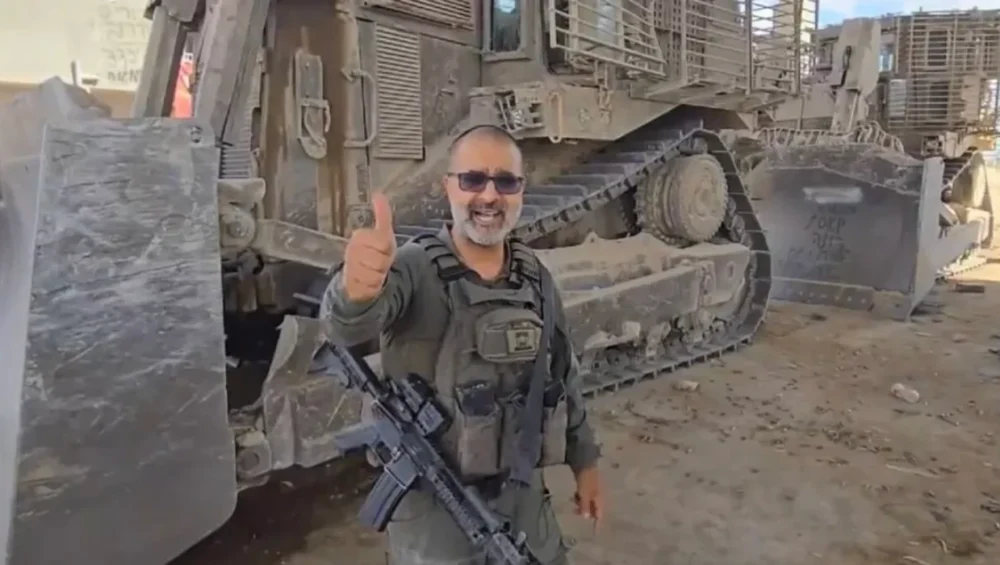
The appointment of Rabbi Avraham Zarbiv as a torchlighter to the 2026 Independence Day ceremony in Israel has sparked a severe international conflict between the military operation, social symbolism, and legal responsibility. The ceremony at Mount Herzl held every year is generally considered as one of the most important of the Israeli national rituals, which is meant to show unity, sacrifice and contribution towards civic life. Nevertheless, the addition of Zarbiv has made the focus to be directed towards the accusations directed at his reported involvement in the military operations in Gaza.
The scandal lies in the fact that there is a lot of footage that has been shared of Zarbiv working with heavy machinery when carrying out operations in Gaza reciting religious verses. The human rights organizations suggest that the imagery poses some serious questions in the international humanitarian law especially in terms of civilian infrastructure destruction in the midst of active hostilities. The publicity surrounding such recordings has elevated the case to be iconic of what critics term the increasing influence of digital evidence in defining accountability discourses.
Gaza Operations And The Visual Record Of Conflict
The rise of the so-called War Crimes on Camera debate is directly linked to the spread of user-created documentation of the battlefield in the course of the Gaza conflict, specifically after the intensification that started in October 2023.
Documented Destruction And Operational Claims
There are videos attributed to Zarbiv which show the destruction of residential buildings in southern Gaza such as Khan Younis and Rafah, during stepped-up Israeli military action. These actions occurred after the 2023 attacks by Hamas which claimed more than 1,200 lives in Israel and caused a massive military backlash in Gaza. By 2026, tens of thousands of Palestinian deaths and massive destruction of infrastructure had been reported by Gaza health authorities.
According to critics, the destruction depicted in the footage is beyond what is allowed by the concept of military necessity, especially where civilian facilities seem to be targeted on a basis that is not well justified in the operations. The destruction has been estimated to be on a scale of hundreds of thousands of housing units destroyed or damaged, which helped to create what humanitarian organizations refer to as almost complete displacement in some of the territory.
Religious Framing And Interpretive Tensions
Another controversial point is that Zarbiv is observably practicing the expression of religion in the course of operation. In the video, he is reciting prayers and blowing a shofar as buildings are being destroyed. According to legal analysts and pressure groups, because of the mixture of religious symbolism and the element of destruction, the issue of intent becomes difficult to define especially on the basis of the international legal norms in protection of civilian property.
The combination of symbolism and military action has sparked controversy as to whether this kind of behavior is an act of individual initiative, ideology or a larger cultural construct within some quarters of the military service.
Legal Complaints And Accountability Mechanisms
The charges leveled against Zarbiv’s actions have already taken a formal legal process and this is indicative of the growing presence of international institutions to record conflict-based behavior.
International Criminal Court Filings
In 2025, the Hind Rajab Foundation filed a complaint with the International Criminal Court claiming that the activity of Zarbiv could be considered under the provisions of the Rome Statute of intent to target civilian infrastructure. The complaint draws heavily on video content, which it claims is self-documented evidence, and which is publicly available.
Though Israel is not a party to the court, the filing is part of a larger trend of efforts to create individual responsibility with international legal tools. The documentary dependency on digital media is a sign of change in the documentation and evaluation of modern conflicts.
Domestic Military Distance And Institutional Positioning
The Israel Defense Forces has already made its position clear when it announced that Zarbiv was not chosen as a torchlighter by the military institution and that it does not reflect the organization policy. This detachment underscores a pattern of conflict between personal reservist behavior and institutional accountability amid extended wars.
As military analysts observe, such differences are formally significant, but tend to be blurred by the masses as people are both soldiers and public figures, and also symbolic figures in national rallies.
National Symbolism And Institutional Strain
The Independence Day torchlighting is a traditionally curated account of national identity. The introduction of an element that is connected to the conflicted wartime imagery adds another dimension of interpretation conflict.
Changing Meaning Of National Rituals
Historically, the torchlighters have featured people who are known for their social contribution, perseverance or national service. The choice of Zarbiv’s brings on board a character whose media image is characterized not just by his military career, but also by the accusation of having been involved in destructive acts which are under international investigation.
Surveys of the population of Israel show a split attitude, with some groups of the population seeing the appointment as an acknowledgement of military sacrifice, with others fearing reputation effects in the face of continuing legal investigation. The rift indicates the larger social conflict concerning the way war behavior should be commemorated.
Military Service And Public Representation
Sustained warfare has made the intertwining of the reserve military service and public symbolic recognition a more complicated issue. Operational personnel can also be turned into public figures as a result of viral media coverage and develop a dual identity that makes messaging by institutions difficult.
This dynamic poses the question of how states are able to handle representation when military actions are exposed to real-time global view and legal interpretation.
International Reactions And Diplomatic Context
War Crimes on Camera has been a controversial issue that has not been confined to domestic debate but it has traversed into the wider geopolitical sensitivities.
Global Rights Discourse And Political Framing
The destruction of civilian infrastructure in conflict zones have long been reported by human rights organizations, such as B’Tselem. The video material in this case has increased external criticism especially in those jurisdictions where the international humanitarian law has taken centre stage in the foreign policy discourse.
According to the statements by advocacy groups, the common glorification of people associated with the controversial operations leads to the normalization of the behavior that can be subject to legal scrutiny. These meanings add to a larger narrative conflict between local identification and global responsibility.
Diplomatic Sensitivities And Strategic Positioning
The episode unfolds amid heightened diplomatic scrutiny of Israeli military operations in 2025 and 2026, including ongoing proceedings at international legal forums and debates over ceasefire negotiations. The symbolic elevation of figures associated with frontline operations intersects with these developments, potentially influencing external perceptions of state intent.
At the same time, domestic political dynamics continue to emphasize military service as a central pillar of civic identity, reinforcing the internal legitimacy of such selections despite external criticism.
Digital Evidence And The Transformation Of Accountability
One of the defining features of the War Crimes on Camera debate is the role of digital documentation in shaping legal and political narratives.
From Battlefield Footage To Legal Claims
The widespread availability of operational footage has altered how allegations are constructed and assessed. Video material now functions not only as documentation but also as evidentiary input in legal complaints, media reporting, and diplomatic discourse.
This shift has reduced the distance between operational action and global visibility, increasing the speed at which allegations enter international debate and formal scrutiny channels.
Challenges Of Interpretation And Verification
While digital evidence strengthens transparency, it also introduces challenges related to context, intent, and verification. Conflicting interpretations of the same footage underscore the difficulty of establishing definitive legal conclusions in active conflict environments.
These uncertainties contribute to prolonged disputes over accountability, particularly in cases where jurisdictional authority is contested or enforcement mechanisms are limited.
A Ceremony Under The Shadow Of Ongoing Debate
The inclusion of Rabbi Zarbiv in the Independence Day ceremony illustrates how national rituals can become focal points for broader geopolitical and legal disputes. The symbolism of the torchlighting, traditionally associated with unity and continuity, now intersects with contested narratives of military conduct and international law.
As the ceremony proceeds, the underlying questions remain unresolved: how states reconcile internal recognition with external scrutiny, how digital evidence reshapes accountability frameworks, and how individuals become symbolic actors in conflicts defined as much by imagery as by battlefield outcomes. The tension between national commemoration and global legal discourse continues to evolve, leaving open the question of how future ceremonies will navigate the increasingly visible intersection of symbolism, warfare, and legal judgment.