
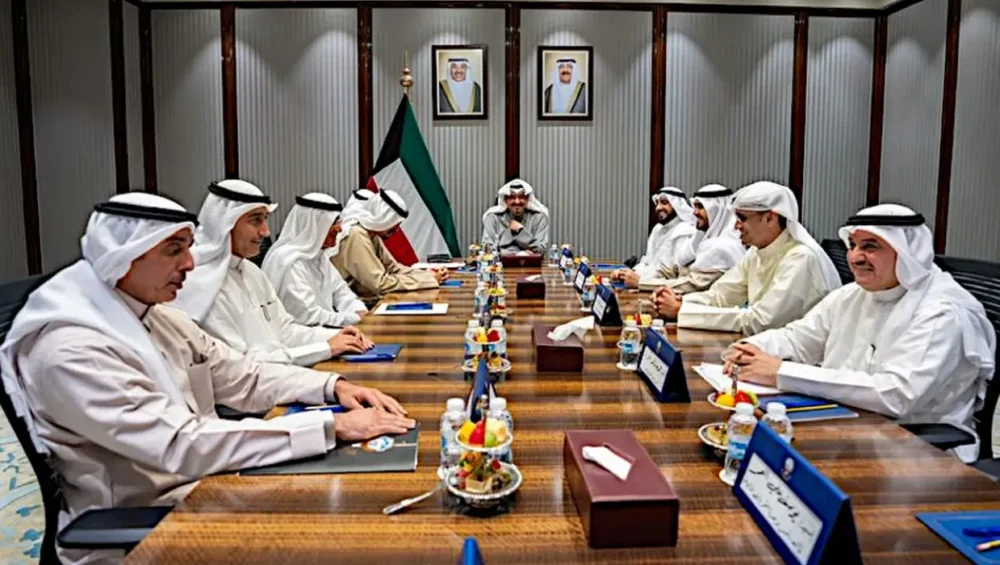
Kuwait ‘s government is currently placing much emphasis on their anti-money laundering and anti-terrorist financing efforts, as well as on strengthening their relationships among the various key institutions that will help them comply with the FATF’s global standards.
With Kuwait being included on the FATF grey list as of Feb 2026 for reported vulnerabilities concerning their financial oversight, even though they have made a lot of progress over time with anti-money laundering and anti-terrorist financing.
Starting at the top end of the Kuwaiti Government, with high level direction from the Prime Minister Sheikh Ahmad Abdullah Al-Ahmad Al-Sabah through to hands-on involvement from the head of the FIU (Financial Intelligence Unit) Dr. Hamad Al-Makrad, the country is bringing together legal amendments, memoranda of understanding between institutions, and new strategic reforms to form a coordinated and comprehensive approach that will support the methods used by Kuwait to restore their international standing.
Escalating Efforts Amid Grey List Pressure
The urgency behind these developments was crystallized with Kuwait’s advancement to the FATF grey list after the May 11-13, 2026 Plenary session of the FATF (the Financial Action Task Force). The FATF recognized the “significant progress” that Kuwait had made on almost all of the recommendations stemming from the 2024 MER (Mutual Evaluation Report) with 95.0% progress on a national AML/CFT/CPF, rollout of the new national AML/CFT/CPF strategy, and improved compliance with International Sanctions.
Current realities demonstrate a shortfall in the ability of the Kuwaiti Government to meet FATF recommendations due to ongoing deficiencies, particularly with respect to sectors involved in the buying and selling of real property (real estate) and trading in precious metals. Additionally, inconsistent reporting of suspicious transactions represents a significant problem for ongoing efforts of the Kuwaiti Government as it moves toward satisfying FATF compliance standards.
An essential part of the Kuwaiti Government’s efforts to address the FATF’s observations is the National Committee for Anti-Money Laundering (AML), which, according to Dr. Hamad Al-Makrad, has increased its “Integrated and Intensive Efforts” to address FATF’s observations and improve the effectiveness of Kuwait’s AML compliance framework.
The above procedures are not only tactical (operational), but they represent a strategic pivot to protect the integrity of Kuwait’s financial system (which is critical to the oil-based economic structure) from the outflow of illicit money which could potentially undermine foreign investment confidence in Kuwait and future international business partnerships.
Legislative Overhauls and Institutional MoUs
A cornerstone of this revitalized approach lies in targeted legislative amendments passed in June 2025, which empower a dedicated government committee to enforce United Nations Security Council (UNSC) resolutions on terrorist financing. These changes mandate the identification of beneficial ownership for companies, a critical measure to pierce the veil of anonymous shell entities often exploited for laundering. Oversight of exchange houses has shifted to the Central Bank of Kuwait (CBK), streamlining supervision, while penalties for non-compliance have escalated to fines of up to 500,000 Kuwaiti dinars—equivalent to approximately $1.64 million—ensuring a strong deterrent effect.
Complementing these laws are a series of high-impact MoUs signed in July 2025, forging tighter links between ministries and regulators. The Ministry of Interior and the General Administration of Customs inked an agreement focused on data-sharing and regulatory alignment with FATF guidelines, enabling swifter detection of cross-border anomalies. Similarly, the Capital Markets Authority (CMA) and the FIU committed to information exchange, joint training programs, and collaborative control mechanisms, creating a unified front against financial crimes. In January 2026, the Ministry of Commerce and Interior further solidified this network with another MoU explicitly aimed at combating money laundering, reflecting a maturing ecosystem where siloed operations give way to synchronized action.
These pacts are more than paperwork; they operationalize Kuwait’s commitment to global norms, addressing FATF’s call for reinforced outreach to real estate agents and dealers in precious metals and stones (DPMSs). By disseminating sector-specific indicators for suspicious transactions, authorities aim to elevate reporting rates and investigative rigor, particularly for cross-border currency movements and bearer negotiable instruments (BNIs). Ensuring accurate beneficial ownership data in public registries, coupled with dissuasive sanctions for inaccuracies, forms another pillar, directly responding to the grey list triggers.
Navigating FATF Mandates and Sectoral Challenges
The FATF’s action plan for Kuwait is precise and demanding, zeroing in on three core deficiencies that demand immediate rectification. First, regulators must intensify efforts to educate and enforce STR protocols among high-risk non-financial sectors like real estate and DPMS, where cash-heavy dealings have historically posed evasion risks. Second, the nation must guarantee that beneficial ownership information is not only collected but reliably maintained and verified in official registries, closing loopholes that allow criminals to hide behind nominees. Third, prosecutions and investigations into money laundering—especially those involving international transfers—need a decisive uptick to demonstrate prosecutorial muscle.
Kuwait’s core legal backbone remains AML/CFT Law No. 106/2013, which birthed the KFIU and imposed obligations for customer due diligence (CDD), record-keeping, STR filings, and internal controls across financial institutions and designated non-financial businesses and professions (DNFBPs). Supervising entities like the CBK for banks, the Ministry of Commerce for non-financials, and the CMA for markets provide the enforcement muscle. Yet, while these structures are robust on paper, the grey listing exposes execution shortfalls, prompting Finance Minister Nora Al-Fassam to highlight in 2025 how recent amendments
“improve transparency and meet international standards”.
Dr. Al-Makrad has been vocal about the forward trajectory, emphasizing that Kuwait’s authorities are pursuing these measures to “boost financial system integrity”. This rhetoric aligns with FATF’s prior nod to Kuwait’s high-level political will, evident since the June 2024 MER, and its proactive national strategy rollout. As of early 2026, no granular statistics on case volumes, seizures, or convictions have surfaced publicly, but the trajectory suggests a data-driven push to quantify progress and satisfy evaluators.
Broader Implications for Kuwait’s Global Standing
This anti-money laundering coordination surge carries profound ramifications for Kuwait, a nation whose sovereign wealth fund and petroleum revenues position it as a pivotal player in global finance. Grey list status, while not a blacklist, invites heightened due diligence from foreign banks, potentially hiking transaction costs and deterring investment—a sting felt acutely in a post-oil diversification era. By stepping up inter-agency harmony, Kuwait signals resolve to international partners, including the FATF’s Middle East and North Africa Financial Action Task Force (MENAFATF), where it has long been active.
The collaborative MoUs and legal tweaks also ripple into regional dynamics, enhancing Kuwait’s role in GCC-wide financial security. For instance, the FIU’s analytical prowess, honed since 2013, now feeds into joint operations that transcend borders, mirroring global trends where terrorism financing and laundering networks exploit jurisdictional seams. Kuwait’s pledge to sustain FATF engagement, as reiterated in official channels, underscores a long-game strategy: not just delisting, but embedding resilience against evolving threats like virtual assets and trade-based laundering.
Critically, these reforms test institutional capacity. The shift of exchange house supervision to the CBK promises tighter reins on remittances, a vector rife for abuse given Kuwait’s expatriate workforce. Beneficial ownership mandates, if enforced, could unearth opaque corporate structures tied to corruption scandals that have sporadically rocked the region. Yet challenges persist—cultural reticence in high-value sectors, resource strains on regulators, and the need for skilled personnel amid rapid upskilling via FIU-CMA training.
Path Forward: From Coordination to Compliance
Looking ahead, Kuwait’s trajectory hinges on translating coordination into tangible outcomes. The National Committee’s intensive phase, post-March 2026, positions it for the next FATF plenary, where demonstrable advances in investigations and sanctions could hasten grey list exit. Dr. Al-Makrad’s assurance of ongoing work, backed by ministerial MoUs, paints an optimistic canvas, but success demands unwavering execution.
In this landscape, Kuwait vows continued cooperation with the FATF, as echoed in government online updates, blending resolve with realism. For a thinktank attuned to intricate political-financial intersections—much like those navigating Berlin’s regulatory labyrinths amid EU AML directives—Kuwait’s saga offers a case study in high-stakes adaptation.
“Kuwait bolsters efforts, boosts regional coordination,”
as one official dispatch framed it, capturing the essence of a nation recalibrating for a scrutiny-proof future.