
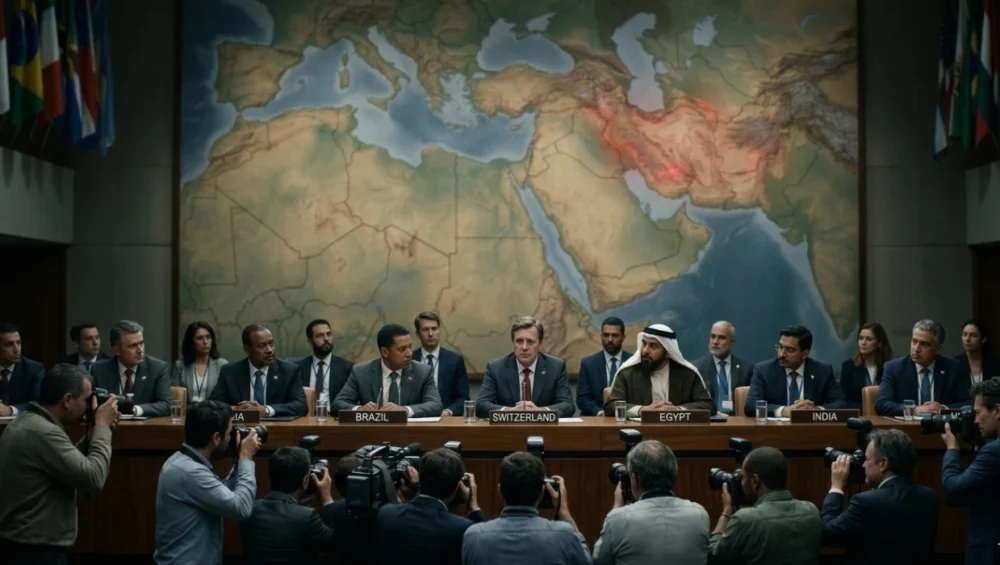
The ongoing U.S.-Israel-Iran war, triggered by joint strikes killing Iran’s Supreme Leader Ayatollah Ali Khamenei, has shattered Gulf states’ neutrality pledges and unleashed widespread violations of international humanitarian law (IHL) and human rights norms. Civilian casualties, attacks on protected infrastructure, and the militarization of neutral territories underscore a crisis where geopolitical maneuvering trumps protections for vulnerable populations. This analysis critically dissects these failures, drawing on facts, figures, and official statements to highlight accountability gaps.
Background: War Onset and Neutrality Claims
The war erupted with U.S.-Israel strikes that expanded rapidly, drawing in Gulf Cooperation Council (GCC) states despite their declared neutrality. Saudi Arabia, Qatar, UAE, Bahrain, Kuwait, and Oman issued coordinated pledges refusing to permit their “airspace, land, maritime waters, or logistical support for attacks on Iran,” aiming to shield sovereignty amid U.S. military buildup and Iran’s “total war” rhetoric.
Key facts reveal the fragility: The U.S. operates 8 permanent bases in the region across 19 Middle East sites (Bahrain, Kuwait, Qatar, Saudi Arabia, UAE), positioning GCC hosts as de facto battlegrounds. Iran has launched near-daily missiles and drones, intercepted by Gulf defenses, targeting U.S. assets and civilian infrastructure like Qatar’s energy facilities—hit hours after war’s start despite Doha’s mediation role. U.S. aims include dismantling Iran’s navy, missiles, nuclear program, proxies (Hezbollah, Houthis), with regime change “hinted but downplayed.” These dynamics expose neutrality as illusory, violating UN Charter principles on non-use of force and state sovereignty.
Human Rights Violations in Neutral Territories
Gulf states’ hosting of U.S. bases, even passively, implicates them in IHL breaches under Common Article 1 of the Geneva Conventions, obliging prevention of grave violations. Iran’s “defensive” strikes on these bases—framed as not violating “political neutrality” of hosts—have caused civilian deaths and infrastructure damage, breaching proportionality and distinction principles. Figures show Gulf air defenses active daily, with Iranian assaults on U.S. assets spilling into civilian zones, disrupting global energy markets via targeted facilities.
Critically, U.S. relocation of troops from vulnerable bases to densely populated hotels and offices exacerbates risks. Human rights advocates decry this as “unconscionable,” potentially violating U.S. combat rules and IHL by endangering civilians. “It is unacceptable for U.S. forces to consciously endanger civilians by abandoning their installations and relocating to hotels situated in densely populated urban centers,” stated Brian Castner, Amnesty International crisis researcher. “The officials who authorized these moves… should be scrutinized for breaching U.S. combat regulations.” This tactic blends combatants with civilians, inviting reprisals and constituting human shielding risks.
Pre-existing abuses compound the crisis: Migrant workers on U.S. Gulf bases face trafficking-like conditions—recruitment fees, passport confiscation, involuntary servitude—violating U.S. federal regulations on contractors. War amplifies these, as bases become targets, ensnaring legions in harm’s way without recourse.
Iranian Actions: Indiscriminate Attacks and Repression
Iran’s response violates IHL through disproportionate strikes deepening “human suffering” on civilians and vital facilities. Targeting GCC energy infrastructure, despite neutrality, ignores protected status under Additional Protocol I, Article 52. Amnesty notes parallel Israeli strikes on Iran killed over 1,100, including 45 children, damaging civilian sites like Evin prison (80 civilian deaths, including prisoners’ families), warranting war crime probes.
Internally, Iran intensified repression: Thousands arbitrarily detained, protests met with lethal force. This dual-track—external aggression, internal crackdown—breaches ICCPR rights to life, security, and expression. Iran’s Foreign Ministry claims strikes are “defensive measures against imminent threats,” respecting host “integrity,” but evidence shows civilian impacts contradicting this.
U.S.-Israel Conduct: Aggression and Disregard for Neutrality
The war’s instigation—strikes sans UNSC approval—breaches UN Charter Article 2(4). International law experts allege “clear breach,” citing officials’ “worrisome disregard for… rules safeguarding civilians.” U.S. President Trump initially hinted at regime change, later softened, while defending actions as eliminating “short- and long-term threats posed by Iran.” The White House accused Iran of “maiming and killing Americans,” labeling it “main state sponsor of terrorism.”
U.S. bases in neutral states pressure hosts into complicity, undermining self-determination (ICCPR Article 1). Studies show U.S. presence can worsen host human rights when strategically vital, as here. Relocations to civilian areas further erode protections, per Geneva IV.
Stakeholder Perspectives and Official Statements
Gulf leaders emphasized pragmatism: Unified diplomacy rejected territorial use for anti-Iran attacks, prioritizing “sovereignty protection.” Analysts from Middle East Council deem neutrality “incomplete” militarily, urging deterrence-diplomacy balance. Al Jazeera opined it’s “untenable” amid proxies, Hormuz threats, allied rifts (NATO hesitance, UNSC divides).
Iran’s stance: “Defensive” framing dodges responsibility. U.S. counters with security justifications. DAWN noted Iran views bases as “extensions of the battlefield.” These reveal hypocrisy: Neutrals host aggressors’ forces, invite violations.
Critical Analysis: Structural Failures and Accountability
Neutrality’s limits stem from power asymmetries—GCC economic ties to U.S., Iran’s proxy reach—rendering Article 2 Hague Conventions (1907) obsolete in asymmetric wars. Violations cascade: Indiscriminate attacks (Iran), base relocations (U.S.), spillovers harm civilians disproportionately, per IHL customary law.
Critically, all parties fail positive obligations: Gulf states didn’t expel U.S. forces despite risks; U.S. didn’t segregate combatants; Iran didn’t precision-target. Figures—1,100+ Iranian civilian deaths, 80 from Evin, Gulf interceptions daily—demand ICC referrals. Pre-war abuses (Iran’s executions, U.S. base trafficking) contextualize but don’t excuse escalation.
Stakeholders’ statements mask inaction: Gulf pledges ring hollow sans enforcement; Trump’s rhetoric prioritizes “stability” over rights. True neutrality requires demilitarization, per UN practice. Without it, human rights erode.
Impacts on Vulnerable Groups
Civilians bear brunt: Gulf migrants, Iranian protesters, prisoners. Qatar’s facility strikes hit workers; U.S. hotels risk bystanders. Women, children (45 Iranian child deaths), minorities face amplified repression. Energy shocks exacerbate poverty, food insecurity—indirect rights violations (ICESCR).
Pathways Forward
End impunity via UN fact-finding, arms embargoes, base reviews. Gulf must enforce neutrality via U.S. withdrawals; parties adhere IHL. Stakeholders: Renew mediation (Qatar’s prior role). Without accountability, neutrality remains a facade, perpetuating cycles of violation.